

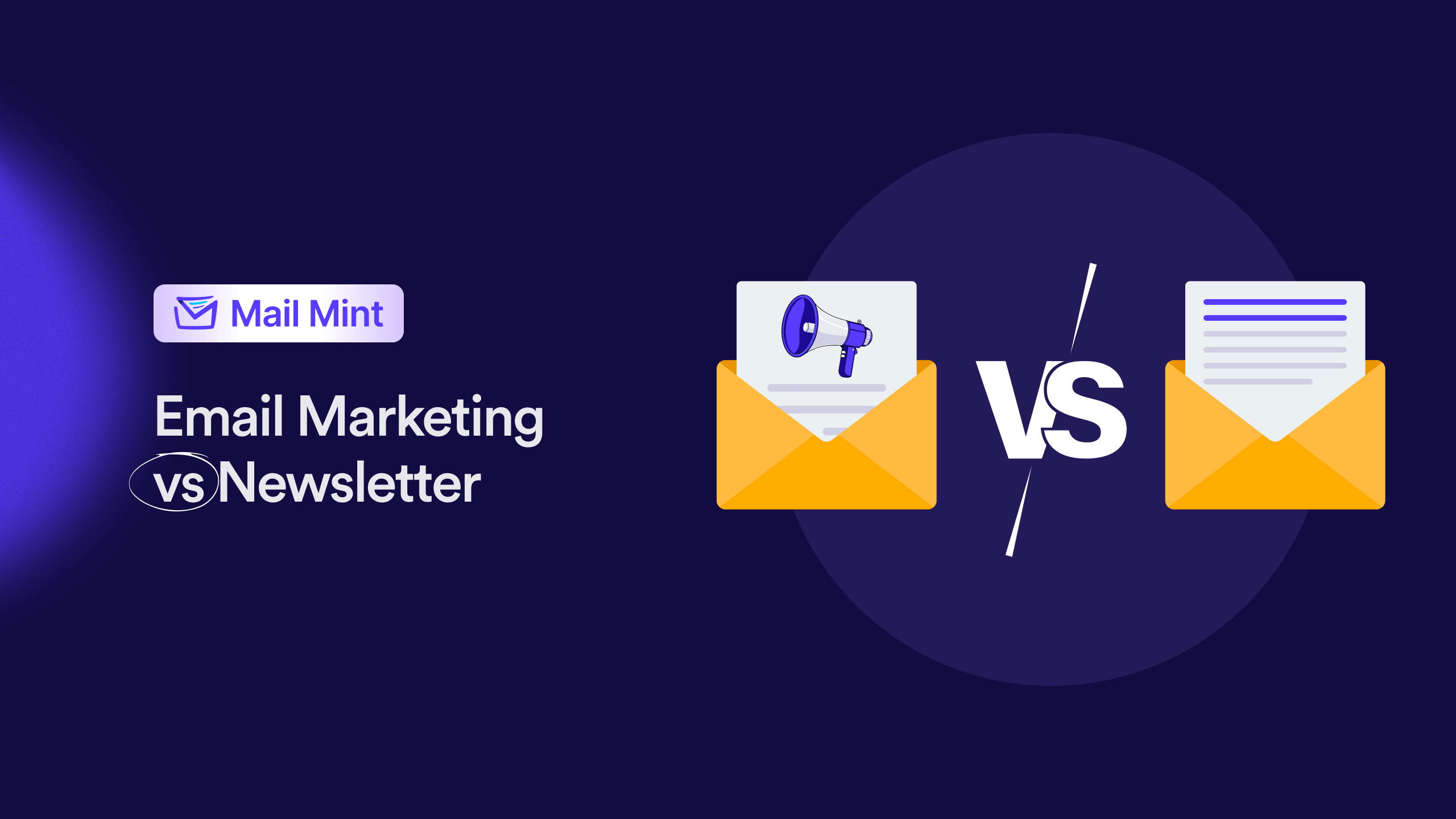

If you’re new to email marketing, it’s easy to think that email marketing and email newsletters are the same thing.
That’s because both are sent through email. But they aren’t used in the same way.
Understanding the difference can help you create better campaigns and send emails that match your goals.
So, what’s the difference?
In simple terms, email marketing includes every email you send to promote your business and connect with customers. An email newsletter is just one type of marketing email, usually used to share updates, news, or helpful content.
Let’s look at exactly how they differ and when to use each one.
TL;DR – Email Marketing vs Newsletter
- Email marketing is the overall strategy of using email to connect with your audience and grow your business.
- A newsletter is one type of marketing email, mainly used to share updates, news, and valuable content.
- While both are sent through email, they have different goals and are used in different situations.
- Email marketing includes newsletters, promotional emails, welcome emails, automated workflows, and more.
- Knowing the difference helps you choose the right type of email for your audience and marketing goals.
Now, let’s look at what email marketing and newsletters are, how they differ, and when you should use each one.
At a Glance: Email Marketing vs Newsletter
Before we dive deeper, here’s a quick side-by-side comparison of email marketing and newsletters.
| Email Marketing | Newsletter | |
|---|---|---|
| Primary goal | Drive a specific action | Build trust and engagement |
| Content focus | Product, offer, or conversion | Value, information, updates |
| Call to action | Single, direct CTA | Soft links or no direct CTA |
| Frequency | Triggered by timing or behavior | Regular schedule |
| Tone | Direct and outcome-focused | Conversational and editorial |
| Success metric | Conversions, revenue, clicks | Open rate, replies, retention |
| Triggered by | A campaign date or customer action | A calendar |
| Audience | Segmented by behavior or intent | Broad list or general segment |
The table gives you the quick answer. But knowing the labels isn’t enough. You need to understand why those differences exist and what goes wrong when you ignore them.
Let’s start with email marketing.
What Is Email Marketing?
Email marketing is any email you send to a list with a business goal behind it.
That goal might be a purchase, a sign-up, a booking, or a recovery. Every element of the email, from the subject line to the button, is built to drive one specific outcome.
It includes:
- Abandoned cart recovery emails
- Product launch announcements
- Post-purchase upsell sequences
- Win-back campaigns for customers who have gone quiet
- Flash sale emails
- Onboarding sequences for new sign-ups
The defining characteristic is intent. Email marketing is conversion-focused. You measure it by clicks, revenue, and conversion rate.
💡 For example, a customer adds a cast-iron skillet to your cart and leaves without buying. Sixty minutes later, your automation fires an email showing exactly what they left behind, with one checkout link and a note that stock is limited. That email has one job. You measure it by how many people came back and completed the purchase.
That’s email marketing in its purest form.
One thing worth clarifying: the term “email marketing” sometimes describes every email a business sends. In that broad sense, newsletters are email marketing too.
But in practice, when people talk about email marketing campaigns, they mean conversion-focused sends. That’s the distinction this article uses throughout.
If you want to understand where transactional emails fit into this picture, this guide on transactional email vs marketing email covers the distinction clearly.
So, where does a newsletter fit in? That’s a different job entirely.
What Is an Email Newsletter?
A newsletter is one specific format within email marketing. Its job is not to sell directly. Its job is to stay relevant, deliver value, and keep your audience connected between the times you ask them to buy something.
A newsletter might include:
- A roundup of your latest blog posts
- Industry updates your readers care about
- A tip, tutorial, or practical insight
- A behind-the-scenes look at your business
- Brief product updates without a hard sales push
There’s usually more than one thing to read. The reader can skim, click on what interests them, and still get value. There’s no single CTA demanding immediate action.
💡 For example, a clothing store sends a short email every Thursday morning — this week it’s three ways to style a linen shirt for summer. There’s a link to a full blog post and a passing mention of a new arrival. No countdown timer. No discount code. No urgency. Just something worth reading. That’s a newsletter.
Quick answer: Can a newsletter include promotions? Yes. But selling shouldn’t be the primary purpose. The moment your newsletter becomes mostly promotional, it stops doing the relationship-building job it was designed for.
Now that you know what each one is, the next question is: how exactly do they differ in practice? There are four differences that actually matter.
The 4 Real Differences Between Email Marketing and Newsletters
1. The goal is different
Email marketing has a single conversion goal. Every element of the email exists to drive one specific action. If you can’t point to a clear outcome the email is meant to produce, it’s not focused enough.
A newsletter doesn’t have one conversion goal. It succeeds if the reader opens it, reads something useful, and stays subscribed. The conversion happens later, through the relationship the newsletter builds over time.
2. The content is different
An email marketing campaign covers one thing: the offer, the product, and the reason to act now. Anything extra in the email is a distraction that reduces click-through.
A newsletter can cover multiple things. It’s structured like a digest. A section on an industry tip, a link to a new blog post, a brief product note. Variety is part of the value.
3. The audience is usually different
Email marketing campaigns go to a segment. Customers who viewed a product without buying. People who abandoned a cart in the last 24 hours. Subscribers who haven’t purchased in 90 days. The audience is narrowed by behavior or status.
A newsletter generally goes to your full list or a broad segment. It’s not behavior-triggered. It’s relevant to a wide range of people at the same time
4. The success metric is different
This is where most people go wrong. When you judge a newsletter by its conversion rate, it almost always looks like it failed. When you judge a promotional campaign by how enjoyable it was to read, you lose sight of whether it drove revenue.
For newsletters: track open rate, click rate, and unsubscribe rate over time. A healthy newsletter holds a consistent open rate and a very low unsubscribe rate.
For email marketing campaigns: track conversion rate, revenue attributed, and click-through rate on the primary CTA.
Measure each by what it’s actually trying to do.
These four differences sound clean on paper. But in practice, a lot of stores blur the line between the two without realizing it. And when that happens, both stop working.
What Happens When You Mix Them Up
Knowing the difference is one thing. Using the right type of email at the right time is another.
When you treat newsletters and marketing emails the same way, your email results can start to decline.
When your newsletter becomes too promotional:
People subscribe to your newsletter because they expect useful content. If every email is focused on selling or discounts, they’ll slowly lose interest.
They may not unsubscribe right away, but they’ll open fewer emails and click less often. Over time, even your best promotional campaigns become easier to ignore.
When you send only promotional emails and no newsletter:
Every email asks for something. Subscribers start treating your emails as advertising. Even a strong offer stops getting the attention it deserves.
💡 For example, your store has 2,000 subscribers. Six months ago your promotional emails were opening at 28%. Now they’re at 14%. You’ve tried bigger discounts. They lift results for a week, then drop again. The list hasn’t shrunk. But subscribers have started treating your emails like ads because every single one asks them for something.
The fix isn’t a better subject line or a bigger discount. It’s using both types of email the way they were meant to work — together.
How Email Marketing and Newsletters Work Together
A newsletter keeps your audience warm. Email marketing converts that warmth into action. Remove either one and the other becomes less effective. A proper customer journey automation setup helps businesses deliver the right messages at the right stage of the customer lifecycle.
💡 For example, a cookware store sends a newsletter every Wednesday — a recipe, a kitchen tip, nothing more. At the start of the month, a promotional email goes out featuring a new product. The subscribers who’ve been reading those Wednesday emails for a few months open that promotion at nearly double the rate of people who only ever heard from the store when there was something to buy.
Ask yourself one question before you write anything: What do I want this email to do right now?
If the answer is “drive a specific action,” send a marketing email — a product launch, an abandoned cart recovery, a win-back, a flash sale.
If the answer is “stay relevant and build trust,” send a newsletter.
Keep them separate and measure them differently. Don’t put a hard sales CTA inside your newsletter. Don’t pad a promotional email with editorial content.
You don’t need a large list to run both. Even at 200 subscribers, a newsletter going out every two weeks and a simple abandoned cart sequence are enough to build a real email program.
Once you’re clear on the strategy, the next step is making sure your tool doesn’t slow you down.
For WordPress and WooCommerce users, the simplest setup is one tool that handles both email and newsletter campaigns from the same place. Mail Mint runs inside your WordPress dashboard. Your newsletters and your WooCommerce automations draw from the same contact list. When a customer completes a purchase, they move automatically from a cart recovery sequence into a post-purchase follow-up — all inside one workflow, without external sync.
If you want to go deeper on setting up automated sequences inside WordPress, this guide on email marketing automation best practices covers the full setup step by step.
Conclusion
The difference between email marketing and a newsletter isn’t just semantic. It changes how you write the email, who you send it to, how often you send it, and how you measure whether it worked.
Email marketing converts. Newsletters build trust that makes conversion possible. You need both, and you need to keep them doing their separate jobs.
Start with the one you’re not doing. If you’ve only been sending promotional emails and performance is declining, start a newsletter. If you’ve been sending content for months but have no structured promotional campaigns, set one up.
Keep newsletter and email marketing separate. Measure them differently. And use a tool that lets you run both from one place so your contact data tells the same story across everything you send.
Frequently Asked Questions
Is a newsletter the same as email marketing?
No. Email marketing is the broader strategy that includes every type of email you send with a business goal. A newsletter is one specific format within that strategy, focused on building engagement rather than driving immediate action. All newsletters are email marketing, but not all email marketing is a newsletter.
Can I use my newsletter to sell products?
Yes, but carefully. You can mention products or include a soft recommendation. What you want to avoid is turning every newsletter into a sales pitch. Once subscribers feel like the newsletter exists to sell them things, they stop reading it.
What should a newsletter include?
A useful tip, a curated resource, an industry insight, a short tutorial, or a behind-the-scenes update. Most good newsletters pick two or three things per send. The reader should open it, get something useful in three minutes, and feel like it was worth their time.
How long should a marketing email be compared to a newsletter?
A promotional email should be short, around 150 to 200 words. One offer, one CTA, no padding. A newsletter can run longer, typically 400 to 600 words, because the reader is there to read rather than act immediately.
Does sending a newsletter hurt your email deliverability?
Not if you send consistently and people actually open it. A newsletter that subscribers look forward to improves your sender reputation over time, which helps your promotional emails land in the inbox too. What hurts deliverability is sending emails nobody opens.
Should a newsletter have an unsubscribe link?
Yes, always. It is legally required under CAN-SPAM and GDPR. An easy unsubscribe also keeps your list clean. Someone who cannot find the unsubscribe link does not stay subscribed. They mark you as spam, which damages deliverability for everyone on your list.