
It’s been years that I have been working with WooCommerce store owners, and one thing is clear: more traffic does not always mean more revenue.
I’ve seen stores double visitors but see little profit growth because the real issue was conversion and AOV.
The average eCommerce conversion rate is around 2–3%
which means most visitors will not buy. So sending more traffic alone often doesn’t change revenue in a big way.
I’ve seen store owners spend more on ads when a small AOV increase could have boosted revenue immediately.
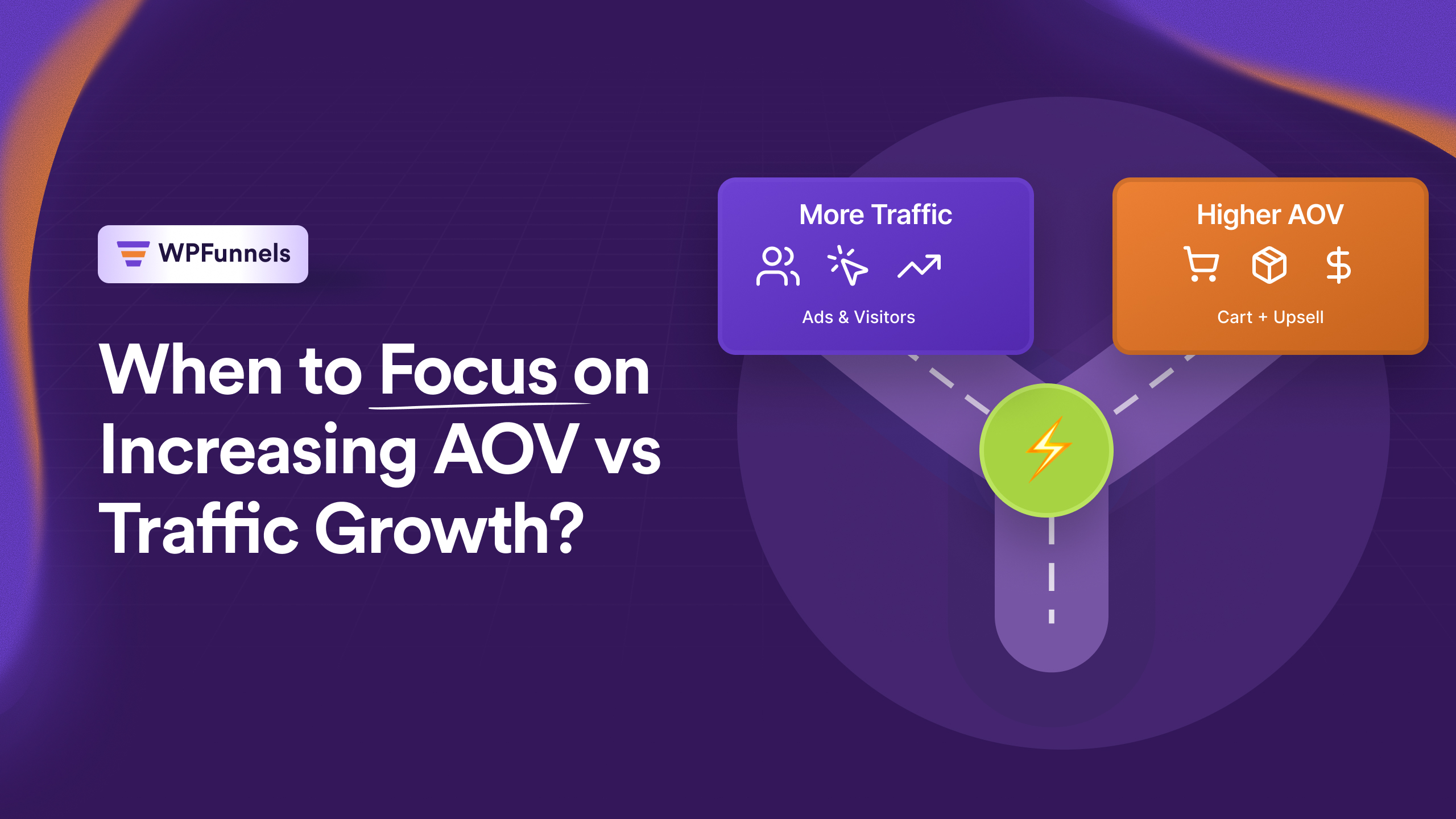
Traffic matters, but focusing on the right lever at the right time is what truly grows your store.
So let’s get started with what is helpful according to your current situation.
TL: DR – AOV vs Web Traffic Growth: What Actually Grows Revenue?
- More traffic does not always mean more revenue
- Case Study Insights:
- If traffic is low but conversion is healthy → focus on web traffic growth.
- If traffic is steady but revenue feels stuck → improve Average Order Value (AOV).
- If traffic is high but low intent → optimize AOV before buying more visitors.
- Final Verdict: Before spending more on ads, optimize AOV with bundles and one-click upsell in your WooCommerce funnel.
AOV vs Web Traffic Growth: What Actually Grows Revenue?
Before choosing a direction, you need to understand this:
Revenue = Traffic × Conversion Rate × Average Order Value
You can grow revenue by:
- Getting more visitors
- Converting more of them
- Increasing AOV
Most WooCommerce store owners focus only on traffic. But traffic is usually the hardest and most expensive thing.
Now let’s look at real cases.
Case Study 1: When Web Traffic Growth Makes Sense
For example, you are running a WooCommerce store selling handmade leather wallets.
Right now, your numbers look like this:
- Traffic: 1,200 visitors per month
- Conversion rate: 2%
- Average Order Value: $65
- Monthly revenue: $1,560
At first glance, you may think you need to optimize your funnel or add one click upsell.
But look deeper.
The Real Situation
Your product has:
- Strong customer reviews: Your customers are leaving positive reviews, which shows they trust your product. This social proof makes it easier for new visitors to feel confident buying.
- High repeat purchase rate: People keep coming back to buy again, proving your product delivers value. Repeat customers also mean you have a foundation to build loyalty programs or upsells.
- Consistently positive feedback: The overall sentiment about your product is excellent, which confirms you’re meeting customer expectations. Positive feedback can also help you confidently scale your marketing efforts.
- Almost zero paid advertising: Your sales are happening mostly through organic traffic, showing there’s real demand. This gives you a strong starting point before investing heavily in ads.
This tells you something important. Your offer is working. Customers like the product. They trust it. They buy it.
- You don’t have a conversion problem.
- You don’t have an AOV problem.
- You have an exposure problem.
- Your store is simply under-seen.
Why Web Traffic Growth Is the Right Move
Let’s break it down from your perspective.
- Your 2% conversion rate is healthy for most niches.
- A $65 AOV is solid for handmade leather goods.
- Customers are coming back – which proves product-market fit.
That means your focus won’t be monetization. It’s visibility.
If you increase traffic from 1,200 to 3,000 visitors per month without changing anything else, here’s what happens:
- 3,000 × 2% × $65 = $3,900 per month
That’s more than double your revenue.
- And you didn’t touch your funnel.
- You didn’t add order bumps.
- You didn’t implement one-click upsell.
- You didn’t change pricing.
You simply put your validated offer in front of more people.
What You Should Do If This is You
If your store looks like this, your focus should be clear.
You should:
- Invest in SEO to rank for buyer-intent keywords
- Scale paid ads gradually
- Launch influencer collaborations in your niche
- Strengthen content marketing around your product story
Because at this stage, you’ve already validated:
- Your offer
- Your pricing
- Your product-market fit
And when your foundation is solid, web traffic growth becomes a predictable growth lever. Trying to increase AOV before fixing visibility would be premature.
First, bring more qualified people into your store.
Then, once traffic is consistent and scalable, you can optimize monetization.
But right now?
Your growth is waiting in front of new eyeballs, not inside your checkout.
Case Study 2: When Increasing AOV is Smarter
Not always will increasing traffic solve your revenue problem. Sometimes you have to think differently to get more revenue with the same traffic. Let’s see how can you make it step by step:
For example, your WooCommerce store sells fitness supplements, and you have
- Traffic: 18,000 visitors/month
- Conversion rate: 2.2%
- AOV: $32
- Monthly revenue: ~$12,672
You are running ads regularly. Traffic is still steady. But profit margins are tight.
The Real Issue
Customer acquisition cost (CAC) is rising.
More traffic means:
- Higher ad spend
- More risk
- Smaller margins
This store doesn’t have a traffic problem.
- It has an AOV problem.
What Happens If You Focus on Increasing AOV Instead?
Let’s say you introduce:
- Order bumps (e.g., shaker bottle for $7)
- Bundle offers (Buy 2, Save 10%)
- Post-purchase one-click upsell (premium recovery formula)
If AOV increases from $32 → $44.
- Revenue becomes: 18,000 × 2.2% × $44 = $17,424
That’s nearly $5,000 extra revenue without increasing traffic and without increasing ad spend.
This is where strategies like one-click upsell become effective. After checkout, the customer sees a relevant offer and can accept it instantly without re-entering payment details.
You monetize the same traffic harder.
- Learn more – How to Increase AOV in WooCommerce – 10 Step Guide
Case Study 3: High Traffic, Low Intent – Fix AOV First
Suppose you have a fashion accessories store. Your scenario is:
- Traffic: 40,000 visitors/month
- Conversion rate: 0.8%
- AOV: $21
Your company believes you need even more traffic.
But the real issue?
Your most traffic comes from:
- Viral Pinterest pins
- Broad blog content
- Low buying intent keywords
Adding more traffic would just amplify inefficiency.
Correct Strategy is:
Instead of chasing web traffic growth:
- Improve product bundles
- Add order bump offers
- Introduce threshold incentives (Free shipping at $50)
- Use post-purchase one-click upsell flows
A small AOV increase to $28 would significantly shift revenue even before fixing the conversion rate.
The Decision Framework: Traffic or AOV?
If you run a WooCommerce store, use this quick test:
Focus on Web Traffic Growth if:
- Conversion rate is strong (2%+ for most niches)
- AOV is already optimized for your market
- You have strong margins
- You are not spending aggressively on ads
- Demand is proven, but visibility is low
Focus on Increasing AOV if:
- You already have steady traffic
- Paid ads are your main channel
- Customer acquisition cost is rising
- Profit margins feel tight
- Your checkout experience is basic
- You don’t have anorder bump or one-click upsell in place
In most scaling WooCommerce stores, increasing AOV is usually the faster lever.
Why WooCommerce Stores Often Pick the Wrong Lever? Because traffic feels exciting.
- New visitors
- More impressions
- Bigger numbers in analytics
But AOV optimization is quieter. Yet more profitable.
If you improve AOV by $10: Every future visitor becomes more valuable.
- Traffic growth increases volume.
- AOV increases value.
Value compounds faster. The Real Growth Order (Based on Store Maturity)
Practical Roadmap of Your WooCommerce Store
If you want a practical roadmap, here’s how you should approach your growth step by step:
- Stage 1 – Validate Your Product: Start by getting initial traffic and real sales. You need proof that people actually want your product before you try to scale anything.
- Stage 2 – Optimize Your Conversion Rate: Now focus on turning more visitors into buyers. Improve your checkout, add trust signals, show reviews, and remove anything that creates hesitation.
- Stage 3: Increase Your AOV – This is where you start maximizing each customer. Add a relevant order bump, create smart bundles, and introduce a post-purchase one-click upsell to increase revenue without adding friction.
- Stage 4: Scale Traffic – Once everything is optimized, you can confidently push more traffic. At this point, every visitor becomes more valuable, and scaling feels profitable instead of expensive.
Most WooCommerce store owners try to jump from Stage 1 straight to Stage 4. That’s why scaling feels risky – you’re sending more traffic to a store that isn’t fully optimized yet.
Conclusion
If your store is new and not getting much attention, focus on web traffic growth first. You need more people visiting before you try to increase how much each customer spends.
If you already have steady traffic but profits feel low, focus on increasing AOV. Making more money from the same visitors is usually easier than getting new ones.
When you are running ads, AOV becomes even more important. The more each customer spends, the more profitable your ads become.
In most scaling stages, the safer and faster move is to increase AOV using order bumps, bundles, and one-click upsells.
** FAQs **
When should I focus on increasing AOV rather than on getting more traffic?
If you are already getting consistent visitors and regular sales, increasing AOV should be your next move. You can grow revenue faster by getting each customer to spend more, rather than chasing new traffic. When your margins feel tight, this shift can immediately improve profitability.
How do I know if my store has enough traffic to optimize AOV?
If you are getting daily visitors and steady weekly orders, you have enough data to start. You don’t need massive traffic to test bundles or order bumps. If customers are already buying, you have room to increase what they spend.
Why does scaling traffic sometimes reduce profit?
When you increase traffic through ads, your acquisition costs usually go up. If your AOV stays low, you earn less from each customer while paying more to get them. That’s why you should strengthen your AOV before aggressively scaling ads.
Will increasing AOV lower my conversion rate?
It can if you overwhelm customers with irrelevant offers. But if you present helpful add-ons or complementary products, you actually improve the buying experience. When you make the offer feel useful, customers are more likely to accept it.
What is the simplest way to start increasing AOV in WooCommerce?
You can begin by adding a relevant order bump at checkout. Then test product bundles or free shipping thresholds to encourage higher cart value. Once that works, you can introduce a one-click upsell to increase revenue without adding extra friction.