
eCommerce has become super saturated nowadays. And if you go on to learn how to grow your revenue, in most cases, you will hear people obsessing over traffic growth.
But, if you have been running a WooCommerce store for a few months and getting some constant traffic or orders already, then “traffic” is not really the best growth lever.
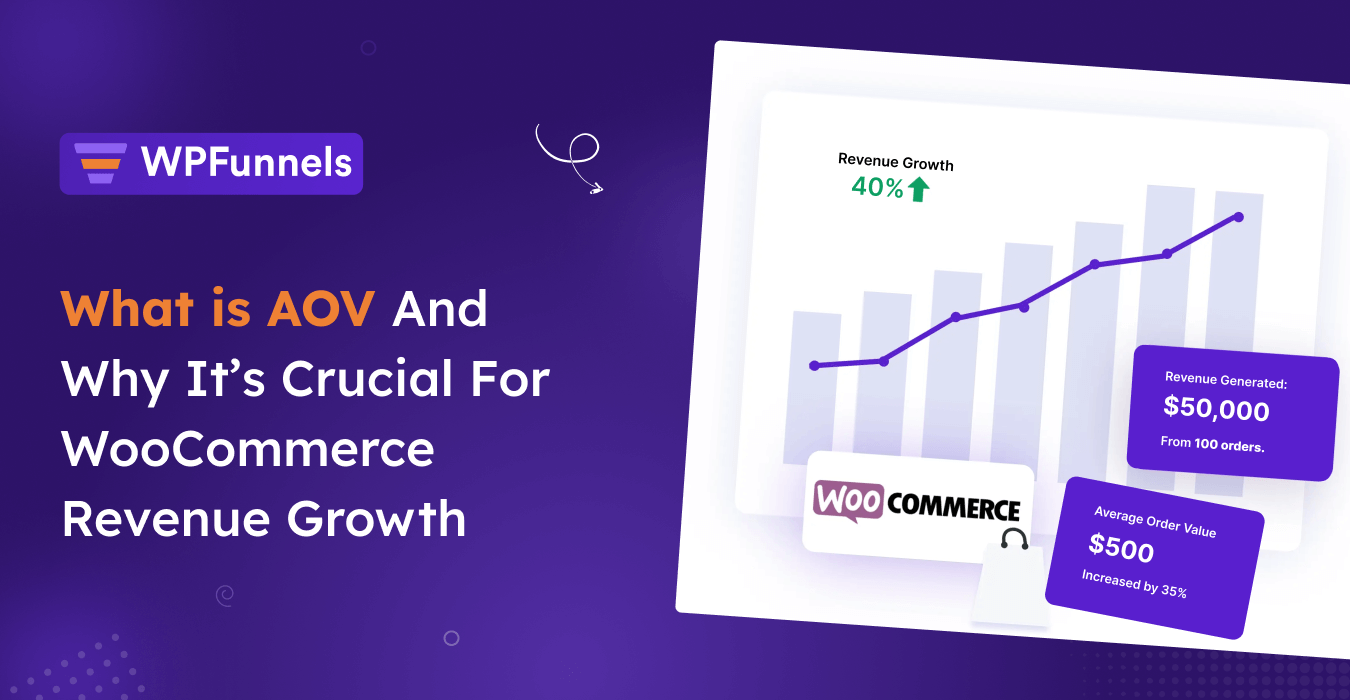
Your biggest priority should be increasing Average Order Value (AOV).
Speaking from over 8+ years of working in eCommerce growth, and after going through several case studies, I can tell you that once you get traction, it’s easier to make more profits simply by focusing on AOV.
In fact, it’s actually possible to double your revenue even by getting as low as 10% traffic growth.
Now, in this guide, I’ll give you a good understanding of “what is AOV”, and then, I will lead you to an actionable guide to help you grow your AOV easily.
So let’s begin.
TL:DR – What Is AOV And Why It Matters For WooCommerce
- AOV (Average Order Value) is the average revenue you earn per order.
- AOV formula: AOV = Revenue ÷ Orders (in a certain sales period)
- For growing WooCommerce stores with steady traffic, increasing AOV is often easier and more impactful than chasing more traffic.
- Even small AOV increases can significantly boost revenue and profit without raising acquisition costs.
- AOV directly affects profitability, operational flexibility, and how much you can afford to spend on ads.
- You can increase AOV using upsells, order bumps, bundles, and strategic offers, but only after you have traction.
- The next step to take is to implement tactics to increase AOV.
👉 Learn them here.
Now, let’s get into the details.
What Is AOV In General?
AOV stands for Average Order Value. It simply means:
On average, how much money does a customer spend each time they place an order in your store?
Let me explain with an example.
Suppose you sell t-shirts online. Let’ imagine two scenarios.
Scenario 1:
Let’s say last month, you sold t-shirts to about 200 different customers. And you earned a total of $6000.
So, last month, your AOV was about $30 per customer, i.e., form every customer, on average, you earned about $30.
(This does not mean every customer placed $30 worth of orders. Some paid less, and some paid more. But on average, this is the number.)
Scenario 2:
Imagine if you would get 200 orders but you would rather make $35 per customer instead of $30.
So, from the same 200 orders, you would end up making $7000 (i.e. $1000 more).
If you can work on increasing AOV, then you will end up with higher revenue without much increase in acquisition costs, i.e., higher profit margin.
Average Order Value Formula
No complex tools are needed to understand AOV. Here’s the formula:
AOV = Total Revenue ÷ Total Number of Orders
What Is AOV in eCommerce (And Why It Matters More Than You Think)
In eCommerce, revenue doesn’t come from traffic alone. It comes from three crucial metrics working together:
- Traffic
- Conversion Rate (CR)
- Average Order Value (AOV)
The real equation looks like this:
Revenue = Traffic × Conversion Rate × AOV
So imagine you got 10k visitors, have a 2% conversion rate, and a $40 AOV.
- So, your Revenue = 10,000 × 0.02 × 40 = $8,000
If you can lift any one of these, your revenue will grow.
So Why Focus On AOV And Not Traffic or CR?
Here’s something interesting you will find eye-opening.
- It’s easier to lift AOV than it is to increase conversion rates or traffic.
- And it is more impactful if you work on CR or AOV, compared to traffic growth.
If you go by Effort vs Impact prioritization,
| Increase Traffic = High Effort vs Low Impact |
| Increase CR = Medium Effort vs High Impact |
| Increase AOV = Low Effort vs High Impact |
So, almost always, the most logical first priority is increasing AOV.
But here is the catch. You should only prioritize increasing AOV when you already have a constant flow of traffic and conversions.
Let me explain.
If you have 10000 traffic with a 5% conversion rate and AOV $20, it means you have 50 orders and earned about $1000. Increasing AOV by as little as $5 will uplift the revenue to $1250 (i.e. $250 more earnings).
But, if you only have 100 traffic with a 5% conversion rate and AOV $20, it means you only have 5 orders and earned about $100. Increasing AOV by $5 here will mean only $25 more. So, focusing on AOV here is not a very good idea.
The bottomline, if you are in a growing state and already have some traction, then working on AOV can increase the overall results.
- For a startup, focus on traffic.
- For a growing store, focus on AOV first, and then CR.
Real Case Study Of Using AOV Lift To Increase Revenue
Let’s share a specific campaign we ran last year.
For project privacy, I will not name the exact product or share the exact numbers, but I will share the stats with you with ballpark figures.
We launched a product last year. Let’s call it Product X.
Initially, one of our launch plans was priced at about $650 (after 60% discount). But what we did was, we tied the buying journey with a bundle (which included two other products we already had and relevant). Let’s call it Bundle Z.
The journey was like this:
- People got into a landing page where we offered Product X at an offer price of around $650.
- They decided to purchase Product X and proceeded to checkout for payment.
- But then, we added a one-click upsell after checkout with Bundle Z at 50% off, priced at $800.
- If people rejected Bundle Z, we made a downsell offer on another product, priced at $400 at 50% off.
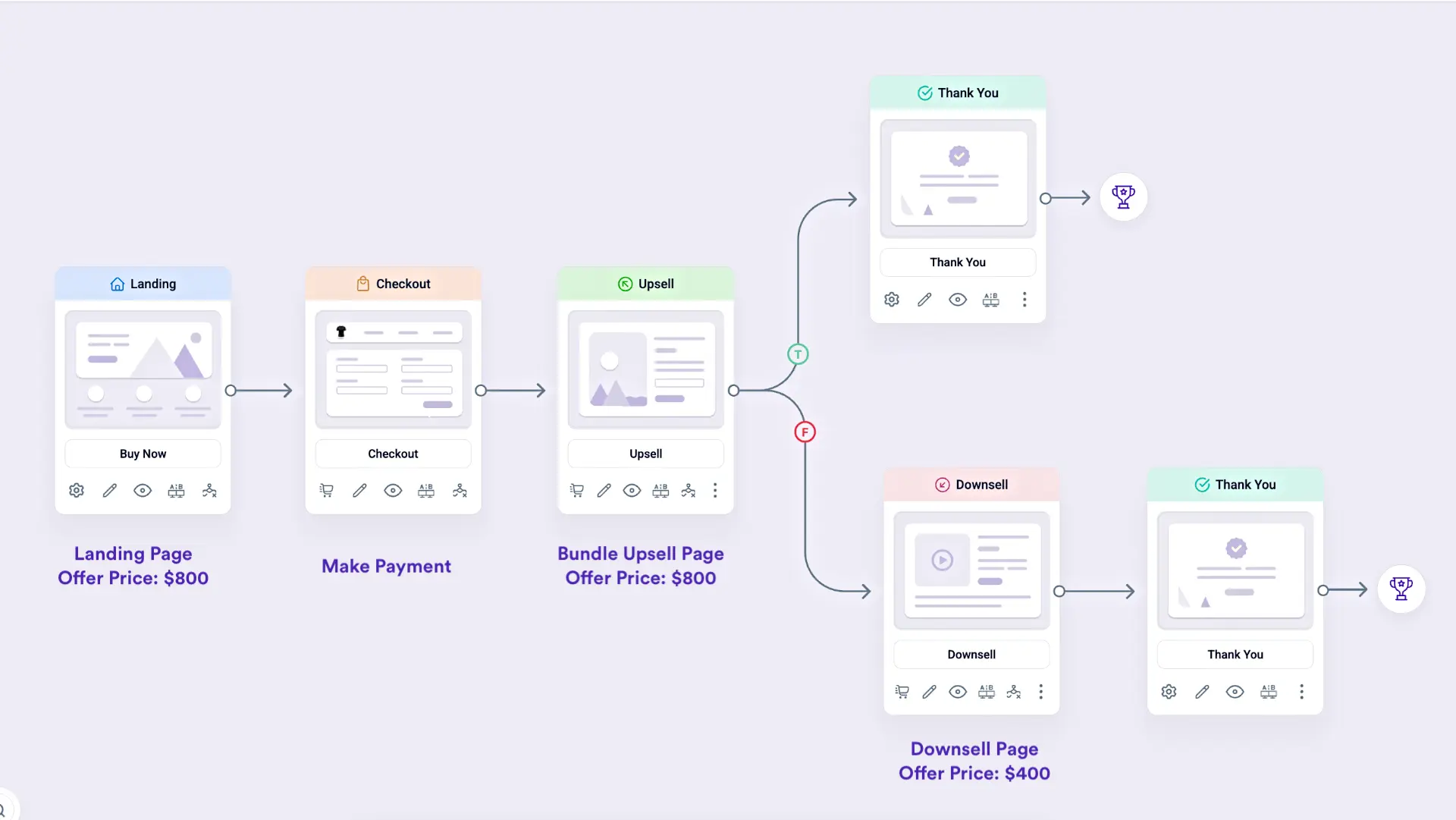
Now, during launch, we’ve had about 30 orders for that particular plan. Normally, that would be a total of $19500.
But, out of these, about 12 of them accepted the upsell offer, adding up about $9612 more.
Here, we didn’t do anything extraordinary. We just used a simple tactic to increase AOV (i.e. One-click upsell).
If you think about it, all we needed was an extra page after checkout and an irresistible offer to get over 40% lift in revenue.
Rather, it had cost us more to bring in the traffic than to set up a one-click upsell (which we did using our own plugin, WPFunnels).
How AOV Affects Your Profit (Not Just Revenue)
Let’s talk about profitability. Suppose you run a WooCommerce store.
Now, every order comes with fixed costs:
- Hosting cost
- Payment processing fees
- Packaging materials
- Shipping handling time
- Support overhead, etc.
If your AOV is $25, and your net profit per order after all costs is $8 (i.e. 32% profit margin), you need a lot of orders to make a good profit.
Now imagine your AOV is $100.
In this case, even if your profit margin percentage stays the same, the absolute profit per order is much higher. You get to keep $32 per order instead of $8.
With this extra money, you could afford higher ad costs, handle more support time, re-invest, and handle growth without much operational chaos.
You don’t just make more revenue; you build a breathing room into your business and keep your WooCommerce store alive long term.
How to Calculate AOV in WooCommerce
You don’t need external tools to find this. Inside your WooCommerce dashboard:
- Go to WooCommerce > Analytics > Orders
- Choose the date range.
- View the total no. of orders, revenue earned, and AOV.
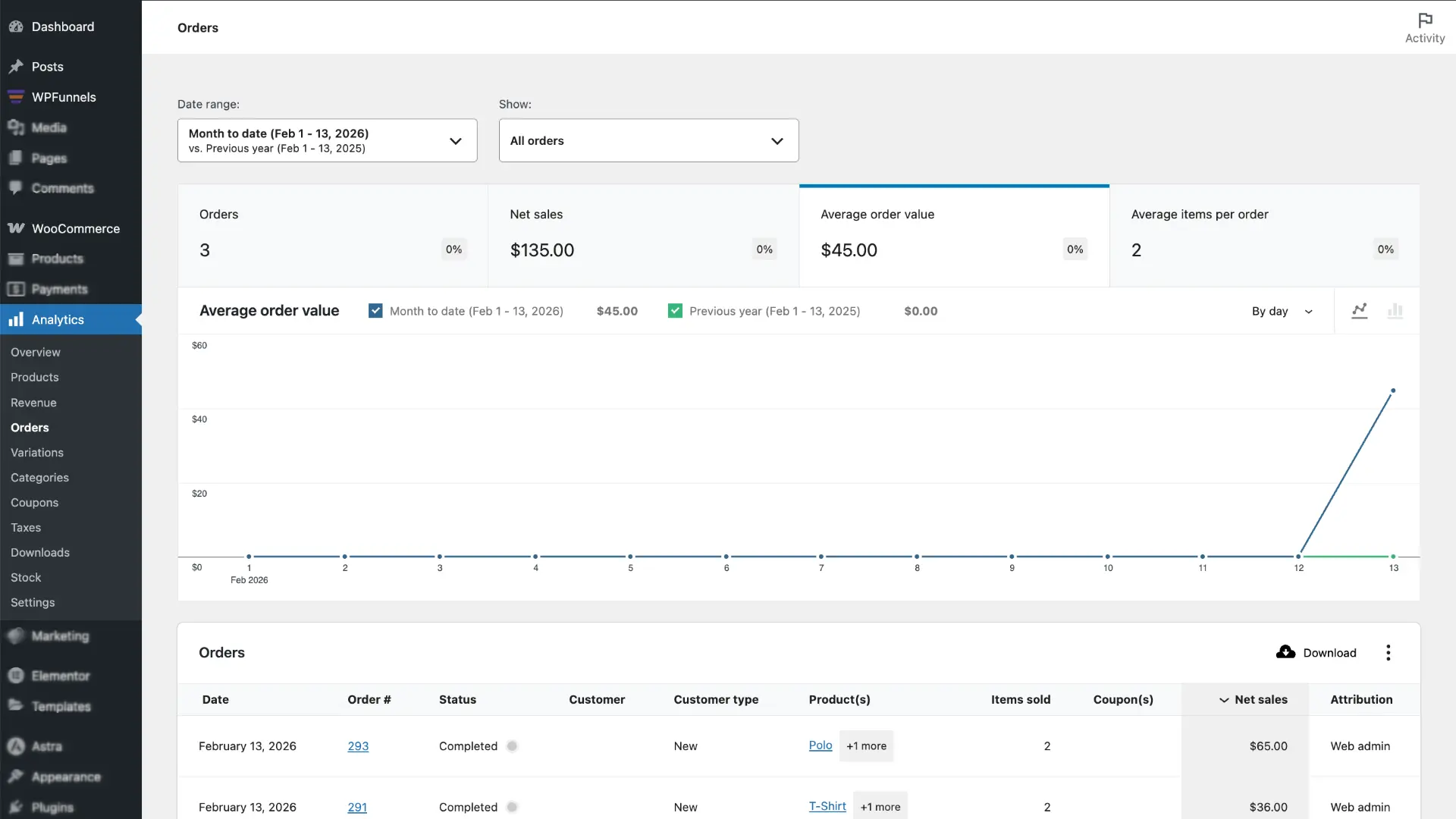
However, this is not always accurate as there are a lot of anomalies like orders on hold, or chained products, refunds, etc.
Some payment gateways charge a transaction fee on refunds, but that may not always be reflected in WooCommerce. Then there are orders you manually handle and may lack shipping data upon returns or cancellations.
In this case, it’s better to manually calculate the AOV. Simply find out the net revenue and the total number of completed orders. Then, divide the revenue by the no. of orders.
You may use this calculator:
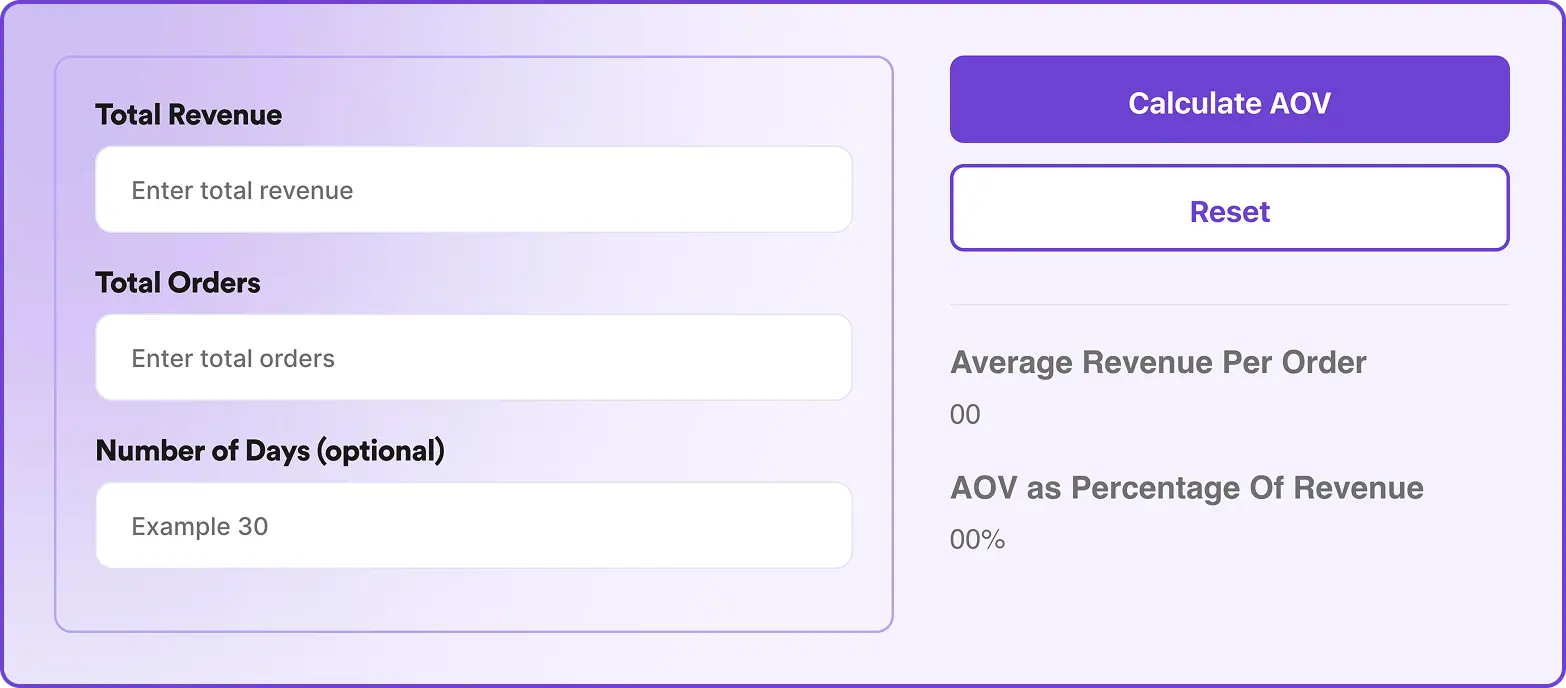
Most store owners maintain a separate spreadsheet to keep track of the accurate revenue earned.
AOV vs Customer Lifetime Value (CLV)
Do not confuse AOV with CLV.
AOV measures the amount earned on average for each order.
CLV measures the entire relationship of each customer, i.e., total amount earned in customer’s lifetime.
If your AOV is $60 and your average customer buys 4 times, then your CLV value is $240.
Both metrics matter, but they answer different questions.
- AOV tells you how well you are earning off of each new order.
In this case, you focus on changing offer strategy or customer buying journey for improvement.
- CLV tells you how strong your customer relationship is over time in terms of revenue earned from them.
In this case, you focus on improving follow-up sequences, nurturing, and personalized offerings via email.
It takes less effort to increase AOV compared to CLV (which involves tons of activities to increase repeat purchases and retention).
What Naturally Influences AOV in WooCommerce?
Even if you don’t actively try to change it, AOV moves based on structural factors in your store.
For example:
- If you sell high-ticket products, your AOV will naturally be higher.
- If your catalog includes complementary products, customers tend to spend more.
- During holiday seasons, customers often buy more per order.
- Deep discount periods sometimes increase order volume but reduce AOV.
You should expect AOV to fluctuate, but you can, of course, control it at different times of the year with your offer strategies.
Do not panic if you see AOV falling at a time. Try to understand why it fell and re-plan accordingly.
How Can You Increase AOV For Your WooCommerce Store?
Now the gold question, how can you increase AOV, and not just hope it increases?
Well, there are several proven tactics you can use to increase average order value. Some of them include:
- Using complementary order bumps to add to cart on the checkout page.
- Offering one-click upsell after checkout.
- Setting up a target cart total to get discount or free shipping.
- Making bundle offers at an attractive discount.
And many more.
Well, we have prepared an actionable guide to help you implement AOV growth tactics.
👉 10 Ways To Increase Your AOV In WooCommerce
Here, we did not just list tactics. We have also shared how you can implement them and discussed tools you can use to do so. I’m sure you will find it useful.
Final Thoughts
If you want to grow your WooCommerce revenue, then it is crucial to focus on AOV, not just traffic.
As a growing WooCommerce store, your goal should be maximizing profit from every customer first, and then invest in further traffic acquisition.
You could spend more on paid ads or other acquisition strategies to get those number of orders up, but if the profit margin is low, it would not amount to much of a viable revenue to rest on.
So, now, it’s time to take the next action… Implementing working tactics to increase your current AOV.
And as I said, I have this wonderful guide to learn what you can do and how you can implement them easily.
FAQs
1. What is a good AOV for a WooCommerce store?
There isn’t one universal number you should aim for.
A “good” AOV depends on your niche, margins, and acquisition cost.
Instead of comparing yourself to others, ask:
- Does your AOV allow you to acquire customers profitably?
If yes, you’re in a healthy position.
2. Can Increasing AOV increase the profit even if conversion rate decreases?
Yes, and it happens often when you change your pricing strategy.
For example, let’s say you sell courses and you have two relevant courses on your website which you sell for $99 each.
Suppose your current conversion rate is 5%. So from 1000 visitors, you are able to convert 50 into customers. Now, let’s say, from this 50, you earned about $5940. That’s an AOV of about $118.80.
But, let’s say you decided to merge the two courses into one and charge $179 instead.
You will notice a drop in conversion rate, let’s say to about 3.5%, meaning 35 orders for every 1000 visits.
However, your AOV is now $179. So your total earnings will be about $6265.
So, with a smart pricing strategy change, you will be able to get extra earnings without spending too much extra to change the tactic.
3. Should you track AOV weekly or monthly?
If you’re running paid ads actively, review it weekly. If your store is mostly organic and stable, monthly tracking is usually enough.
However, if you are experimenting with pricing strategy or new tactics, you should track every week to stay on top of the performance.
4. Is higher AOV always better?
In most cases, yes. But if AOV increases because of heavy discounting or forced bundling that reduces profit margins, it may not be the ideal result you want.
So, when applying any AOV growth strategy, you should be careful about your offerings. You don’t want to end up losing money just to see higher numbers.
5. Why does AOV matter more than traffic sometimes?
Because traffic without strong transaction value creates operational strain.
A higher AOV lets you earn more from the same number of customers.
And that’s one of the cleanest ways to grow a WooCommerce business sustainably.
Learn The Best Ways To Increase WooCommerce AOV
If you are willing to take the next step, there is this guide we prepared that you definitely what you want to follow next.
Here, we have listed proven ways you can increase your average order value without extensively increasing your cost.
Here’s the guide:
👉 How to Increase AOV in WooCommerce – 10 Step Guide [2025]
Feel free to leave comments if you have any questions.
Cheers!