


If you’re using Kajabi, you already know how convenient it is to manage your courses, community, email marketing, and checkout in one place. But that convenience comes at a price. Kajabi Basic costs $1,716/year when billed annually, and you’re limited to 2,500 contacts and 5 products.
As your business grows, upgrading can push your costs even higher. And if you’re not using all the features Kajabi offers, you might be paying for more than you actually need.
But you don’t have to settle for that. There are alternatives that let you sell courses, manage memberships, and market your products at a price that fits your business.
In this guide, I’ll cover:
- 12 Kajabi alternatives with real pricing and honest pros and cons
- How each platform compares in features, costs, and flexibility
- Which options fit your business, whether you prefer a hosted platform or WordPress
By the end, you’ll know what switching could cost and which tools are worth considering.
Let’s get started.
What Is Kajabi and What Are the Pros and Cons of Kajabi?
Kajabi is a hosted business platform for experts who sell online courses, coaching, memberships, and paid communities. Your website, landing pages, email broadcasts, and checkout all run from the same dashboard.
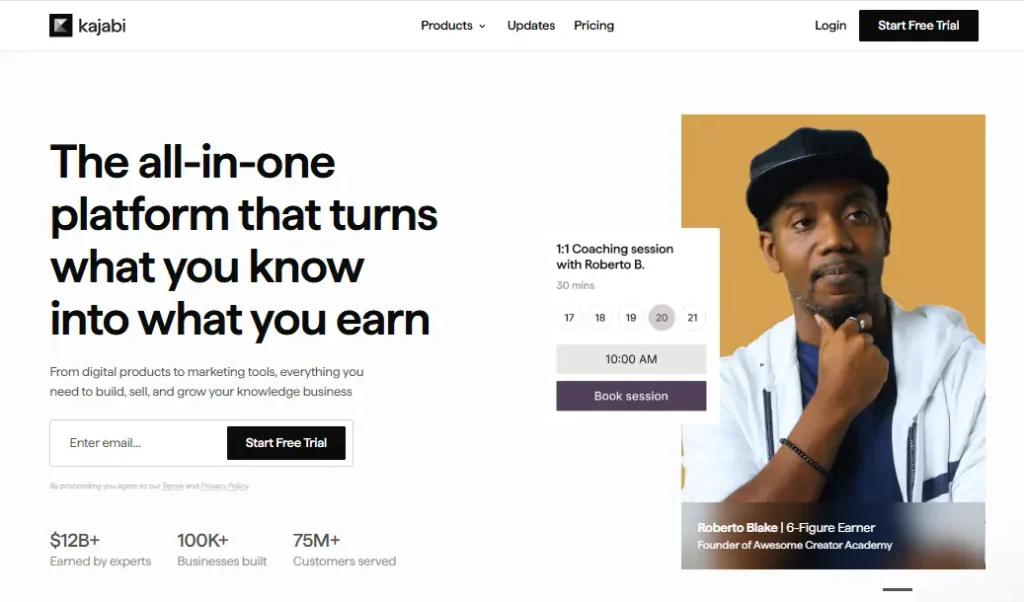
That’s a real advantage when you’d rather not stitch tools together. The price of that convenience is a monthly bill that starts high, caps on contacts and products, and a business that only exists inside Kajabi’s account.
Pros and Cons of Kajabi
| Kajabi Pros | Kajabi Cons |
|---|---|
| Everything a course business needs sits behind one login | The Basic plan stops at 2,500 contacts and 5 products |
| Landing pages, funnels, and marketing emails are unlimited on all plans | The entry price is $143/month billed annually, or $179/month billed monthly |
| Kajabi Payments adds no transaction fee | Connecting your own Stripe account costs an extra 2% on Basic |
| Course video hosting comes with every plan | Affiliate tools and advanced automations start on Growth at $199/month billed annually |
| Students get a polished experience, and you can trial it first | Your pages, contacts, courses, and payment data sit on Kajabi’s servers |
Kajabi Pricing
| Plan | Monthly Billing | Annual Billing | Contacts | Products | Transaction Fee |
|---|---|---|---|---|---|
| Basic | $179/month | $143/month ($1,716/year) | 2,500 | 5 | 0% with Kajabi Payments, 2% with your own Stripe |
| Growth | $249/month | $199/month ($2,388/year) | 25,000 | 50 | 0% with Kajabi Payments, 1% with your own Stripe |
| Pro | $499/month | $399/month ($4,788/year) | 100,000 | Unlimited | 0% with Kajabi Payments, 0.5% with your own Stripe |
Card fees are charged on top of every plan. Kajabi only adds the third-party processor fee in regions where Kajabi Payments is offered, and PayPal is exempt.
Throughout this guide, Kajabi Basic, at $143/month billed annually, is the number every alternative is measured against. Kajabi’s pricing page says the annual option saves $432, which takes the $2,148 monthly total down to $1,716/year.
Good to Know: Kajabi works, and plenty of creators run profitable businesses on it. What you’re really paying for is never having to think about servers, plugins, or email deliverability.
So the useful question isn’t whether Kajabi is good. It’s whether that convenience is worth $1,716 a year at your size, and the tools below give you different answers.
With that baseline set, here’s the fastest way to narrow the list.
Find the Best Kajabi Alternative in 30 Seconds Based on Your Goal
Start with the job you need done, not the feature list. Find the row that matches your situation, and you’ll have a shortlist before reading a single review.
| If your goal is… | Best tool | Why |
|---|---|---|
| Own your courses, checkout, and email on WordPress | Creator LMS | Free version with unlimited students; upsells, cohorts, and Mail Mint automation on Business at $200/year |
| Launch a course fast with AI and pay once | Klasio | AI course builder, a free plan, and lifetime plans from $399 one-time |
| Add funnels, order bumps, and upsells to WooCommerce, LearnDash, or Tutor LMS | WPFunnels | Free custom checkout plus 1 order bump and 1 upsell per funnel; LMS funnels on Business |
| Stay with a WordPress LMS you already know | LearnDash | Mature WordPress LMS from $259/year with no per-student fees |
| Give students a polished, structured course | Thinkific | Order bumps from Basic, upsells and memberships from Start at $82/month billed annually |
| Launch a first course with a student app | Teachable | iOS and Android student apps on every plan from $29/month billed annually |
| Sell courses and downloads from a simple storefront | Podia | Courses, downloads, community spaces, and email from $42/month billed annually |
| Replace Kajabi for free or close to it | Systeme.io | Free plan with 2,000 contacts; Startup at $17/month for 5,000 |
| Run deep marketing automation | Kartra | Unlimited email and SMS with 2,500 contacts on Starter at $119/month |
| Build funnels with room for a bigger list | ClickFunnels | 10,000 contacts and 3 courses on Launch at $81/month billed annually |
| Build interactive, certificate-based training | LearnWorlds | Interactive courses, SCORM uploads, and memberships from Pro Trainer |
| Sell digital products with no monthly bill | Gumroad | No monthly fee; 10% + $0.50 per direct sale |
That’s the shortcut. If you already have a specific rival in mind, the next table settles it in a sentence.
Kajabi vs Other Tools at a Glance
A lot of Kajabi users arrive with one competitor already in mind, often because a peer just switched. Here’s the one-line answer for each matchup.
| Comparison | Short answer |
|---|---|
| Kajabi vs Creator LMS | Choose Creator LMS to run courses, upsells, and email on a site you own, for one yearly license. |
| Kajabi vs Klasio | Choose Klasio if a one-time price and AI course drafting matter more to you than funnels. |
| Kajabi vs WPFunnels | WPFunnels takes over checkout, bumps, and upsells, but you’ll still need an LMS for lessons. |
| Kajabi vs LearnDash | LearnDash goes deeper on quizzes and grading, but email and upsells are up to you. |
| Kajabi vs Thinkific | Thinkific teaches just as well for less money, with lighter marketing tools. |
| Kajabi vs Teachable | Teachable is cheaper to start, but its Starter plan keeps 7.5% of every sale. |
| Kajabi vs Podia | Podia is easier and cheaper until your list outgrows its 1,000-subscriber ceiling. |
| Kajabi vs Systeme.io | Systeme.io matches most of Kajabi’s toolset for far less, with rougher edges. |
| Kajabi vs Kartra | Kartra automates more and costs less at 2,500 contacts. |
| Kajabi vs ClickFunnels | ClickFunnels wins on funnels and list size and loses on course delivery. |
| Kajabi vs LearnWorlds | LearnWorlds suits interactive, assessment-heavy training better. |
| Kajabi vs Gumroad | Gumroad costs less at low volume, then its per-sale fee overtakes Kajabi’s flat price. |
| Kajabi vs WordPress | WordPress trades a monthly rental for ownership, and you take on hosting and a handful of plugins. |
Those answers give you the big picture. The full breakdown of each tool starts below, and the feature map after it shows exactly what each one replaces.
12 Best Kajabi Alternatives for Courses, Coaching, and Memberships
The reason you’re looking usually decides the winner. If it’s price, the cheaper hosted tools matter most, and if it’s the contact cap or ownership, the WordPress options do.
Three tools here run on WordPress: Creator LMS, WPFunnels, and LearnDash. The other nine, Klasio included, are hosted services, so choosing one means switching landlords rather than owning the building.
Every entry covers what the tool does well, where it falls short, what it costs, and how it stacks up against Kajabi Basic. First up is the option built around ownership.
1. Creator LMS: Own Your Courses, Checkout, and Email on WordPress

Creator LMS turns your WordPress site into a course platform for coaches, consultants, and educators. There’s no monthly platform bill, and it doesn’t need WooCommerce to take payments.
Even the free version handles unlimited courses, lessons, and students, plus quizzes, verified certificates, and Stripe checkout. That’s enough to launch a first paid course without upgrading.
Each paid tier adds a layer on top. Starter brings memberships, subscriptions, gamification, and AI course building, Pro adds Mail Mint’s Pro email automation, and Business adds one-click upsells, cohorts, and live Zoom classes.
Business also bundles WPFunnels’ Pro features and content protection, and Agency adds a built-in community. Feature for feature, Business is the tier to hold up against Kajabi Basic.
The difference that matters most is where everything lives. Your courses, student records, and payments stay in your own database instead of on a vendor’s servers.
How Creator LMS Helps You Grow Revenue Without a Bigger Bill
- Keep the whole sale: Stripe checkout comes free, with no platform percentage added on top.
- Sell recurring access early: Memberships and subscriptions are part of Starter, so a monthly program doesn’t force an upgrade.
- Offer the next step at checkout (Business): One-click upsells and cross-sells move a buyer into your next program without a second card form.
- Teach groups live (Business): Cohort courses and Zoom classes let you run intakes with fixed start dates.
- Automate follow-up (Pro and up): Mail Mint Pro automation, dynamic segments, and abandoned cart recovery come included.
- Bring your old LMS with you: Free importers copy courses and students from LearnDash, Tutor LMS, LearnPress, MasterStudy, and SCORM files, leaving the originals untouched.
Where Creator LMS Differs From Kajabi
- Price: One Business license at $200/year covers courses, memberships, upsells, cohorts, and Mail Mint automation, against $1,716/year for Kajabi Basic. Hosting and email sending are added in the savings section, so the gap you see there is the real one.
- Course & membership delivery: Lessons live on your domain and inside your theme, with cohorts on Business and community on Agency. Kajabi delivers everything through its own hosted site and templates.
- Data ownership: Every student, order, and lesson is a record in a database you control. Kajabi exports contacts and videos, but lesson content has to be copied out by hand.
- Email automation: Mail Mint reacts to what students do, such as stalling before lesson two, and a bigger list never bumps you up a tier. On Kajabi, contact number 2,501 is what pushes you into Growth.
Pros and Cons of Creator LMS
| Pros | Cons |
|---|---|
| The free plugin already covers unlimited courses, lessons, students, quizzes, and certificates | Upsells aren’t available below Business |
| Stripe checkout works without WooCommerce | Community is an Agency-only feature |
| The $70/year Starter plan includes memberships and subscriptions | Affiliate tracking needs a separate plugin |
| Business bundles Mail Mint Pro automation and WPFunnels Pro features | Videos play through a branded player, so you host them on YouTube, Vimeo, or your own server |
| Free importers for LearnDash, Tutor LMS, LearnPress, and MasterStudy | Hosting and updates are your responsibility |
Creator LMS Pricing
| Free | Starter | Pro | Business | Agency |
|---|---|---|---|---|
| $0 | $70/year | $100/year | $200/year | $300/year |
| Unlimited courses and students, quizzes, certificates, Stripe checkout | 1 site, memberships, subscriptions, AI course builder, gamification | 5 sites, Mail Mint Pro automation, cart recovery | 10 sites, upsells, cohorts, Zoom classes, WPFunnels Pro features | 50 sites, community, white label |
These are the current sale prices on creatorlms.net, and the regular yearly rates are $139.99, $199.99, $399.99, and $599.99. Every paid plan can be refunded within 15 days.
Should You Switch to Creator LMS?
If courses, coaching, or memberships pay your bills and each new batch of subscribers makes Kajabi pricier, Creator LMS is the cleanest way to take ownership. Build one course on the free plugin first, so you’re judging the real thing.
Line Business up against Kajabi, since that’s where upsells, cohorts, and automation meet. If you don’t sell upsells yet, Pro at $100/year still gives you courses, memberships, and Mail Mint automation.
Two pieces sit outside the plugin: video hosting and affiliate tracking. The branded player handles YouTube, Vimeo, or Bunny Stream video, and an affiliate plugin fills the other gap.
Pro Tip: Price Creator LMS against the Kajabi tier you’ll need in twelve months. A list about to cross 2,500 contacts means Kajabi Growth at $2,388/year, while your license price doesn’t move.
Related read: Creator LMS Vs Kajabi
Try Creator LMS Free → | Get Creator LMS Now →
Owning your platform takes a little setup. If you’d rather hand the building work to AI, the next tool is designed for exactly that.
2. Klasio
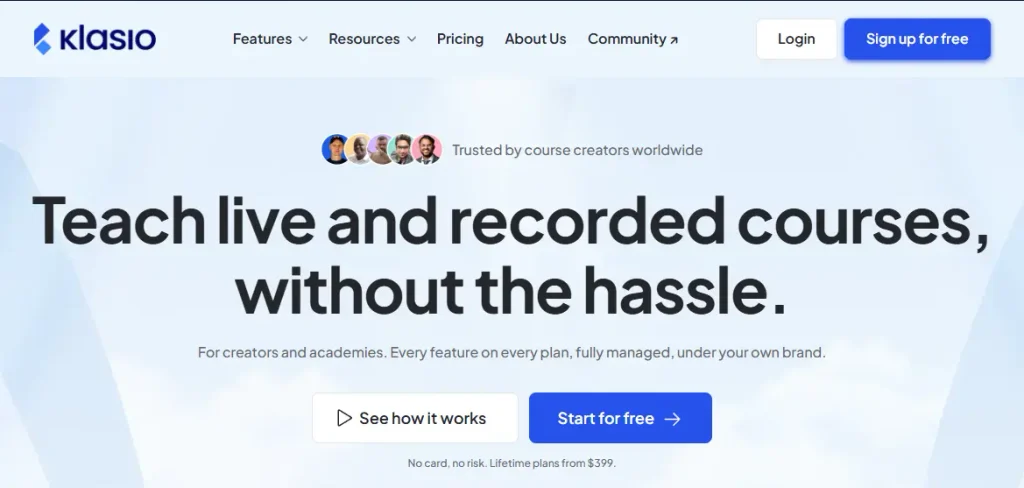
Klasio is a hosted course platform where AI writes the first draft. Type in your topic and it outlines a full curriculum, which you then shape into your own course.
You can run live and recorded classes, coaching, subscriptions, and downloads from one account. A free plan covers 1 course and 50 students.
Its biggest difference from Kajabi is how you pay. Klasio offers lifetime plans: $399 for Starter, $699 for Growth, and $999 for Business, each paired with a small per-sale fee.
Paid plans show limits for email sends and subscribers. We couldn’t find funnels, order bumps, or an affiliate program, so think of Klasio as a swap for Kajabi’s course engine rather than its marketing side.
How Klasio Helps You Go From Idea to Live Course
- Skip the blank page: Describe the course, and the AI returns a curriculum you can edit.
- Stop the monthly bill: One payment replaces a subscription.
- Upload video without a second host: Starter comes with 100GB of storage.
- Sell more than courses: Coaching and subscriptions are included on paid plans.
- Put it on your domain: Every paid plan supports a custom domain.
Pros and Cons of Klasio
| Pros | Cons |
|---|---|
| AI turns a single prompt into a course outline | We found no funnel builder or order bumps |
| Lifetime access starts at $399 one-time | Each lifetime tier takes 1% to 3% of sales |
| The free plan covers 1 course and 50 students | No affiliate program for your partners |
| Starter includes 100GB of video storage | The free plan keeps Klasio branding and has no custom domain |
| 14-day, no-questions refund window | Still a young platform with a small review base |
Klasio Pricing
| Free | Starter | Growth | Business | Enterprise |
|---|---|---|---|---|
| $0 | $399 one-time | $699 one-time | $999 one-time | Custom |
| 1 course, 50 students | 100GB video, custom domain, coaching, subscriptions, 3% fee | Higher limits, 300GB video, 2% fee | Unlimited videos and downloads, 1% fee | Unlimited everything |
These prices come from Klasio’s lifetime pricing page, which warns they’ll rise after September 30. Refunds are available for 14 days.
Is Klasio Better Than Kajabi?
When finishing a course is what’s holding you back, Klasio is faster to launch and much cheaper in the first year. A one-time $399 for Starter sits against $1,716 every year for Kajabi Basic.
Don’t ignore the per-sale fee, though. Selling $2,000 a month, Starter’s 3% comes to $720 a year, which puts your first-year total near $1,119, still well below Kajabi.
Remember: Klasio’s lifetime prices change after September 30. Before buying for the one-time price, check which fee your tier carries, since it comes out of every sale for as long as you use it.
Klasio handles the teaching side. For the selling side, meaning checkout, bumps, and upsells, the next plugin fills that gap on WordPress.
3. WPFunnels
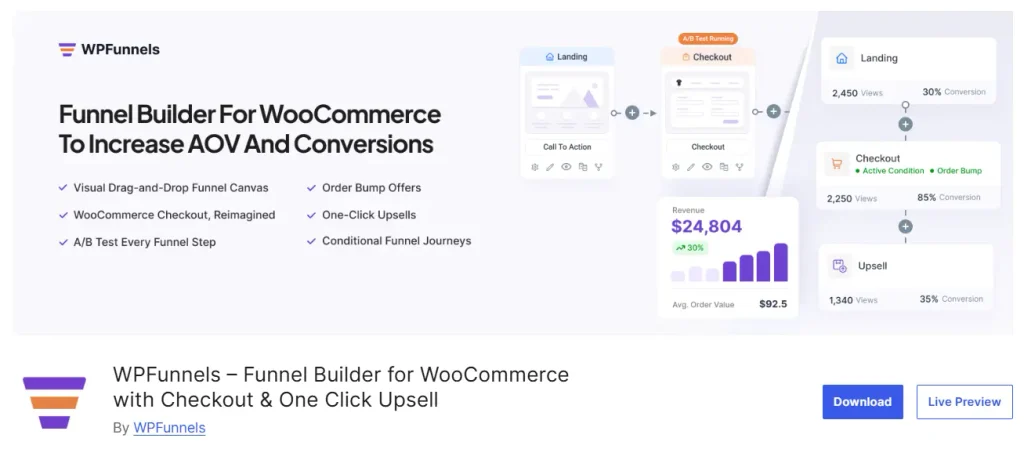
WPFunnels is the WooCommerce funnel plugin our team builds. Every step of a purchase, from landing page to checkout, order bump, upsell or downsell, and thank-you page, is laid out on a visual canvas.
To be clear, it doesn’t host courses. It’s the add-on for three situations: you sell through WooCommerce, you want lead funnels and A/B tests, or your courses run on LearnDash or Tutor LMS.
On the Business plan, you can sell Tutor LMS courses with WPFunnels or build LearnDash course funnels. Creator LMS Business users already get WPFunnels’ Pro features, so there’s nothing extra to buy.
We use it for our own product launches, and in a recent campaign, one-click upsells brought in 14% more revenue. In Kajabi terms, it replaces the checkout page and the offers you stack around it.
How WPFunnels Helps You Earn More From Each Checkout
- Map the journey visually: Arrange landing, checkout, and offer steps as blocks, or begin with a ready-made template. It works with Gutenberg, Elementor, Divi, Bricks, and Oxygen.
- Swap in a better checkout: Custom WooCommerce checkout layouts are free, and the Checkoutify field editor comes with paid plans.
- Stack offers at the right moment: Each free funnel gets one order bump and one one-click upsell, and Starter lifts the limit.
- Collect leads before the sale: Lead funnels with opt-in forms feed Mail Mint for follow-ups and marketing campaigns.
- See what’s earning (Starter): A/B testing and analytics show which step or offer adds revenue.
Pros and Cons of WPFunnels
| Pros | Cons |
|---|---|
| The free plan includes custom checkout, lead funnels, 1 bump, and 1 upsell per funnel | Sales funnels run on WooCommerce |
| The $103.99/year Starter plan unlocks unlimited bumps, upsells, A/B tests, and analytics | Course delivery still needs an LMS |
| Pro adds email automation and abandoned cart recovery | LearnDash and Tutor LMS funnels start on Business |
| Widgets for Gutenberg, Elementor, Divi, Bricks, and Oxygen | Only works on WordPress |
| Business adds conditional funnels and dynamic upsells |
WPFunnels Pricing
| Free | Starter | Pro | Business | Agency |
|---|---|---|---|---|
| $0 | $103.99/year | $159.99/year | $319.99/year | $479.99/year |
| Custom checkout, lead funnels, 1 bump and 1 upsell per funnel | 1 site, unlimited bumps and upsells, A/B testing, analytics, Checkoutify | 1 site, email automation, cart recovery | 5 sites, conditional funnels, dynamic upsells, LearnDash and Tutor LMS funnels | 50 sites, every add-on |
These are the discounted rates listed on the WPFunnels pricing page, and regular prices are $129.99, $199.99, $399.99, and $599.99 a year. Paid plans come with a 15-day refund window.
Is WPFunnels Better Than Kajabi?
For checkout and post-purchase offers, yes, and at a fraction of the price. The $103.99/year Starter plan covers what Kajabi’s checkout does inside a $1,716/year subscription.
What it won’t do is deliver lessons. If Creator LMS is your only sales channel, you can likely skip WPFunnels, since Creator LMS Business already handles checkout and upsells.
Good to Know: Creator LMS, WPFunnels, and Mail Mint are separate plugins made by the same team. You install only the jobs you need: courses, funnels, or email.
Related read: How To Craft A Highly Effective Online Course Sales Funnel In 2026
Next is a WordPress LMS you may already be running, and one Creator LMS can import from for free.
4. LearnDash
LearnDash has been one of the best-known WordPress LMS plugins for years. People choose it for its course builder, its quizzing, and the large number of add-ons and themes built around it.
You get unlimited courses and learners on every plan, with no per-student fees. Essentials already covers memberships, subscriptions, bundles, and Stripe or PayPal payments.
Marketing is the missing piece. LearnDash has no email marketing or upsell tools of its own, so matching Kajabi means adding an email plugin and a funnel tool.
How LearnDash Helps You Teach on Your Own Site
- Structure long programs: Lessons, topics, and quizzes are arranged in a drag-and-drop builder.
- Sell access your way: Memberships, subscriptions, and bundles come with Essentials.
- Help students finish: Video progression and focus mode keep learners moving through the material.
- Track results (Pro): Pro adds advanced reports, weighted grading, and an AI outline and quiz builder.
- Manage teams (Elite): Elite brings group management, instructor roles, and seat sales.
Pros and Cons of LearnDash
| Pros | Cons |
|---|---|
| Mature course and quiz builder | No built-in email marketing |
| No per-student fees on any plan | No built-in upsells or order bumps |
| Memberships, subscriptions, and bundles from Essentials | Essentials starts at $259/year, more than Creator LMS Business |
| Large ecosystem of themes and add-ons | You handle hosting and plugin updates |
| Works with WPFunnels Business for course funnels | AI tools need the Pro plan |
LearnDash Pricing
| Essentials | Pro | Elite |
|---|---|---|
| $259/year | $399/year | $599/year |
| Course and quiz builder, memberships, subscriptions, bundles, Stripe and PayPal | AI outline and quiz builder, advanced reporting, weighted grading | Group management, instructor roles, front-end course creation, seat sales |
All plans are renewed annually and include unlimited courses and learners.
Is LearnDash Better Than Kajabi?
On the learning side, LearnDash goes deeper, especially on quizzes and grading. Its $259/year Essentials plan costs a fraction of Kajabi Basic’s $1,716/year.
On the selling side, Kajabi wins out of the box. By the time LearnDash has email and funnels bolted on, you’re maintaining three products to match one.
Pro Tip: Already on LearnDash? Creator LMS imports your courses and students for free and leaves the originals in place, so you can run both side by side before deciding.
Related read: Creator LMS Vs LearnDash
That’s the last of the WordPress options. Everything from here is hosted, starting with the course platform Kajabi users weigh it against most.
5. Thinkific
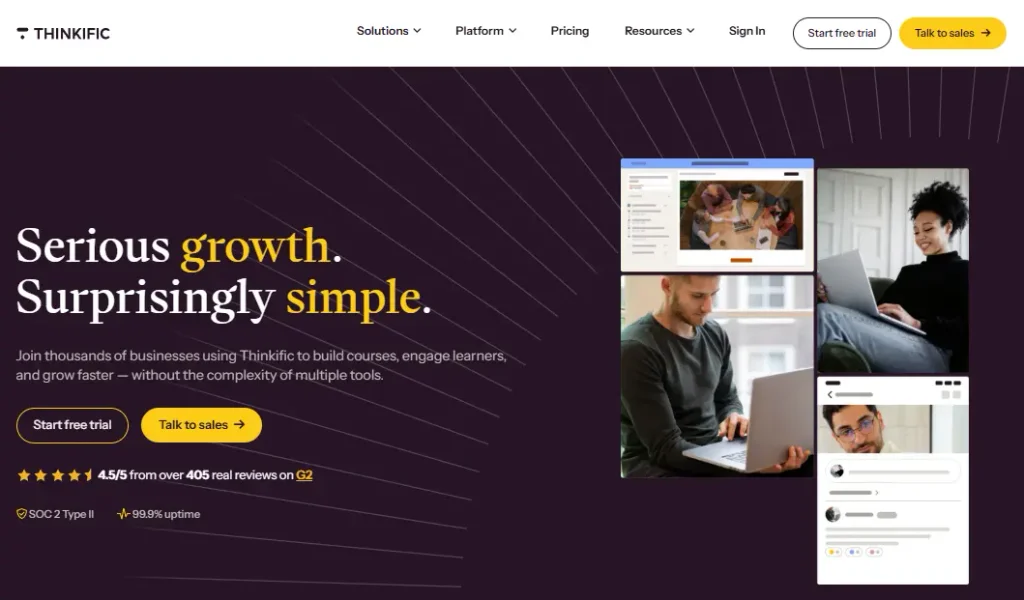
Thinkific is a hosted platform designed around how students learn. The course player, progress tracking, and community spaces are where it puts most of its effort.
Basic isn’t bare, either. It includes unlimited courses, a community, checkout with order bumps, and abandoned-cart emails, while Start adds upsells, payment plans, memberships, certificates, and live cohorts.
Marketing is thinner than Kajabi’s. There’s no multi-step funnel builder, and plenty of Thinkific users send their newsletters through a separate email tool.
How Thinkific Helps Students Finish What They Buy
- A course player students like: The builder and player are the most polished parts of the product.
- Bigger orders from day one: Basic’s eCommerce tools include order bumps and coupons.
- Recurring and upsell offers (Start): Bundles, upsells, payment plans, and subscriptions open up on Start.
- Live cohorts (Start): Cohorts come with Zoom sessions, booking calendars, and attendance tracking.
- Win back abandoned checkouts: Abandoned-cart emails are on every plan from Basic up.
Pros and Cons of Thinkific
| Pros | Cons |
|---|---|
| Strong course builder and student experience | No multi-step funnel builder like Kajabi’s |
| Unlimited courses on every plan | Upsells and memberships need Start |
| Order bumps and abandoned-cart emails from Basic | Removing Thinkific branding needs Grow |
| Live cohorts and coaching on Start | Branded mobile app only on Thinkific Plus |
| 25% savings on annual billing | Email tools are lighter than Kajabi’s |
Thinkific Pricing
| Basic | Start | Grow | Thinkific Plus |
|---|---|---|---|
| $40/month billed annually | $82/month billed annually | $164/month billed annually | Custom |
| Unlimited courses, 1 community, order bumps, abandoned-cart emails | Upsells, memberships, cohorts, certificates | Branding removal, 3 communities, API access | SSO, SCORM, branded mobile app |
Thinkific lists a 25% saving for paying annually instead of monthly. Card fees are charged separately.
Is Thinkific Better Than Kajabi?
For a business built around courses, Thinkific gives students an experience on par with Kajabi’s for less money. Start costs $82/month billed annually, compared with $143/month billed annually for Kajabi Basic.
Where Kajabi still leads is marketing. If your sales run through funnels and email sequences, expect to add a funnel tool alongside Thinkific.
Remember: Thinkific Basic doesn’t include upsells or memberships. If either is part of your offer, price the start plan, not the entry tier.
Related read: Thinkific vs Kajabi – Which One is Better for Selling Courses?
Thinkific leads with learning quality. The next option leads with speed to launch, plus mobile apps for students on every plan.
6. Teachable
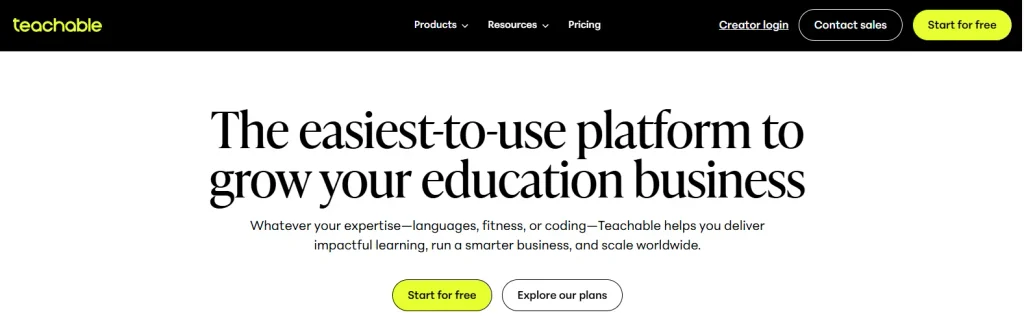
Teachable is a hosted course platform known for how quickly you can get a first course live. Every plan includes AI course creation, iOS and Android student apps, and global payments with tax handling.
Upsells and cart recovery are on every plan too. The catch is on Starter, which charges a 7.5% transaction fee and allows 5 products.
Builder removes the fee and adds an affiliate program. Growth adds certificates, branding removal, and imported students.
How Teachable Helps You Launch a First Course
- Get started fast: Create with AI and a simple course builder are on every plan.
- Give students an app: iOS and Android student apps come with Starter.
- Handle taxes for you: Global payments and tax handling are built in.
- Upsell from day one: Upsells and cart recovery are on every plan.
- Run affiliates (Builder): The affiliate program unlocks on Builder.
Pros and Cons of Teachable
| Pros | Cons |
|---|---|
| Low entry price at $29/month billed annually | Starter charges a 7.5% transaction fee |
| Student apps on every plan | Starter allows only 5 products |
| Upsells and cart recovery on every plan | Certificates need Growth |
| Global payments and tax handling | Removing Teachable branding needs Growth |
| 7-day free trial and 30-day guarantee | Marketing tools are lighter than Kajabi’s |
Teachable Pricing
| Starter | Builder | Growth | Custom |
|---|---|---|---|
| $29/month billed annually ($348/year) | $69/month billed annually ($828/year) | $139/month billed annually ($1,668/year) | Contact sales |
| 5 products, student apps, upsells, 7.5% fee | 10 products, 0% fee, affiliate program | 50 products, certificates, branding removal | Dedicated success manager, migration assistance |
Monthly billing costs $39, $89, and $189 a month. Teachable shows a 22% saving for yearly billing, and every plan includes a 7-day free trial and a 30-day guarantee.
Is Teachable Better Than Kajabi?
For a first course on a budget, Teachable costs far less than Kajabi. Builder at $828/year avoids the transaction fee and compares with Kajabi Basic at $1,716/year.
Watch the fee on Starter. At $1,000 a month in sales, 7.5% costs you $75 a month, which is enough to make Builder the better deal.
Good to Know: Teachable counts products, not contacts. If you sell more than 10 courses, coaching offers, and downloads combined, you’ll need Growth.
Related read: Kajabi vs Teachable – Which One You Need to Survive
Teachable makes a first launch painless. Podia, next, does the same for your whole storefront.
7. Podia

Podia gives you one hosted shop for courses, downloadable products, coaching sessions, webinars, and paid community access. Its appeal is how little setup it takes.
Every plan includes email marketing, and Shaker unlocks affiliates and upsells. You won’t find a Kajabi-style funnel builder, so multi-step sequences need another tool.
The number to check is your subscriber count. Podia’s plans top out at 100, 500, or 1,000 email subscribers, well below Kajabi Basic’s 2,500.
How Podia Helps You Get a Storefront Live This Week
- One place for every product: Courses, downloads, coaching, and webinars sit in the same store.
- Email without a second login: Every plan comes with email marketing.
- Community spaces included: Mover already gives you 25 spaces.
- Upsells and affiliates (Shaker): Shaker adds both, along with PayPal and Zapier.
- A trial with no card: You can try it for 14 days without entering payment details.
Pros and Cons of Podia
| Pros | Cons |
|---|---|
| Simple setup for courses and downloads | No funnel builder |
| Email marketing and community spaces on every plan | Email plans cap at 100 to 1,000 subscribers |
| Unlimited customers on every plan | 5% transaction fee on Mover |
| No transaction fees on Shaker and up | Upsells and affiliates need Shaker |
| 14-day free trial with no card needed | Cost at 2,500 subscribers isn’t published |
Podia Pricing
| Mover | Shaker | Earthquaker |
|---|---|---|
| $42/month billed annually ($504/year) | $84/month billed annually ($1,008/year) | $150/month billed annually ($1,800/year) |
| 100 email subscribers, 50 products, 500 videos, 5% fee | 500 subscribers, 150 products, affiliates, upsells, no fees | 1,000 subscribers, unlimited products and videos, no fees |
Payment processing is charged separately on every plan.
Is Podia Better Than Kajabi?
If you mostly sell simple courses and downloads, Podia is easier to manage and cheaper to start. Mover runs $504/year, under a third of Kajabi Basic’s $1,716/year.
Bring a 2,500-person list and it’s a different story. The top Earthquaker plan costs $1,800/year and only covers 1,000 subscribers, with anything beyond that priced on top.
Good to Know: A 1,000-subscriber ceiling fills fast on a growing list. Ask Podia for the add-on cost at your list size before comparing totals.
Related read: Podia vs Kajabi – Choosing The Better Tool To Sell Courses
Podia’s strength is simplicity. The next tool costs nothing to start and covers more of Kajabi’s feature list than anything else here.
8. Systeme.io
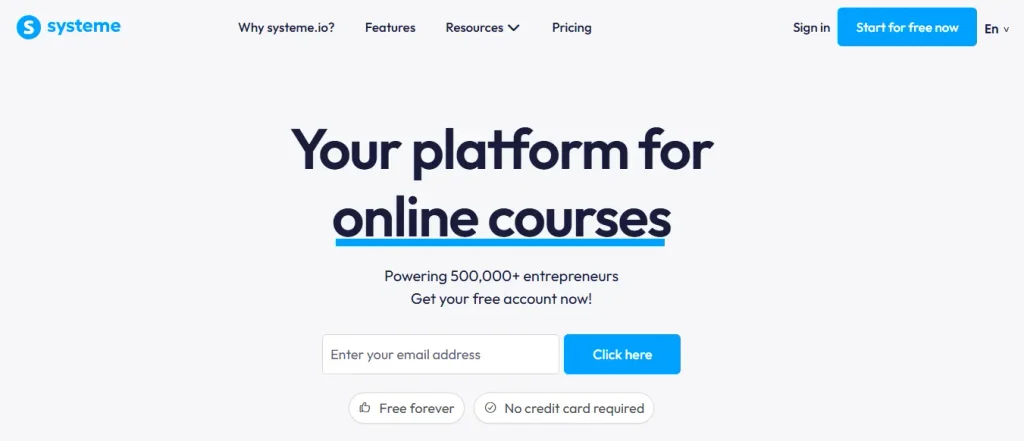
Systeme.io is a hosted platform that bundles funnels, email, courses, affiliates, and webinars. Of every tool here, it mirrors Kajabi’s do-everything model most closely, at a much lower price.
The free plan doesn’t expire, and it includes 2,000 contacts, 3 funnels, 1 automation rule, and 1 custom domain. For $17/month, Startup lifts you to 5,000 contacts, 10 funnels, and 10 automation rules.
Two details matter if you’re coming from Kajabi. Affiliate management is on every plan, including the free one, and Systeme.io takes no transaction fee.
How Systeme.io Helps You Cut Your Software Bill
- A real free tier: 2,000 contacts and 3 funnels, with no card required.
- Affiliates from the start: Partner programs work on every plan, while Kajabi saves them for Growth.
- Pay for scale, not features: Webinar at $47/month covers 10,000 contacts plus evergreen webinars.
- Course video included: Upload lesson videos directly to your account.
- No cut of your sales: Systeme.io charges no platform fee on transactions.
Pros and Cons of Systeme.io
| Pros | Cons |
|---|---|
| Free plan with 2,000 contacts | Less design flexibility than Kajabi |
| Affiliate program on every plan | Automation rules are capped by plan |
| No platform transaction fees | Free plan is limited to 3 funnels |
| Funnels, email, courses, and webinars in one place | Your business still lives on a hosted platform |
| Startup covers 5,000 contacts for $17/month | Course features are simpler than Kajabi’s |
Systeme.io Pricing
| Free | Startup | Webinar | Unlimited |
|---|---|---|---|
| $0 | $17/month | $47/month | $97/month |
| 2,000 contacts, 3 funnels, 1 automation rule | 5,000 contacts, 10 funnels, 10 automation rules | 10,000 contacts, 50 funnels, evergreen webinars | Unlimited contacts, funnels, and automation rules |
These are monthly billing prices. Teams can also book a Custom plan with a dedicated success manager.
Is Systeme.io Better Than Kajabi?
Under 5,000 contacts, Systeme.io handles Kajabi’s essentials for a small slice of the cost. Startup is $17/month, compared with $179/month for Kajabi Basic on monthly billing.
Kajabi’s pages and student area feel more refined. Either way, your business sits on someone else’s platform.
Pro Tip: Before canceling Kajabi, recreate your best-selling funnel and one course on Systeme.io’s free plan. You’ll find the gaps without spending a dollar.
Related read: 10 Popular Kartra Alternatives for Your Course Business [2026]
Systeme.io competes on cost. Kartra, up next, competes on how much of your marketing it can automate.
9. Kartra

Kartra is a hosted marketing suite covering funnels, email, checkout, memberships, video, calendars, and a helpdesk. It tends to attract marketers who care more about automation than about the course player.
Its Starter plan has 2,500 contacts, unlimited email and SMS, 0% transaction fees, and unlimited pages, products, and courses. That contact limit is identical to Kajabi Basic’s.
Costs climb with the tiers. Automations, affiliates, and the helpdesk start on Growth, while Essentials takes 5% of each sale.
How Kartra Helps You Automate the Whole Customer Journey
- Pages and payments together: The funnel mapper, form builder, and checkout live in one account.
- No email ceiling (Starter): Starter sends unlimited email and SMS.
- Video and booking (Starter): Video hosting and calendars are included from Starter.
- Behavior-based automation (Growth): Growth adds automations, funnel simulation, and surveys.
- Partners and support (Growth): Affiliates and the helpdesk also arrive on Growth.
Pros and Cons of Kartra
| Pros | Cons |
|---|---|
| Funnels, pages, email, checkout, and memberships in one account | Automations and affiliates need Growth at $229/month |
| Unlimited email and SMS from Starter | Essentials charges a 5% fee and allows 1 product |
| 0% transaction fees from Starter | Course delivery is less polished than Kajabi’s |
| Video hosting and calendars on Starter | Reviewers often describe the builder as powerful but complex |
| 30-day money-back guarantee | Your site, list, and courses live on Kartra’s servers |
Kartra Pricing
| Starter | Growth | Professional | |
|---|---|---|---|
| $59/month | $119/month | $229/month | $549/month |
| 500 contacts, 10,000 emails/month, 5% fee, 1 product | 2,500 contacts, unlimited email and SMS, 0% fee, video hosting | 12,500 contacts, automations, affiliates, helpdesk | 25,000 contacts, real-time funnel analytics, live chat |
These are monthly billing prices. Kartra says yearly billing saves up to 22%, and every plan carries a 30-day money-back guarantee.
Is Kartra Better Than Kajabi?
With 2,500 contacts, Kartra is cheaper and stronger on automation. Starter is $119/month, while Kajabi Basic is $179/month, both on monthly billing.
For courses and community, Kajabi comes out ahead. Students get a smoother experience, and the community features are more developed.
Remember: Kartra and Kajabi share the same 2,500-contact ceiling on their entry plans. Near that line? Compare Kartra Growth at $229/month with Kajabi Growth at $249/month, both billed monthly.
More on Kartra: 10 Popular Kartra Alternatives for Your Course Business [2026] and Kartra vs Kajabi – Which One’s Better For Selling Courses [2026]
Kartra is about automation depth. The next platform is about funnel depth and a much larger contact allowance.
10. ClickFunnels
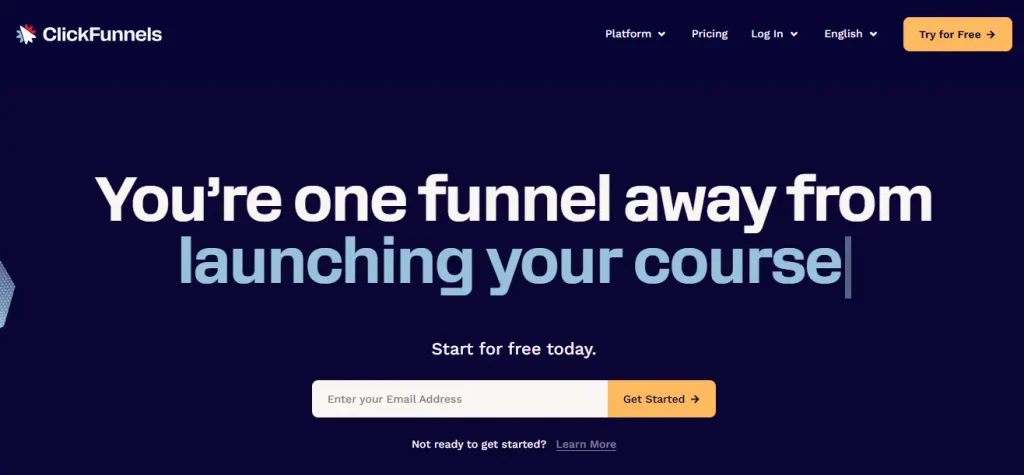
ClickFunnels started as a funnel builder and now bundles courses, email, and a CRM into its hosted plans. It has the biggest funnel-building community on this list and a far larger contact allowance than Kajabi Basic.
Launch comes with unlimited funnels, 10,000 contacts, 3 courses, and 50,000 emails a month. You get four times Kajabi Basic’s contacts while paying less per year.
Where it gives ground is course depth. Launch caps you at 3 courses, and ClickFunnels was built around campaign goals like converting cold traffic more than delivering long programs.
How ClickFunnels Helps You Turn Traffic Into Buyers
- Start from proven templates: Sales page and webinar funnel templates speed up the first build.
- More list room at entry level: 10,000 contacts come with Launch.
- Courses alongside funnels: Launch allows 3 courses, Scale 6, and Optimize 10.
- Built-in email sending: Launch covers 50,000 emails a month and still connects to other email marketing tools.
- AI tools and onboarding: Every plan includes AI tools and group onboarding calls.
Pros and Cons of ClickFunnels
| Pros | Cons |
|---|---|
| Mature funnel builder with a large template library | Only 3 courses on Launch |
| 10,000 contacts on Launch | Course delivery is less polished than Kajabi’s |
| Unlimited funnels on every plan | Launch includes only 2 team members |
| Email, CRM, and courses in one account | Webhooks and full API access need Scale |
| Big community and years of tutorials | Your funnels and customer data live on ClickFunnels’ servers |
ClickFunnels Pricing
| Launch | Scale | Optimize | Dominate |
|---|---|---|---|
| $97/month, or $81/month billed annually ($974/year) | $197/month, or $164/month billed annually ($1,964/year) | $297/month, or $248/month billed annually ($2,974/year) | $5,997/year (annual only) |
| 10,000 contacts, 3 courses, 50,000 emails/month | 75,000 contacts, 6 courses, API access | 150,000 contacts, 10 courses | 400,000 contacts, 20 courses |
Is ClickFunnels Better Than Kajabi?
If your revenue comes from funnels and you need list room, ClickFunnels is the better buy. You pay $974/year for 10,000 contacts, against $1,716/year for Kajabi Basic’s 2,500.
If courses carry the business, Kajabi is ahead. Past 3 courses, or with an active community, its student experience earns the higher price.
Pro Tip: Count your courses before you compare. If you sell 4 to 6, the ClickFunnels plan to price is Scale at $1,964/year, not Launch.
More on ClickFunnels:
ClickFunnels is built to convert. LearnWorlds is built for learners who need to practice, test, and prove what they know.
11. LearnWorlds
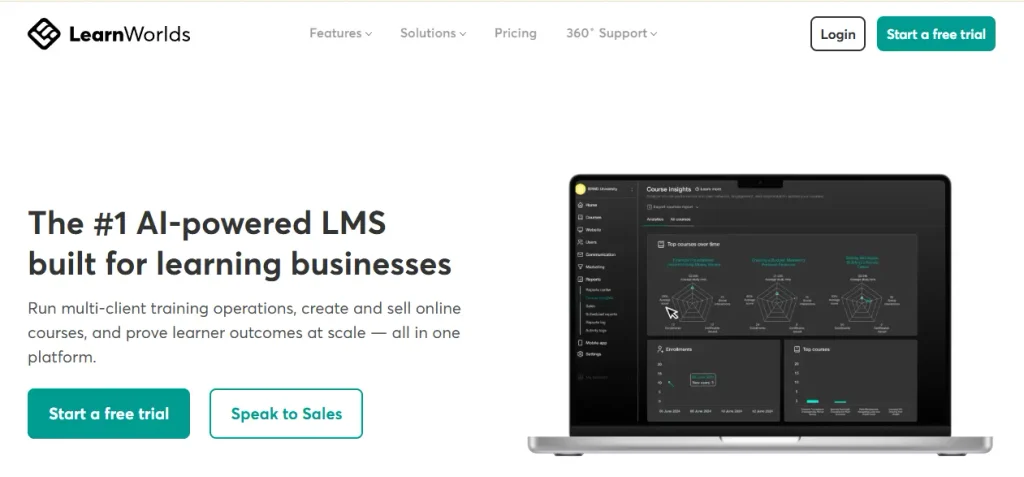
LearnWorlds is a hosted course platform built for interactive learning. It’s known for interactive video, assessments, and certificates, which makes it a common pick for certification programs and corporate training.
Starter costs $29/month but charges $5 per paid enrollment. Pro Trainer removes that fee and adds memberships, subscriptions, payment plans, and SCORM uploads.
Interactive lessons suit subjects where students need to practice, like online math courses or software training. Marketing tools are lighter, so you’d connect an email platform through its 50+ integrations.
How LearnWorlds Helps You Build Interactive Training
- Build courses with AI: The AI course builder and quiz generator are on every plan.
- Sell with your own processor: Starter lets you sell through your own Stripe or PayPal.
- Run live sessions: Live 1:1 and group sessions come with Starter.
- Add memberships and certificates (Pro Trainer): Subscriptions, payment plans, certificates, and up to 20 SCORM uploads unlock here.
- Automate and white-label (Learning Center): Triggers, conditions, delays, and full white-label arrive on Learning Center.
Pros and Cons of LearnWorlds
| Pros | Cons |
|---|---|
| Strong interactive course and assessment tools | Starter charges $5 per paid enrollment |
| AI course builder and quizzes on every plan | Memberships and subscriptions need Pro Trainer |
| Certificates and SCORM uploads on Pro Trainer | Automation needs Learning Center |
| Unlimited courses on Pro Trainer | Learner caps by plan (1,000 or 2,000 active learners a month) |
| 50+ built-in integrations | No built-in funnel builder |
LearnWorlds Pricing
| Starter | Pro Trainer | Learning Center | Corporate |
|---|---|---|---|
| $29/month | $84.15/month (15% off $99) | $254.15/month (15% off $299) | Custom |
| $5 per paid enrollment, 1,000 active learners, 1 admin | No enrollment fees, 2,000 active learners, memberships, certificates | Full white-label, automation, 25 admins | Custom limits, 24/7 phone support |
Prices shown are for monthly billing, and the 15% discount applies for the first 6 months. LearnWorlds says annual billing saves 20%.
Is LearnWorlds Better Than Kajabi?
For training where students need to interact, test, and earn certificates, LearnWorlds goes further than Kajabi. Pro Trainer costs $99/month at its regular monthly price against Kajabi Basic at $179/month on monthly billing.
For marketing a course business, Kajabi is more complete. With LearnWorlds, you’d bring your own email platform.
Remember: The 15% discount on Pro Trainer ends after 6 months. Budget for the regular $99/month when you compare yearly costs.
LearnWorlds goes deep on learning. The last tool strips everything back to simple selling.
12. Gumroad
Gumroad is a simple platform for selling digital products, from ebooks and templates to video courses and memberships. You upload a product, set a price, and share a link.
There’s no monthly fee. Gumroad takes 10% + $0.50 on sales through your profile or direct links, and 30% on sales that come through its Discover marketplace.
Since January 1, 2025, Gumroad has acted as the merchant of record. That means it collects and pays sales tax on your sales worldwide.
How Gumroad Helps You Sell Digital Products
- Start with no monthly bill: You only pay when you make a sale.
- Skip tax paperwork: Gumroad handles sales tax as the merchant of record.
- Sell downloads and memberships: Products, subscriptions, and memberships share one simple storefront.
- Reach new buyers: The Discover marketplace can bring customers you didn’t find yourself, at a 30% fee.
Pros and Cons of Gumroad
| Pros | Cons |
|---|---|
| No monthly fee | 10% + $0.50 on every direct sale |
| Gumroad handles sales tax worldwide | 30% on Discover marketplace sales |
| Very simple setup | Limited page customization |
| Works well for downloads and small products | Not built for structured courses or cohorts |
| Built-in marketplace for discovery | Basic marketing tools |
Gumroad Pricing
| Direct sales | Discover marketplace |
|---|---|
| 10% + $0.50 per transaction | 30% per transaction |
| Sales through your profile or direct links | Sales to new customers who find you on Discover |
Gumroad charges no monthly subscription.
Is Gumroad Better Than Kajabi?
At low sales volume, Gumroad costs less than Kajabi. On a $50 product, Gumroad takes $5.50 per sale, so it only passes Kajabi Basic’s $143/month billed annually after about 26 sales a month.
Past that point, Kajabi’s flat price wins, and it gives you courses, email, and community on top. Gumroad makes the most sense for downloads and side products, not a full course business.
For Examples: At 60 sales a month of a $50 product, Gumroad’s fee comes to $330. Kajabi Basic costs $143/month billed annually, before card processing on either side.
That’s the full list of 12. Next, here’s which Kajabi features each one actually takes over.
What Does Each Kajabi Alternative Replace?
Leaving an all-in-one means working out which features you’ll lose and where each one will live next. The map checks Kajabi’s core features against our three WordPress tools, Klasio, and the two hosted platforms Kajabi users weigh most often.
Treat the Creator LMS, WPFunnels, and Mail Mint columns as one combined setup, since the same team designed them to connect.
| Tool | Courses | Memberships | Checkout | Order Bumps | Upsells | Community | Affiliates | Video Hosting | Own Site & Data | |
|---|---|---|---|---|---|---|---|---|---|---|
| Kajabi (baseline) | ✓ | ✓ | ✓ | ✓ | ✓ | ✓ | ✓ | ✓ (Growth) | ✓ | ✗ |
| Creator LMS | ✓ | ✓ (Starter) | ✓ (free) | ✓ (Mail Mint, from Pro) | ✗ | ✓ (Business) | ✓ (Agency) | ✗ | ✗ (branded player) | ✓ |
| Klasio | ✓ | ✓ (subscriptions) | ✓ | ✓ (paid plans) | ✗ | ✗ | ✗ | ✗ | ✓ | ✗ |
| WPFunnels | ✗ (LMS funnels on Business) | ✗ | ✓ (WooCommerce) | ✓ (Mail Mint, Pro) | ✓ | ✓ | ✗ | ✗ | ✗ | ✓ |
| LearnDash | ✓ | ✓ (Essentials) | ✓ (Stripe, PayPal) | ✗ | ✗ | ✗ | ✗ | ✗ | ✗ | ✓ |
| Thinkific | ✓ | ✓ (Start) | ✓ | ✓ (basic) | ✓ (Basic) | ✓ (Start) | ✓ | ✓ | ✓ | ✗ |
| Teachable | ✓ | ✓ | ✓ | ✓ (basic) | ✓ | ✓ | ✗ | ✓ (Builder) | ✓ | ✗ |
| Podia | ✓ | ✓ | ✓ | ✓ (capped subscribers) | ✗ | ✓ (Shaker) | ✓ | ✓ (Shaker) | ✓ | ✗ |
| Systeme.io | ✓ | ✓ | ✓ | ✓ | ✓ | ✓ | ✓ | ✓ | ✓ | ✗ |
| Kartra | ✓ | ✓ | ✓ | ✓ | ✓ | ✓ | ✗ | ✓ (Growth) | ✓ (Starter) | ✗ |
| ClickFunnels | ✓ (3 on Launch) | ✓ | ✓ | ✓ | ✓ | ✓ | ✓ | ✓ (Optimize) | ✓ | ✗ |
| LearnWorlds | ✓ | ✓ (Pro Trainer) | ✓ | ✗ (integrations) | ✗ | ✗ | ✓ | ✗ | ✓ | ✗ |
| Gumroad | ✓ (basic) | ✓ | ✓ | ✓ (basic) | ✗ | ✗ | ✗ | ✗ | ✓ | ✗ |
Systeme.io, ClickFunnels, and Kartra replace the widest range of Kajabi features. The WordPress tools handle the core, and hand video and affiliates to add-ons, which matter once you look at cost.
Side-by-Side Feature Comparison of Kajabi Alternatives
Here’s every tool on one grid, so you can check it against the Kajabi features you use each week.
| Tool | Runs On | Courses & Memberships | Email Automation | Funnels & Checkout | Community | Video Hosting | Billing Model |
|---|---|---|---|---|---|---|---|
| Kajabi | Hosted | Yes | Yes | Yes | Yes (1 on Basic) | Yes | Monthly or annual |
| Creator LMS | Your WordPress site | Yes; memberships from Starter, cohorts on Business | Via Mail Mint, from Pro | Native checkout; upsells on Business | Agency plan | Branded player only | Yearly license |
| Klasio | Hosted | Yes | Email limits listed on paid plans | Checkout only | Not found | Yes, from 100GB | One-time lifetime |
| WPFunnels | Your WordPress site | Funnels for LearnDash or Tutor LMS (Business) | Via Mail Mint, Pro plan | WooCommerce checkout with bumps and upsells | No | No | Yearly license |
| LearnDash | Your WordPress site | Yes | Needs an email plugin | Stripe and PayPal checkout | Not built in | No | Yearly license |
| Thinkific | Hosted | Yes; memberships on Start | Abandoned-cart emails; lighter than Kajabi | Order bumps on Basic, upsells on Start | Yes | Yes | Monthly or annual |
| Teachable | Hosted | Yes | Lighter than Kajabi | Upsells on every plan | Not listed on plans | Yes | Monthly or annual |
| Podia | Hosted | Yes | Yes, capped subscribers | Checkout; upsells on Shaker | Yes (spaces) | Yes | Monthly or annual |
| Systeme.io | Hosted | Yes | Yes, rules capped by plan | Yes | Yes | Yes | Monthly or annual |
| Kartra | Hosted | Yes | Yes; automations on Growth | Yes | Not a core feature | Yes, from Starter | Monthly or annual |
| ClickFunnels | Hosted | Yes (3 courses on Launch) | Yes | Yes | Yes | Yes | Monthly or annual |
| LearnWorlds | Hosted | Yes; memberships on Pro Trainer | Via integrations; automation on Learning Center | Checkout only | Yes | Yes | Monthly or annual |
| Gumroad | Hosted | Downloads and memberships | Basic customer emails | Simple checkout | Not a focus | Yes | Per-sale fee |
Side-by-Side Pricing Comparison of Kajabi Alternatives
Entry prices make almost every tool look cheap. The fairer test is the plan you’d need with roughly 2,500 contacts and a course, email list, and checkout to run.
| Tool | Entry Price | Price at a Comparable Plan (~2,500 Contacts) | Transaction Fees |
|---|---|---|---|
| Kajabi | $143/month billed annually (Basic) | $143/month billed annually ($1,716/year, Basic) | 0% with Kajabi Payments, 2% with your own Stripe |
| Creator LMS | Free | $200/year (Business), plus hosting and email sending | None from Creator LMS |
| Klasio | Free (1 course) | $399 one-time (Starter lifetime) | 3% on Starter lifetime |
| WPFunnels | Free (1 bump + 1 upsell per funnel) | $159.99/year (Pro, with email automation); courses need an LMS | None |
| LearnDash | $259/year (Essentials) | $259/year, plus an email tool and hosting | None |
| Thinkific | $40/month billed annually (Basic) | $82/month billed annually (Start) | Card processing only |
| Teachable | $29/month billed annually (Starter) | $69/month billed annually ($828/year, Builder) | 7.5% on Starter, 0% above |
| Podia | $42/month billed annually (Mover) | $150/month billed annually ($1,800/year, 1,000 subscribers) plus extra subscribers | 5% on Mover, 0% above |
| Systeme.io | Free (2,000 contacts) | $17/month (Startup, 5,000 contacts) | None |
| Kartra | $59/month (Essentials) | $119/month (Starter, 2,500 contacts) | 5% on Essentials, 0% above |
| ClickFunnels | $81/month billed annually (Launch) | $81/month billed annually ($974/year, 10,000 contacts) | None from ClickFunnels |
| LearnWorlds | $29/month (Starter) | $84.15/month for 6 months, then $99/month (Pro Trainer) | $5 per enrollment on Starter, none above |
| Gumroad | No monthly fee | No monthly fee | 10% + $0.50 per direct sale, 30% on Discover |
Plugin licenses look tiny next to hosted plans, but a WordPress site still pays for hosting and email delivery. The next section puts those costs in.
How Much You Save With the WordPress Stack Over Time
Kajabi’s monthly fee quietly includes servers and email delivery. Move to WordPress and those become separate line items, so they belong in any honest comparison.
The stack I’m pricing is Creator LMS Business for courses, memberships, checkout, upsells, cohorts, and Mail Mint automation, SiteGround GrowBig hosting at its $29.99/month renewal price, and Amazon SES delivering eight emails a month to 2,500 contacts.
WordPress Stack Cost
| WordPress Stack Component | Cost Per Year |
|---|---|
| Creator LMS Business | $200 |
| SiteGround GrowBig (renewal rate) | $359.88 |
| Amazon SES (240,000 emails a year) | $38.40 |
| Total Year 1 | $598.28 |
That’s everything needed to run a 2,500-contact course business at that sending volume. Here’s how it lines up against a year of Kajabi Basic.
Kajabi vs WordPress Stack: 1-Year Cost
| Kajabi Basic | WordPress Stack | |
|---|---|---|
| Annual cost | $1,716 | $598.28 |
| Monthly equivalent | $143 | ~$49.86 |
| Difference | ~$1,117.72 less |
In year one, roughly $1,118 stays in your business instead of going to Kajabi. The gap widens the longer you stay.
Kajabi vs WordPress Stack Over Time
I’ve priced this cautiously. Year one uses today’s Creator LMS sale price, every later year uses the regular $399.99, and hosting sits at its renewal rate from the start.
| Years of Use | Kajabi Basic | WordPress Stack | Approx. Difference |
|---|---|---|---|
| 1 year | $1,716 | $598.28 | ~$1,118 |
| 2 years | $3,432 | $1,396.55 | ~$2,035 |
| 3 years | $5,148 | $2,194.82 | ~$2,953 |
| 5 years | $8,580 | $3,791.36 | ~$4,789 |
Key Takeaway: With 2,500 contacts, the WordPress stack saves about $1,118 in the first year and about $4,789 across five. Kajabi’s 2% surcharge for using your own Stripe isn’t included, so the true figure can be higher.
What Happens When Your List Passes 2,500 Contacts?
Kajabi prices by contacts and products, so a growing list means a new tier. Creator LMS charges per site, which means your license stays put and only sending and hosting costs grow.
| List Size | Kajabi Plan | Kajabi Yearly Cost | WordPress Stack, Year One |
|---|---|---|---|
| 2,500 contacts | Basic | $1,716 | $598.28 |
| 25,000 contacts | Growth | $2,388 | ~$943.88 |
At 25,000 contacts, the first-year gap is about $1,444. That assumes your hosting plan still copes at that size, so confirm it with your host before relying on the number.
The Trade-Off
Cheaper doesn’t mean effortless. Kajabi runs the servers for you, while on WordPress you own them, along with plugin updates and email setup.
Paid Creator LMS plans come with support, Business moves you to priority support, and your host takes care of the server itself.
Savings only count if you can actually get your business out of Kajabi. Here’s what the move involves.
How Hard Is It to Switch From Kajabi?
Leaving Kajabi is a project, not a button. Some assets export cleanly, others have to be rebuilt, and the table shows which is which.
| Kajabi asset | Can you move it? | Typical replacement |
|---|---|---|
| Contacts | Yes: export to CSV from the Contacts tab (limited to your plan’s contact limit) | Mail Mint, or any email tool that imports CSV |
| Email sequences | Rebuild: copy the email text over, then recreate the triggers | Mail Mint, or the new platform’s automation builder |
| Funnels and pages | Partly: pages export as templates, but you rebuild them on the new platform | WPFunnels, Systeme.io, or ClickFunnels |
| Courses | Rebuild: course templates export, but lesson content needs a manual backup, and Creator LMS’s free migrators cover other LMS plugins, not Kajabi | Creator LMS, Thinkific, Teachable, or Klasio |
| Course videos | Yes: download them from your course | YouTube, Vimeo, or Bunny Stream through Creator LMS’s branded player, or the new platform’s video hosting |
| Memberships | Rebuild the access levels, then re-invite members | Creator LMS, Thinkific, or Podia |
| Payments and subscriptions | Reconnect Stripe; subscriptions on Kajabi Payments may need members to resubscribe | Stripe in Creator LMS, or the new platform’s checkout |
| Community | Rebuild: posts and threads don’t come with you | Creator LMS Agency, Thinkific, Podia, or Systeme.io |
| Affiliates | Rebuild: partners will need new links | Systeme.io, Thinkific, or an affiliate plugin on WordPress |
| Custom domain | Yes, if you own it: point its DNS to the new site | Your WordPress host or new platform |
Contacts, videos, and your domain move with you. The rest is a rebuild, so sequencing the move matters more than speed.
Courses and live subscriptions take the most time. Ask your new platform early whether it can take over existing subscriptions, and if it can’t, prepare members for a quick resubscribe.
Kajabi emails your contact export as a CSV, and the download link expires after 3 days. After importing it, send a short email asking contacts to confirm their subscription so your new list starts clean.
Here’s the order I’d follow:
- Pull your contact CSV, download course videos, and copy out lesson content from Kajabi.
- Recreate one course and one sales page on the new platform.
- Point new buyers at the new checkout.
- Bring existing members and subscriptions across.
- Close your Kajabi account after the final renewal has switched over.
Once the moving plan is clear, the last decision is which tool fits the kind of business you run.
Best Kajabi Alternatives for Specific Use Cases
Twelve tools is a lot to hold in your head. These picks match the most common reasons creators leave Kajabi.
Best Free or Cheapest Kajabi Alternative
For a hosted option that costs nothing, Systeme.io leads. Its free plan includes 2,000 contacts and 3 funnels, and Startup covers 5,000 contacts for $17/month.
If you’re open to WordPress, the free Creator LMS plugin handles unlimited courses and students, and Klasio’s free plan hosts 1 course for 50 students. On WordPress, hosting is the one cost to plan for.
Free gets you started. If what you really want is to stop renting, this is the next option.
Best Kajabi Alternative for Owning Your Course Business on WordPress
Creator LMS Business gives you courses, memberships, checkout, upsells, cohorts, and Mail Mint automation on your own site for $200/year. Store owners on WooCommerce, or anyone who wants lead funnels and split tests, can add WPFunnels on top.
The site, the subscriber list, and your prices are all yours, and the five-year math above shows the payoff. In exchange, hosting and updates are on you.
Related read: How To Craft A Highly Effective Online Course Sales Funnel In 2026
Ownership isn’t everyone’s first priority, especially when the student experience comes first.
Best Kajabi Alternative for Courses and Memberships
Among hosted tools, Thinkific is the best fit when courses and memberships are the business itself. Its Start plan, at $82/month billed annually, adds upsells, memberships, certificates, and live cohorts.
Prefer to own it? Creator LMS includes memberships on its $70/year Starter plan and cohorts on Business.
Related read: Thinkific vs Kajabi – Which One is Better for Selling Courses?
Plenty of creators sell more than courses, so here’s the pick for downloads.
Best Kajabi Alternative for Selling Digital Downloads
For downloads with no monthly bill, Gumroad is the simplest choice. It charges 10% + $0.50 per direct sale and takes care of sales tax for you.
If courses and email need to live alongside those downloads, Podia’s Mover plan at $42/month billed annually puts all three in one store.
One last group starts from a different place: they already run a store.
Best Kajabi Alternative for WooCommerce Stores
A WooCommerce store doesn’t need Kajabi as a second shop. Instead, WPFunnels puts funnels, bumps, and post-purchase upsells on top of your current products, while Mail Mint sends follow-ups based on each customer’s orders.
Selling LearnDash or Tutor LMS courses too? WPFunnels Business adds course funnels, and your products, orders, and students stay in one database.
Related read: Top 11 ClickFunnels Alternatives To Craft High Converting Funnels (2026)
Each pick suits a different business. Here’s how to make the final call.
It’s Time to Choose the Right Kajabi Alternative
As you saw above, Kajabi is a powerful all-in-one platform for creating and selling courses, memberships, and coaching programs. But its pricing and plan limits may not work for every course creator, especially as your audience and business grow.
Choosing the right Kajabi alternative can give you more flexibility, better control, and a platform that fits your actual needs.
In the long run:
- You can choose a platform based on the features and pricing that fit your business.
- You can avoid paying for features or capacity you don’t actually need.
- You can choose between a hosted platform or a WordPress setup that gives you more control.
- And most importantly, you can build and grow your online course business on a platform that works for you.
If you want to own your course platform, Creator LMS gives you a WordPress-based option for creating courses, managing students, and growing your learning business.
So go ahead and take the next step. Start with the free Creator LMS plugin and see how it fits your business.
Frequently Asked Questions
What’s the best Kajabi alternative in 2026?
The answer changes depending on whether you want another hosted platform or a setup you own. Among hosted tools, Thinkific leads on courses, and Systeme.io gives you the most features for the least money.
If ownership matters, Creator LMS runs courses, memberships, checkout, upsells, and email automation on your WordPress site. Pair it with WPFunnels if a WooCommerce store, lead funnels, or order bumps are part of your plan.
What’s the cheapest or free alternative to Kajabi?
Systeme.io’s free plan is the strongest hosted option, with 2,000 contacts and 3 funnels, and $17/month gets you 5,000 contacts. If you’re on WordPress, the free Creator LMS plugin covers unlimited courses and students.
Both cost a small fraction of Kajabi Basic’s $1,716/year. On WordPress, budget for hosting and an email sending service too.
Kajabi vs Thinkific: which is better?
Pick Thinkific if teaching quality comes first and you’d like to spend less. Start costs $82/month billed annually, while Kajabi Basic costs $143/month billed annually.
Pick Kajabi if you want funnels, email, and community without adding tools. Thinkific users frequently connect to a separate email or funnel app.
Can WordPress replace Kajabi?
Yes. Creator LMS covers courses, memberships, checkout, upsells, and cohorts, while Mail Mint runs your email automation on the same site.
You’ll still need hosting and a sending service such as Amazon SES. A video host and an affiliate plugin cover the two remaining gaps.
Do these Kajabi alternatives include email marketing?
Nearly all of them do. Systeme.io, Kartra, ClickFunnels, and Podia have email marketing built in, and Creator LMS includes Mail Mint automation from Pro upward.
Thinkific and Teachable offer lighter email tools, while LearnDash and LearnWorlds depend on integrations. Keep in mind that Podia caps subscribers at 1,000 or fewer.

Comments are closed.





Comments (3)
Thanks for such an informative blog.
Hello;
If we are talking about “online course” how can you select wpfunnels as alternative of kajabi?
Does wp funnels have a online course feature?
Thanks..
Hi Hakan, thanks for your comment.
Kajabi has two core purposes –
WPFunnels is a funnel builder in WordPress that works hand in hand with TutorLMS and LearnDash. In that regard, WPFunnels is a great alternative to Kajabi to sell courses using sales funnels, provided that you have hosted your courses in WordPress using the tools above.
But I understand your confusion. We will undate this article with the right information.
Thanks.