
If you run a WooCommerce store, there’s a good chance you’ve been in this situation before. Your blog posts are starting to rank, your ads are bringing people to your store, and traffic doesn’t look bad at all.
But when you open your dashboard, the sales still don’t reflect the effort you’ve been putting in.
So you naturally start looking for something to improve. Maybe you publish more content, increase your ad budget, tweak your product pages, or even install another plugin that promises better conversions.
After all, if sales aren’t growing, something in the funnel must be broken.
The problem is that most WooCommerce store owners don’t stop to ask which funnel. That’s exactly where the confusion between marketing funnels and sales funnels begins.
Both play a role in growing your store, but they solve completely different problems.
If you spend weeks optimizing your marketing funnel when the real issue is happening during checkout, you’ll keep bringing more visitors into the same leaky buying journey.
On the other hand, if you obsess over your checkout while hardly anyone is reaching your product pages, your sales funnel isn’t the bottleneck either.
The challenge isn’t deciding whether marketing or sales is more important. The challenge is figuring out where your store is actually losing customers so you can spend your time fixing the part of the journey that’s holding your growth back.
Quick Answer: In a WooCommerce store, a marketing funnel is responsible for attracting qualified shoppers and nurturing them until they’re ready to buy. A sales funnel focuses on converting those shoppers into customers through a smooth buying journey and opportunities to increase order value. They work together, but they solve different problems, and which one “drives more conversions” depends entirely on which one is currently leaking.
TL;DR: Sales Funnel vs Marketing Funnel
- A marketing funnel gets a stranger to trust you enough to look at a specific product. A sales funnel takes it from there to “purchased” and, ideally, “purchased again.”
- If you’re getting traffic but few orders, the leak is almost always in the sales funnel, not the marketing funnel.
- Order bumps, one-click upsells, and cart recovery belong to the sales funnel. Blog content, ads, and nurture emails belong to the marketing funnel.
- A sales funnel and a sales pipeline aren’t the same thing. One describes how a customer moves toward buying, while the other is how your team tracks deals internally.
- Fixing sales funnel leaks is usually the faster win because you’re recovering revenue from traffic you already paid to acquire.
- The two funnels only work when they hand off cleanly. A marketing funnel that sends unqualified traffic straight to checkout will underperform no matter how good your sales funnel is.
What a Marketing Funnel Actually Does for a WooCommerce Store
Here’s where you can easily get stuck: it’s easy to treat a marketing funnel as a catch-all for “stuff I post online,” without a clear sense of what it’s supposed to accomplish.
It has one job. It has to turn someone who’s never heard of your store into someone who lands on a product page already leaning toward yes.
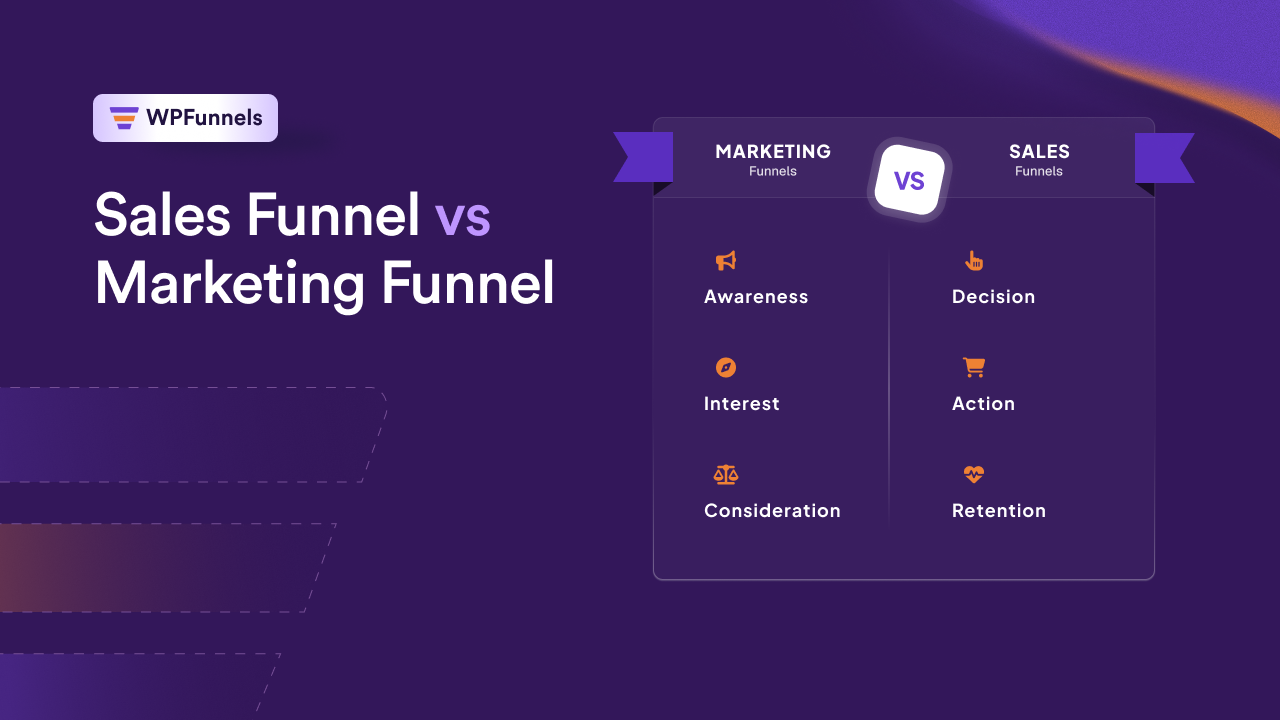
That job happens in three stages, and each one has a specific WooCommerce equivalent.
- Awareness is the first time someone encounters your store through an SEO-optimized blog post, a Google Shopping listing, a Facebook or Instagram ad, or a mention in a niche community. If you sell, say, skincare in the $20–$50 range, this might be a blog post like “Best Ingredients for Sensitive Skin in Winter” ranking for a problem your buyer already has, not a post about your product.
- Interest is where you keep them around long enough to matter. This is usually a lead magnet, a discount code for signing up, a buying guide, or a quiz, captured through a popup or landing page and followed by an automated welcome sequence. This is squarely Mail Mint territory: you set up an opt-in form and automation workflow once, and it runs the same sequence for every new subscriber without manual follow-up.
- Consideration is where trust gets built before they’re anywhere near your checkout. Product reviews, comparison content, and a short email sequence that answers the objections people actually have, like shipping cost, sizing, or your return policy, do the work here. None of this asks for a sale yet. It’s building the case so that by the time someone lands on your product page, they’re not starting from zero.
The marketing funnel’s entire value is compressed into one outcome: it should deliver a visitor to your product page who already half-believes buying from you is a good idea. Everything after that point is a different job.
For Further Reading: We’ve covered the Awareness and Consideration stages in more depth elsewhere: Top of the Funnel Marketing
What a Sales Funnel Actually Covers (It’s Not Just Checkout)
Here’s where you can easily get the wrong idea: thinking of the sales funnel as the checkout page. Checkout is definitely part of it, but it’s only one step in a longer sequence. In reality, some of the biggest opportunities to increase your revenue happen right before or right after checkout, not on the payment form itself.
Your sales funnel picks up exactly where your marketing funnel leaves off. By this point, someone is already looking at a specific product with real buying intent, and your job is to help them complete the purchase and come back again.
- Decision is the product page and cart. This is where anchor pricing, urgency (a genuine low-stock notice, not a fake countdown), and social proof either close the gap or lose the sale. If someone adds a $35 product to your cart and abandons it, the fix isn’t more blog content. It’s figuring out what made them hesitate at that exact moment.
- Action is checkout itself, plus everything that happens around it. This is where order bumps (a small, relevant add-on offered before payment) and one-click upsells (a related, higher-value offer shown immediately after purchase) do their work. A $12 order bump offered alongside a $35 purchase, even if only a modest percentage of buyers accept it, can add more revenue over a month than many content campaigns because you’re not paying to acquire that customer twice. This is exactly what WPFunnels is built for: mapping your checkout-to-upsell journey visually instead of stitching it together with plugins that don’t talk to each other.
- Retention is everything that happens after the order confirmation page. An abandoned cart doesn’t mean your sales funnel has ended. A recovery email sequence through Mail Mint, sent a few hours later and followed up the next day, can recover orders that would otherwise be lost. And when someone does complete a purchase, a follow-up sequence, whether it’s a reorder reminder for consumable products or a personalized recommendation based on what they bought, is what turns a one-time order into repeat revenue instead of a one-time transaction.
Pro Tip: If you have real dashboard numbers, a 30-day order bump acceptance rate or an actual cart recovery percentage says more than any industry benchmark. Swap it in here once you’ve got it.
Related Read: Order bumps specifically deserve their own breakdown, and we’ve written one: What Types of Order Bump Increase AOV in eCommerce. If cart abandonment is your bigger leak, this one’s worth a look too: 8 Effective Cart Abandonment Strategies To Recover Lost Sales.
Sales Funnel vs Sales Pipeline: A Different Question Entirely
These two terms get mixed up all the time, but they solve completely different problems.
A sales funnel focuses on how someone moves from discovering your products to completing a purchase. A sales pipeline focuses on how you track and manage sales opportunities before a deal is closed.
If you sell directly through your WooCommerce store, your priority is almost always your sales funnel. A sales pipeline becomes relevant when your sales process includes discovery calls, proposals, negotiations, or account managers before someone can buy.
Here’s a quick comparison.
| Sales Funnel | Sales Pipeline | |
|---|---|---|
| Describes | The customer’s journey toward a purchase | Your team’s process for managing deals |
| Who’s involved | The shopper, mostly on their own | A salesperson actively working the deal |
| Typical for | Direct WooCommerce checkout, browse-to-buy | High-ticket sales, demos, quote requests |
| Tracked in | Funnel analytics, conversion rate, AOV | A CRM, by deal stage and close rate |
| Relevant to most WooCommerce stores? | Yes, almost always | Only if selling a high-ticket add-on alongside the store |
For example, if someone can browse your products, add them to their cart, and complete the purchase without talking to you, improving your sales funnel will usually have the biggest impact on your revenue.
If most of your sales start with a quote request, a product demo, or a conversation with your sales team, your sales pipeline becomes just as important because that’s where every opportunity is managed before the deal is closed.
For higher-ticket or B2B sales, building that pipeline also means identifying the right companies and decision-makers before an opportunity enters the funnel.
Sales teams can use tools such as GTM AI to research accounts, find relevant contacts, surface buying signals, and enrich prospect data, giving them better information when deciding which opportunities to pursue.
Good to Know: If your store also sells a higher-ticket offer that needs qualifying leads before they buy, that’s a different funnel entirely, and it gets its own guide: Application Funnel for High Ticket Business Leads.
Marketing Funnel vs. Sales Funnel: Key Differences at a Glance
| Marketing Funnel | Sales Funnel | |
|---|---|---|
| Job | Attract and warm up strangers | Convert warm shoppers into buyers |
| Stages | Awareness, Interest, Consideration | Decision, Action, Retention |
| Main channels | Blog, SEO, social, ads, email sequences | Product pages, checkout, order bumps, upsells |
| Key metrics | Traffic, leads captured, email engagement | Conversion rate, cart abandonment, AOV |
| Tool that owns it | Mail Mint | WPFunnels |
| Fix speed | Slower, compounds over months | Usually faster, visible within weeks |
Which Funnel Drives More Conversions?
Neither wins by default. It depends entirely on which one is currently leaking, and the math looks different depending on which side you fix.
Say your store gets 10,000 visitors a month and converts at a typical 2.5%, roughly 250 orders. At a $35 AOV, that’s $8,750 before touching either funnel.
Fix only the sales funnel (that $12 order bump lifting AOV by 20%, to around $42) and the same traffic becomes around $10,500 a month. Same visitors, same ad spend. This is usually the faster win, since you’re not paying to acquire anything new, you’re recovering revenue from people who already showed up.
Fix only the marketing funnel (a working Interest stage, better nurture emails) and you might convert more of those 10,000 visitors into leads and eventual buyers. But each order is still worth $35, and every new customer still costs full acquisition spend. This win shows up slower, and it compounds over months rather than next week’s dashboard.
Fix both, and the repeat customers your marketing funnel keeps warm start buying again at the higher AOV, without costing acquisition spend a second time. That compounding is the honest answer to “which drives more conversions” over any real time horizon.
Key Takeaway: Short term, sales funnel fixes usually win on speed, they’re cheaper to test and faster to see. Long term, it’s whichever one was actually broken, fixed properly. Neither is universally “more important.” The diagnostic below tells you which one is yours.
Which Funnel Is Actually Broken? A Quick Diagnostic
Before you spend more time or money improving either funnel, figure out which one is actually underperforming.
The right fix depends on where your WooCommerce store is losing potential customers, and the cost of guessing wrong is real: weeks spent fixing a funnel that was never broken.
If your product pages are getting visits but your conversion rate is low, or your cart abandonment rate is high, your marketing funnel has already done its job. It got someone there.
The leak is in your sales funnel: checkout friction, no compelling reason to add one more item, or no follow-up when they leave without buying. This is usually the cheaper, faster fix, because you’re not paying for new traffic to test it.
On the other hand, if your product pages barely get any visits at all, your marketing funnel is the bottleneck. No amount of order bump optimization fixes a store nobody’s finding.
That points to your content, ad targeting, or lead capture strategy, not your checkout flow.
| Symptom | Funnel that’s broken | Fix first |
|---|---|---|
| Under 500 sessions a month | Marketing funnel | Content, ads, lead capture |
| Traffic is fine, conversion rate is low | Sales funnel | Product page, checkout, order bumps |
| Cart abandonment above 70% | Sales funnel | Checkout friction, recovery emails |
| Fewer than 1 in 10 customers buy again | Both | Post-purchase emails + a reorder or loyalty incentive |
| AOV flat for 3+ months despite steady sales | Sales funnel | Add one order bump before anything else |
Once your store starts getting consistent traffic, it’s easy to keep focusing on the marketing funnel because that’s where you’ve been investing your time.
But that doesn’t always mean it’s still the problem. There’s a good chance your sales funnel is quietly leaving money on the table instead.
Checking your cart abandonment rate and AOV against the benchmarks for your niche is a much faster diagnostic than guessing where the leak is.
Pro Tip: You don’t need a full audit to start. A few minutes with an AI assistant like Claude or ChatGPT can point you at the right stage before you touch anything. Try this prompt, filled in with your own numbers:
“I run a WooCommerce store selling [your product] at an average price of $[X]. My monthly traffic is [X], my conversion rate is [X]%, and my repeat purchase rate is [X or ‘unknown’]. Based on the marketing funnel (awareness, interest, consideration) versus sales funnel (decision, action, retention) framework, tell me which funnel stage is most likely leaking revenue, and suggest three concrete fixes I could test this month.”
It won’t replace testing, but it’s a faster starting point than a hunch.
This quick diagnosis won’t tell you everything, but it will usually tell you where to start. Once you know which funnel needs the most attention, the next step is making sure your marketing funnel and sales funnel work together instead of pulling in different directions.
How to Align Your Marketing and Sales Funnels in WooCommerce
Once you’ve identified which funnel needs the most attention, the next step is making sure the two are working together instead of against each other.
- Follow your customer’s journey. Click through your own blog posts, ads, or emails and see where they actually land. If someone clicks an email about a specific product but lands on your homepage, you’ve already lost some of the buying intent you worked to build.
- Match your offer to the funnel stage. Educational content works best when someone is still researching. Once they reach your product page or checkout, that’s the right time for order bumps and one-click upsells.
- Don’t stop after the first purchase. A reorder reminder, a complementary product recommendation, or a follow-up email gives customers a reason to come back instead of making every order a one-time sale.
- Measure each funnel separately. Traffic, lead generation, and email engagement tell you how your marketing funnel is performing. Conversion rate, AOV, cart abandonment, and repeat purchases tell you whether your sales funnel is doing its job.
Most revenue leaks don’t come from a completely broken marketing funnel or sales funnel. They usually happen where the two connect.
a landing page that doesn’t match the ad someone clicked, an offer introduced too early, or a missing follow-up email might seem like small issues on their own. Repeated across every visitor who comes through your store, they can have a much bigger impact on your revenue than you realize.
This deserves its own guide, and we’ve written one: Customer Retention Email goes deeper into the follow-up sequences mentioned above. If you’re starting from scratch, How to Create a Sales Funnel for eCommerce walks through the build itself.
Tools to Build and Optimize Your Marketing and Sales Funnel
Understanding the difference between a marketing funnel and a sales funnel is only the first step. The next step is using the right tools at the right stage of your customer’s journey.
Here are the tools I’d recommend for building and optimizing both funnels on your WooCommerce store.
WPFunnels (Funnel Mapping & Building)
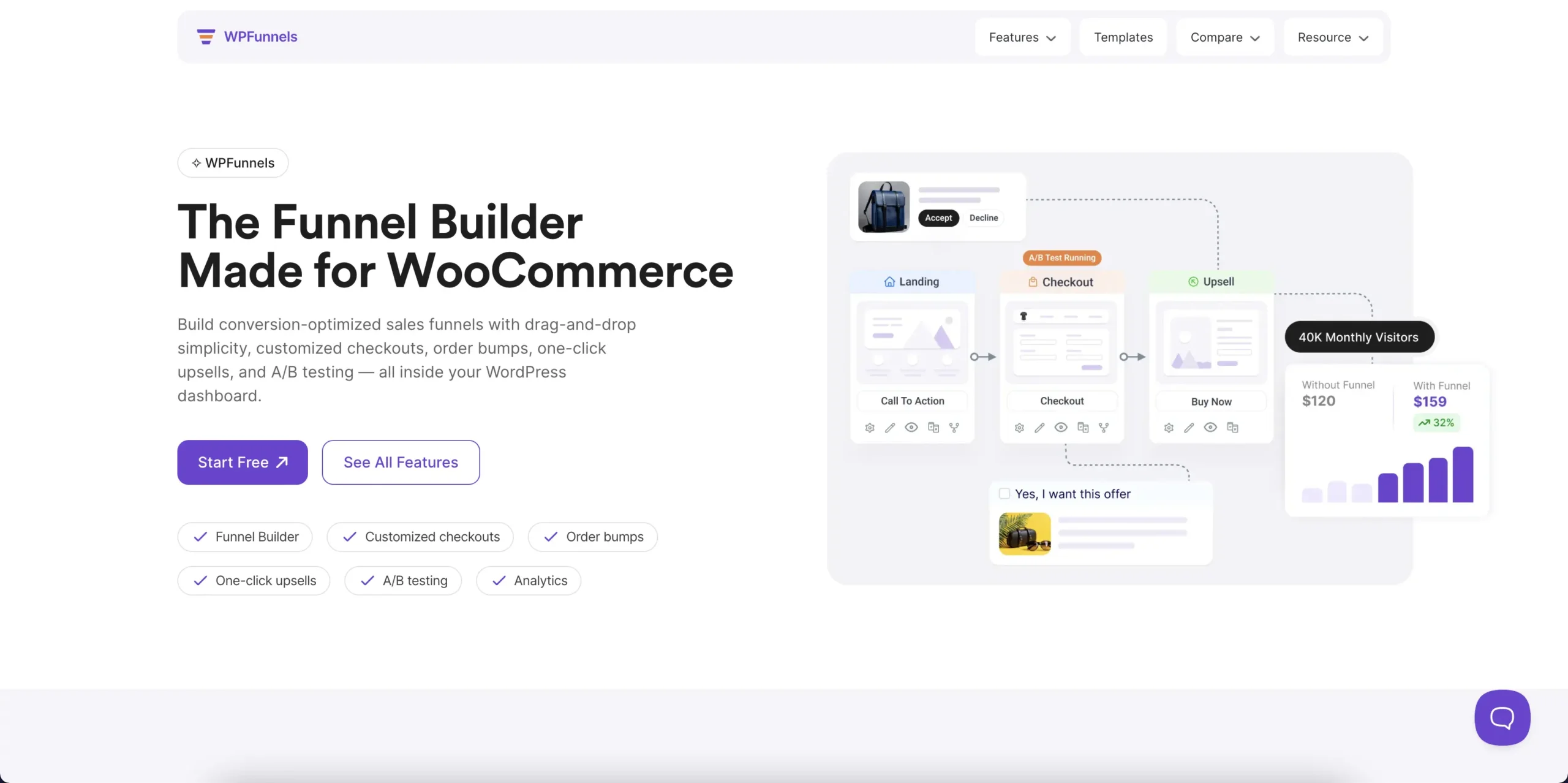
If your WooCommerce store is already getting traffic but too many shoppers leave without completing their purchase, WPFunnels is worth a look.
Instead of relying on the default WooCommerce checkout, you can build a complete buying journey that fits the way you want to sell. From landing pages and checkout to order bumps, one-click upsells, and thank-you pages, everything is planned on a visual drag-and-drop canvas inside your WordPress dashboard.
Because it’s built specifically for WooCommerce, your products, checkout, and payment flow work together out of the box. You don’t have to rely on multiple plugins or a hosted funnel platform just to create a better buying experience.
WPFunnels Key Features
- Storewide Checkout – Replace the default WooCommerce checkout with a cleaner, conversion-focused checkout experience.
- Order Bumps & One-Click Upsells – Offer relevant products before and after checkout to increase average order value.
- Conditional Funnels – Show different offers based on what’s in the customer’s cart, the products they’re buying, or their cart total.
- Visual Funnel Canvas – Build and manage your entire funnel from an easy-to-follow drag-and-drop canvas.
- A/B Testing & Analytics – Compare different funnel variations and track conversions, revenue, and average order value.
- Integrations – Works with Gutenberg, Elementor, Divi, Bricks, Oxygen, and Mail Mint.
WPFunnels Pros
- Built specifically for WooCommerce
- No coding required
- Easy to build and manage complete sales funnels
- Helps increase conversions and average order value
WPFunnels Cons
- Requires WordPress and WooCommerce
- Free version has limits on funnels and offers
- Advanced features like A/B testing and conditional funnels require the Pro version
Price: Free version available. Premium plans start at $99/year.
Best For
WooCommerce store owners who want more control over their checkout experience, higher average order value, and an easier way to build complete sales funnels without juggling multiple plugins.
Mail Mint
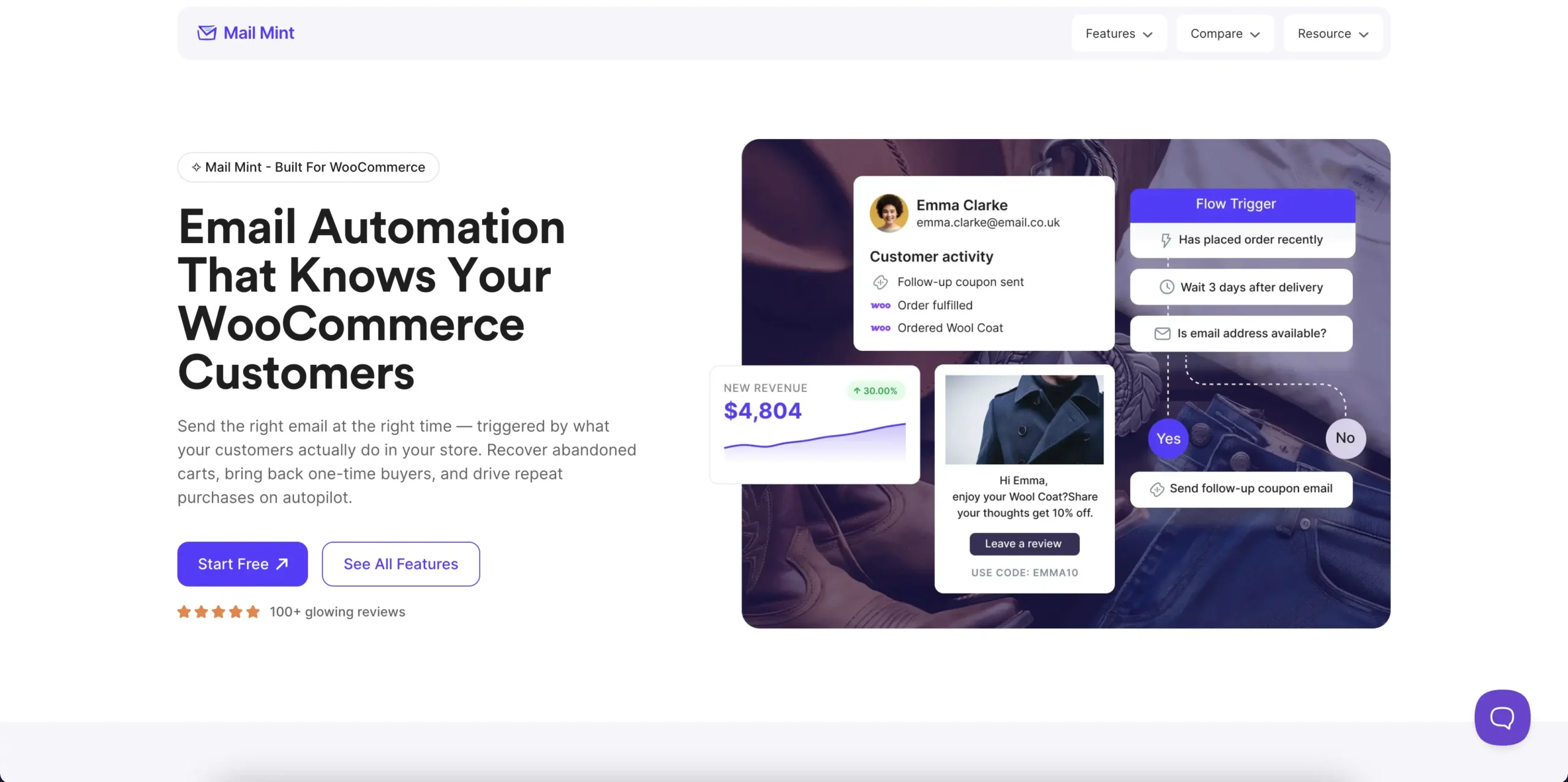
Even with a well-optimized sales funnel, not every visitor is ready to buy the first time they land on your store. Some need more information before making a decision, while others simply leave and forget to come back.
Mail Mint helps you stay connected with those shoppers through automated email marketing. You can capture new leads, send welcome emails, recover abandoned carts, recommend products after purchase, and build email sequences that continue the conversation automatically.
Because it’s built for WordPress and WooCommerce, everything works together inside your existing store. Instead of switching between different tools, you can manage your email marketing, customer follow-ups, and automation from one place.
Key Features
- Email Automation – Create automated workflows for welcome emails, abandoned carts, and post-purchase follow-ups.
- Lead Capture – Grow your email list with built-in opt-in forms and popups.
- Customer Segmentation – Send more relevant emails based on customer behavior and purchase history.
- WooCommerce Automation – Trigger emails automatically when customers abandon a cart, complete an order, or meet specific conditions.
- Analytics & Reporting – Track email performance, engagement, and conversions.
Pros
- Built specifically for WordPress and WooCommerce
- Easy to automate email marketing without coding
- Combines lead capture, campaigns, and automation in one plugin
- Free version available
Cons
- Only works with WordPress
- Advanced automation features require the Pro version
- Some integrations are available only on higher plans
Price: Free version available. Premium plans start at $149.99/year.
Best For
WooCommerce store owners who want to capture more leads, recover abandoned carts, automate customer follow-ups, and increase repeat purchases from existing traffic.
Revive Social
Your marketing funnel only works if new people keep discovering your store. If you’re publishing blog posts but only sharing them once, you’re probably missing out on a lot of potential traffic.
Revive Social automatically shares your blog posts across social media platforms like Facebook, X (Twitter), and LinkedIn. It can also recycle your best-performing content, helping you consistently bring new visitors into your marketing funnel without manually posting every day.
Key Features
- Automatically share WordPress posts to social media
- Recycle evergreen content
- Schedule social media posts
- Support for multiple social platforms
Pros
- Saves time on social media marketing
- Keeps evergreen content driving traffic
- Easy to set up and automate
Cons
- Focused on social media automation only
- Advanced scheduling features require the Pro version
Best For
WooCommerce store owners who want to drive more traffic to their blog posts, landing pages, and product pages through social media.
CoSchedule
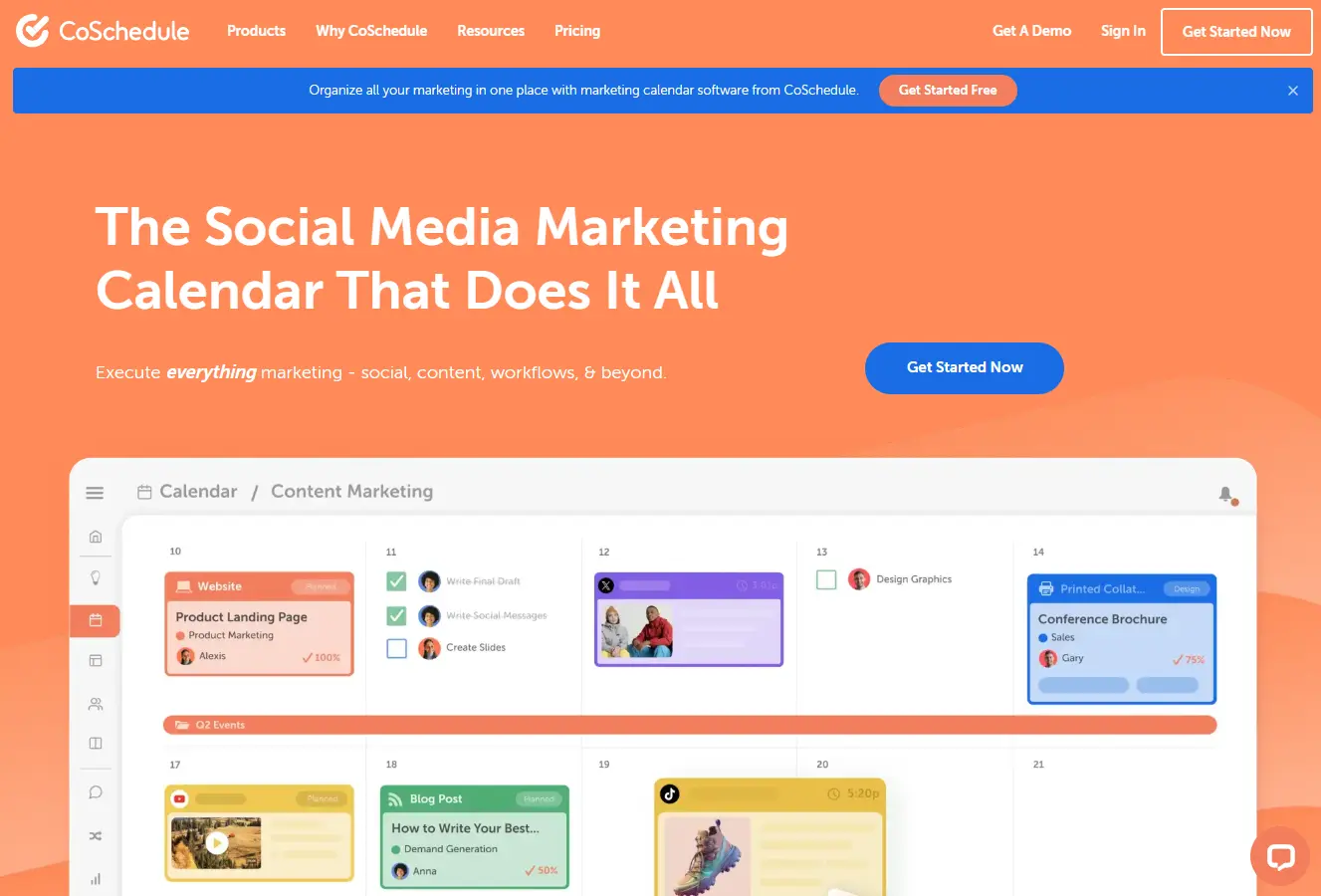
A marketing funnel needs a steady flow of helpful content. If you’re publishing blog posts inconsistently, attracting qualified visitors becomes much harder.
CoSchedule helps you plan, organize, and schedule your content from one marketing calendar. Instead of wondering what to publish next, you can build a consistent content strategy that keeps bringing new people into your marketing funnel.
Key Features
- Marketing calendar
- Content planning and scheduling
- Team collaboration
- Social media scheduling
- Performance tracking
Pros
- Keeps your content strategy organized
- Makes publishing more consistent
- Useful for managing multiple campaigns
Cons
- More features than solo store owners may need
- Premium plans can be expensive
Best For
WooCommerce store owners and marketing teams that publish content regularly and want a better way to plan and manage their marketing campaigns.
MonsterInsights
It’s difficult to improve your funnel if you don’t know where people are dropping off. That’s where MonsterInsights becomes useful.
MonsterInsights connects your WordPress site with Google Analytics and brings your most important reports into your dashboard. You can see where your traffic comes from, which pages convert the best, and where shoppers leave before completing a purchase.
Key Features
- Google Analytics integration
- WooCommerce conversion tracking
- Traffic source reports
- User behavior insights
- Dashboard reporting
Pros
- Easy way to access Google Analytics
- WooCommerce-specific reporting
- Beginner-friendly setup
Cons
- Advanced reports require the Pro version
- Relies on Google Analytics for data collection
Best For
WooCommerce store owners who want to understand how visitors move through their marketing and sales funnels and make improvements based on real data.
Final Thoughts
By now, the difference between a marketing funnel and a sales funnel should be much clearer. One helps more people discover and trust your WooCommerce store. The other turns that trust into completed purchases and repeat customers.
The important thing is knowing which one deserves your attention right now.
If your product pages already get consistent traffic but sales aren’t growing, spending more on ads or SEO probably isn’t your biggest opportunity. Improving your checkout experience, adding order bumps, or following up with abandoned carts can often have a much bigger impact, because you’re making better use of the visitors you already have.
If hardly anyone is reaching your product pages in the first place, start with your marketing funnel. Bringing qualified visitors into your store has to come before optimizing how they buy.
You don’t have to rebuild everything at once. Figure out where your customers are dropping off, fix that stage first, then move to the next bottleneck as your store grows.
Keep Reading: For a broader look at growing revenue beyond just funnel alignment, see How to Increase Sales in Your WooCommerce Store.
Frequently Asked Questions
What’s the difference between a marketing funnel and a sales funnel?
A marketing funnel helps people discover your WooCommerce store and builds enough trust for them to consider buying from you. A sales funnel takes over once they’re ready to buy, guiding them through checkout, increasing average order value, and encouraging repeat purchases.
Which funnel actually drives more conversions?
Neither one, by default. Sales funnel fixes usually show results faster since you’re converting traffic you’ve already paid for. Marketing funnel fixes take longer but compound over time. The one that “drives more conversions” for your store is whichever one is currently broken, fixing the wrong one won’t move your numbers regardless of which you pick.
How do I know whether my marketing funnel or sales funnel needs attention first?
Start by looking at your product page traffic. If people are visiting your products but not buying, your sales funnel is usually the problem. If very few people are reaching your product pages in the first place, your marketing funnel is where you should focus first.
Is a sales funnel the same as a sales pipeline?
No. A sales funnel follows your customer’s journey from discovering your store to completing a purchase. A sales pipeline helps a business track and manage sales opportunities before a deal is closed. If customers buy directly from your WooCommerce store, your sales funnel is usually far more important than a sales pipeline.
Do I need different tools for my marketing funnel and sales funnel?
Not necessarily, but they usually solve different problems. Marketing funnel tools help you attract visitors, capture leads, and nurture them through email. Sales funnel tools help you optimize checkout, increase average order value, and convert more shoppers into customers. Using tools designed for each stage usually gives better results than trying to make one tool do everything.
What’s the quickest way to improve conversions if my WooCommerce store already gets traffic?
Look at your sales funnel before spending more on marketing. A high cart abandonment rate, a low average order value, or a complicated checkout often creates bigger opportunities than bringing in more visitors. Small improvements, like adding an order bump or setting up abandoned cart emails, can make a noticeable difference.
Can a marketing funnel work without a sales funnel?
Not for long. Your marketing funnel can bring people to your store, but your sales funnel is what turns that interest into actual sales. Without a smooth path from your product page to checkout, you’ll attract visitors but struggle to convert them into paying customers.