


As an online instructor, you know how tough it is to stand out. With so many experts offering similar skills, it’s hard to attract the right clients.
So, how can you prove you’re the best choice?
A Challenge Funnel might be the answer. It’s a proven strategy that’s helped many marketers build trust, attract quality leads, and even become millionaires.
Considering that 54% of marketers struggle to improve lead quality, this could be your game-changer.
In this guide, I’ll first show you how to build a challenge funnel from scratch. Then, we’ll look at five successful challenge funnel examples and see what made them work.
Let’s get started.
Quick Answer: A challenge funnel is a marketing funnel that uses a free multi-day challenge to attract participants, build trust, and help them achieve a quick win. At the end of the challenge, participants are introduced to a related paid product, course, coaching program, or membership.
TL;DR – Things To Learn From Successful Challenge Funnel Examples
- A Challenge Funnel is a short, high-value experience (usually 5-10 days) designed to get the audience a specific quick win related to your core product.
- The primary goal is to build deep trust and demonstrate your expertise by delivering tangible results before asking for a significant financial commitment.
- The funnel relies on immediate, easy-to-digest content (daily tasks/videos) to maximize participation and keep the audience engaged and moving toward completion.
- Challenges serve as a powerful lead magnet and pre-sell event, naturally leading participants to enroll in your high-ticket program (the core offer) as the logical next step.
- Successful challenges require a dedicated landing page, seamless payment processing, a private community group for accountability, and clear daily content delivery.
- Examples like the “One Funnel Away Challenge” prove this model effectively converts high volume, low-cost entries into motivated buyers for premium courses and coaching.
- To create funnels, you will need a reliable tool (such as WPFunnels) that gives you more visual control. You can recommend such a tool to your clients.
What is a Challenge Funnel?
As John Paul said, “You prove your worth with your actions, not with your mouth.” Simply saying you’re an expert isn’t enough, you have to show it.
That’s where a challenge funnel comes in. It’s a proven strategy where you guide your audience through a short challenge designed to help them achieve a specific result.
For example, As a fitness coach, you offer a free 7-day “Morning Energy Boost Challenge.”
Participants commit to 15 minutes of guided morning exercises each day, designed to increase energy and focus.
At the end of this fitness marketing challenge, they feel the results and trust your expertise. This builds a strong foundation for you to pitch a longer fitness program.
Benefits of Using a Challenge Funnel
- Build trust: By guiding participants to achieve a small win, you prove your expertise through actions, not words. This helps establish credibility and confidence in your abilities.
- Attract participants: A clear goal and a simple signup page make it easy for people to join. This approach excites them about the challenge and increases your reach.
- Show value: Offering free, actionable content showcases your knowledge and abilities while delivering tangible results your participants can appreciate.
- Convert leads: When participants achieve their desired results, they’re more likely to trust you and invest in your services or programs.
- Works everywhere: Challenge funnels are versatile and can be adapted to any business type, whether you’re a coach, trainer, or entrepreneur.
- Build loyalty: Regular follow-ups and engagement after the challenge keep participants connected, turning them into long-term clients or advocates.
Steps to Create Your First Challenge Funnel
Here’s how you can create your first challenge funnel in simple steps:
- Set a Specific Goal: Decide on a clear goal or problem your challenge will solve. Focus on something that promises a small win for participants.
- Create Engaging Free Content: Design content that guides your audience step-by-step over a few days. Make it actionable and easy to follow.
- Build a Signup Page: Create a signup page where participants can join your challenge. A simple, clear page is key to attracting more participants.
- Showcase Your Expertise: Share daily instructions or tips, like a digital calendar with bookmarked tasks, to help participants achieve their desired results.
- Build Trust: After the challenge, follow up with participants to confirm they got the promised outcome. This reinforces your value.
- Convert Leads to Clients: Offer a special discount or bonus for participants who want to take the next step with your service.
- Drive Action: Continue nurturing participants with helpful tips and encouragement to turn them into loyal clients.
How to Build a Challenge Funnel Using WPFunnels + Mail Mint
If you’re using WordPress, you don’t have to build each piece separately. With WPFunnels and Mail Mint, you can create your funnel pages, automate your emails, and guide participants from signup to your final offer, all from one place.
Let’s see how the whole process works.
Step 1: Create the Landing Page
The first thing you need is a landing page where people can register for your challenge. This is where you’ll explain what the challenge is about, what participants will learn, and why they should join.
To get started,
- Go to WPFunnels from your WordPress dashboard.
- Click Funnels.
- Click Add New Funnel.
You’ll now see two options:
- Start from Scratch
- Import Template
For this tutorial, we’ll use Import Template because it’s much faster and gives us a professionally designed funnel that we can customize.
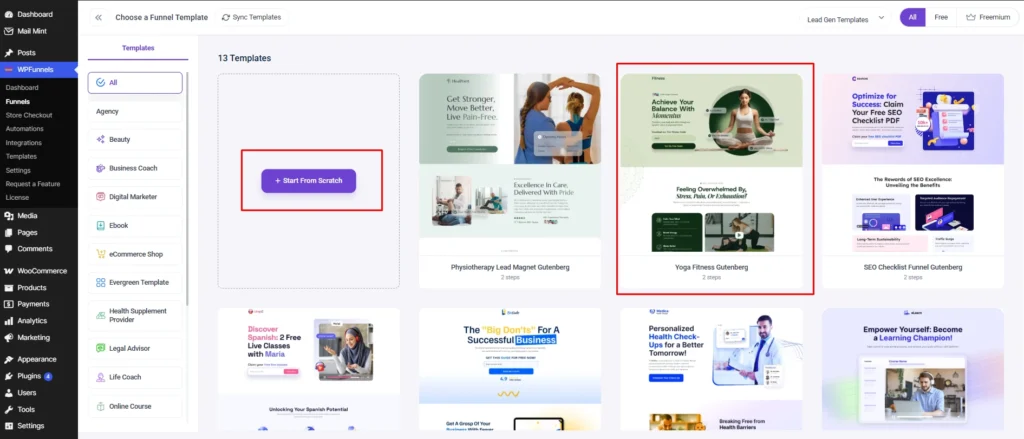
Choose a template that matches your goal and click Import.
Once the template is imported, you’ll be redirected to the WPFunnels Visual Canvas. This is where you’ll build and manage your entire funnel.
By default, you’ll see two steps:
- Landing Page
- Thank You Page
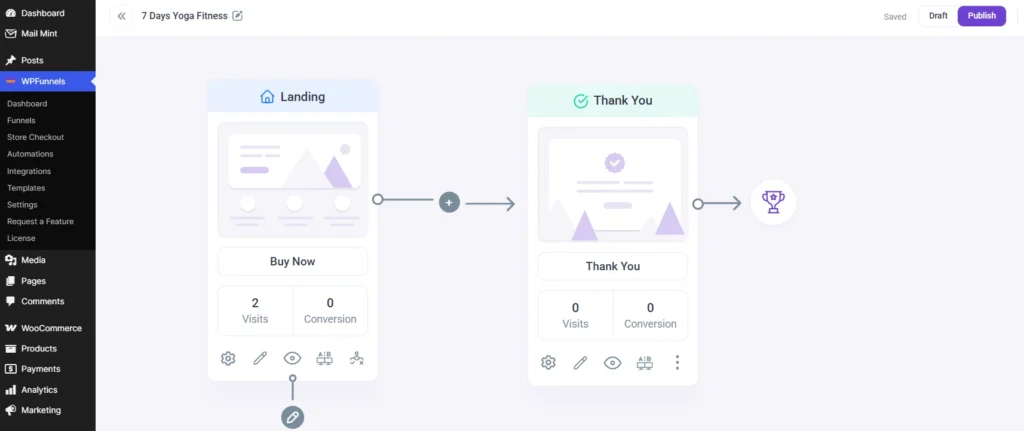
Now it’s time to customize the landing page.
Hover over the Landing Page step and click the Edit icon.
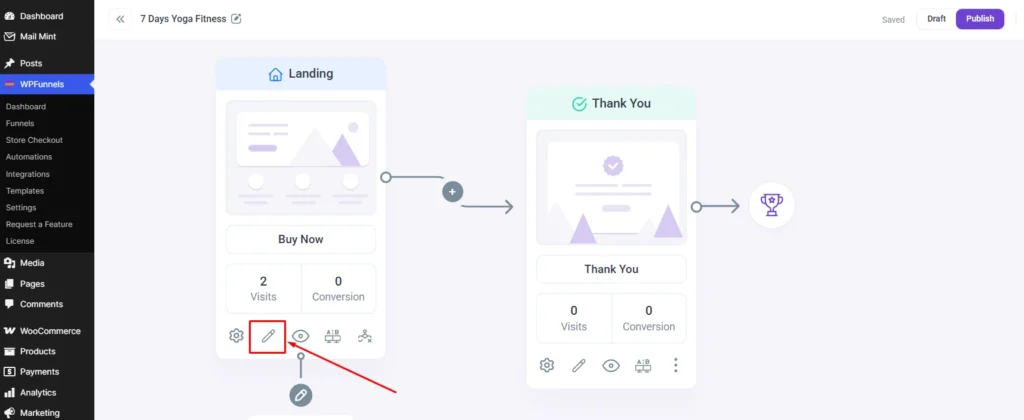
This will open the page in your preferred page builder. Replace the default content with information about your own challenge.
Here’s what you should update:
- The headline
- The subheadline
- The challenge benefits
- The call-to-action button
- Images and branding
- Any placeholder text
Don’t worry about the signup form yet. We’ll create it in Mail Mint and connect it to this page in the next step.
Step 2: Create a Signup Form
Now that your landing page is ready, it’s time to create a signup form so visitors can register for your challenge.
To create a form in Mail Mint:
- Go to Mail Mint from your WordPress dashboard.
- Click Forms.
- Click Create Form.
You’ll now see two options:
- Start from Scratch
- Use a Template
You can choose either option depending on your preference. For this tutorial, we’ll use a pre-built template to save time.
Select the template you want to use and click Import.
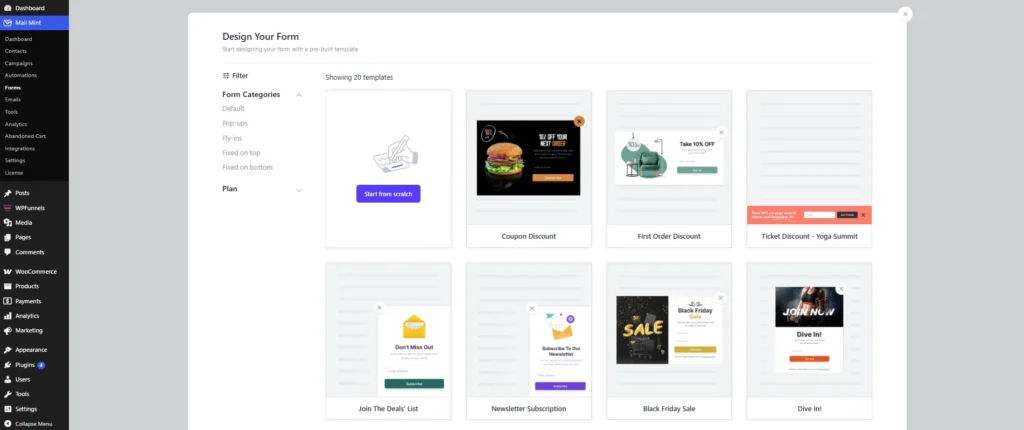
Once the template is imported, you’ll be taken to the form editor where you can customize the form for your challenge.
Here, you can:
- Update the form title.
- Add or remove form fields.
- Customize the submit button text.
- Adjust the styling to match your landing page.
For most challenge funnels, collecting the participant’s name and email address is all you need. Keeping the form short usually results in more signups.
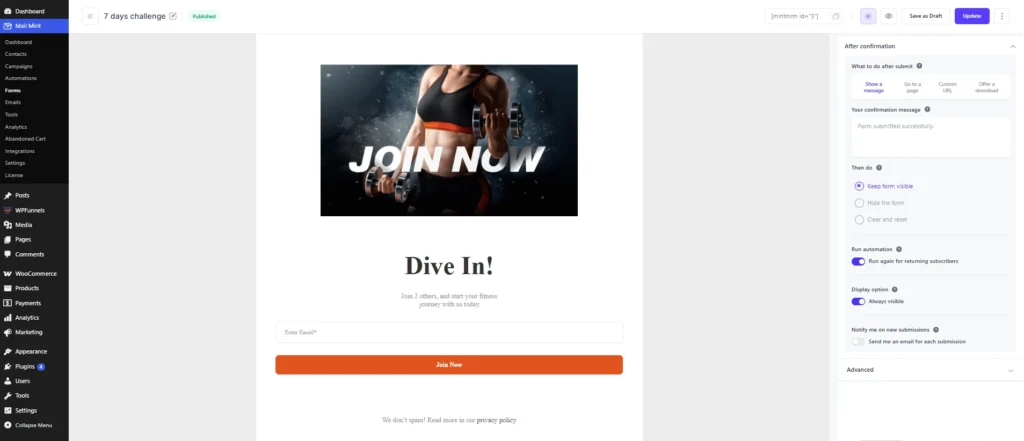
Once you’ve finished customizing the form, click Save. In the next step, we’ll add this form to the landing page so visitors can start registering for your challenge.
Now it’s time to place the form on your landing page.
Go back to your landing page in WPFunnels and open it in your preferred page builder.
Then,
- Search for the Mint Form widget or block.
- Drag it to the section where you want the signup form to appear.
- From the settings panel, select the form you just created.
- Click Update or Publish to save your changes.
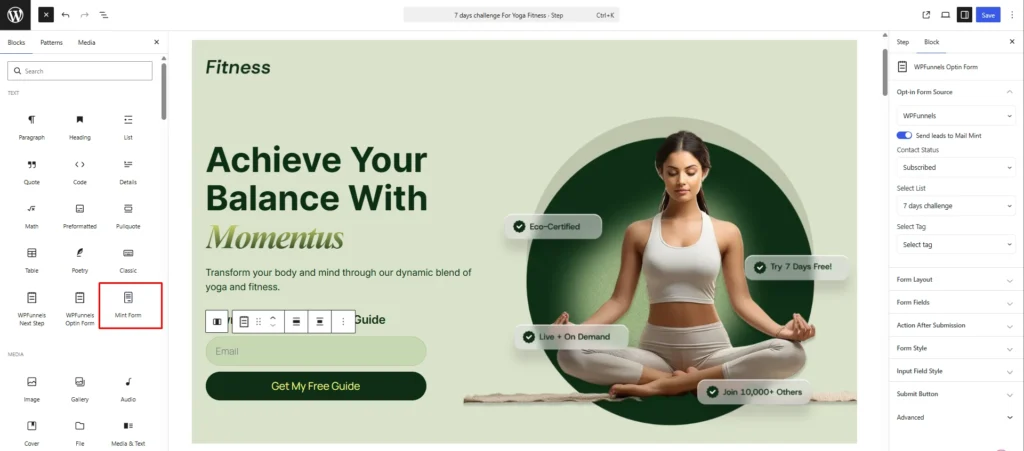
That’s it. Your landing page is now connected to Mail Mint. Whenever someone fills out the form, they’ll automatically be added to your Mail Mint contact list and become ready to receive your challenge emails.
In the next step, we’ll customize the Thank You page and prepare it for new participants after they sign up.
Step 3 — Create the Thank You Page
Once your signup form is connected, the next step is to customize the Thank You page. This is the first page participants will see after registering, so it’s a great place to confirm their registration and tell them what to expect next.
Go back to the WPFunnels Visual Canvas.
- Hover over the Thank You page.
- Click the Edit icon.
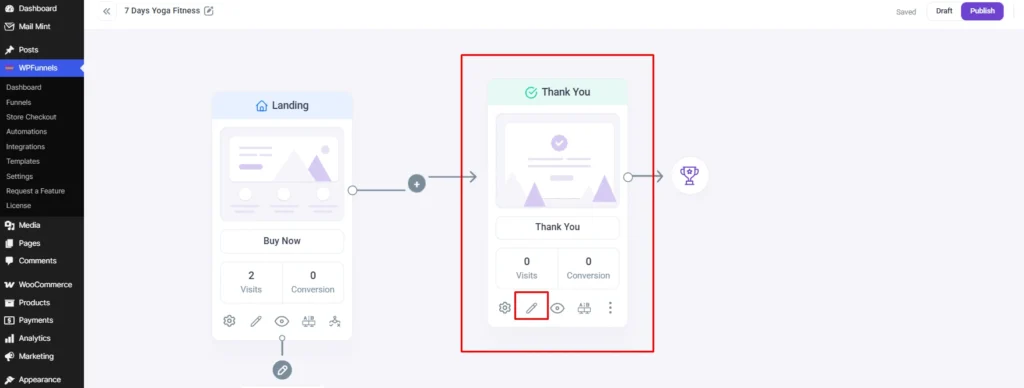
This will open the Thank You page in your preferred page builder.
Now replace the placeholder content with your own message. At a minimum, your Thank You page should:
- Confirm that the registration was successful.
- Thank participants for joining the challenge.
- Tell them when the challenge starts.
- Let them know to check their inbox for the welcome email.
- Encourage them to whitelist your email address so they don’t miss any challenge emails.
You can also use this page to invite participants to join your private Facebook group, WhatsApp community, or Discord server before the challenge begins.
Once you’ve finished editing the page, click Update or Publish to save your changes.
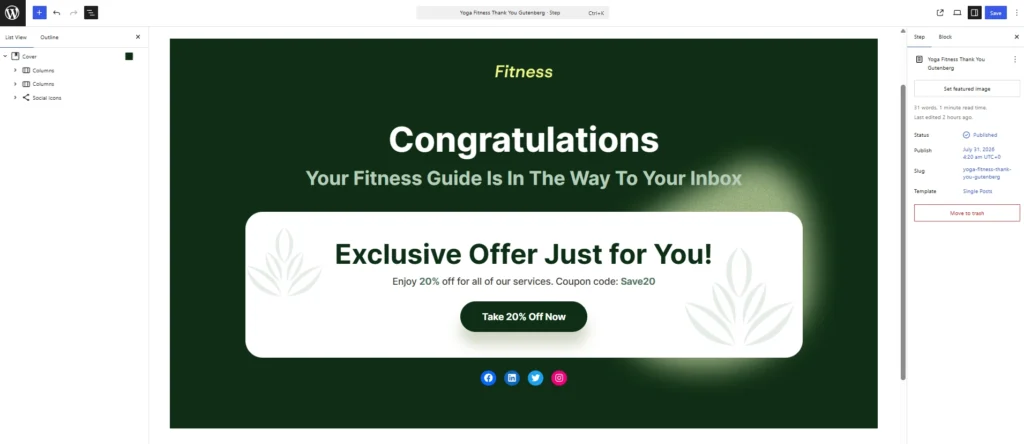
Your registration flow is now complete. When someone signs up through your landing page, they’ll automatically be redirected to this Thank You page while Mail Mint prepares to send the welcome email.
In the next step, we’ll create the email automation that delivers your challenge content automatically.
Step 4 — Build Your Email Automation
Now that the landing page, signup form, and thank you page are ready, it’s time to create the email sequence that participants will receive throughout your challenge.
There are two ways to build this automation.
- You can create each email directly from the WPFunnels Visual Canvas and connect them using automation rules.
- Or, you can create the entire email sequence from the Mail Mint dashboard and then connect it to your funnel.
For this tutorial, I’m using the Mail Mint dashboard because it makes managing multiple challenge emails much easier.
Create a Sequence Campaign
To get started,
- Go to Mail Mint from your WordPress dashboard.
- Click Campaigns.
- Open the Sequence for Automation tab.
- Click Create Emails.
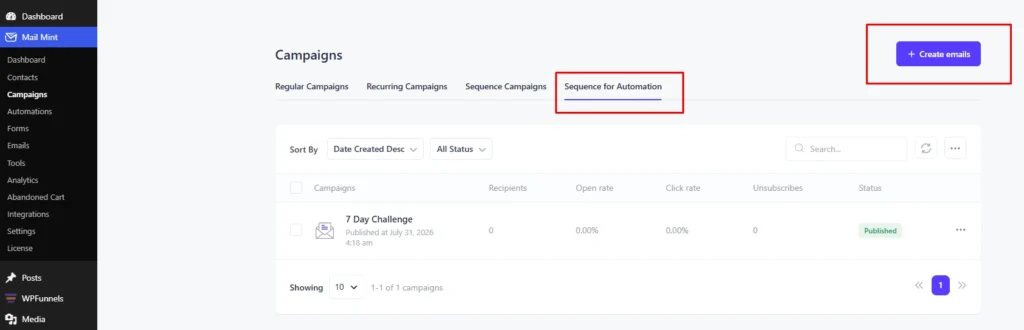
This will open the sequence campaign editor where you can create every email for your challenge.
For this example, I’m creating a 7-Day Challenge sequence. I’ll create one email for each day of the challenge, followed by a final offer email. You can create as many emails as your challenge requires.
Configure Your Emails
After creating the campaign, you’ll be taken to the email editor.
Here, update the following details for each email:
- Campaign title
- Subject line
- Preview text
- Sender name
- Reply email
- Email design
- Email content
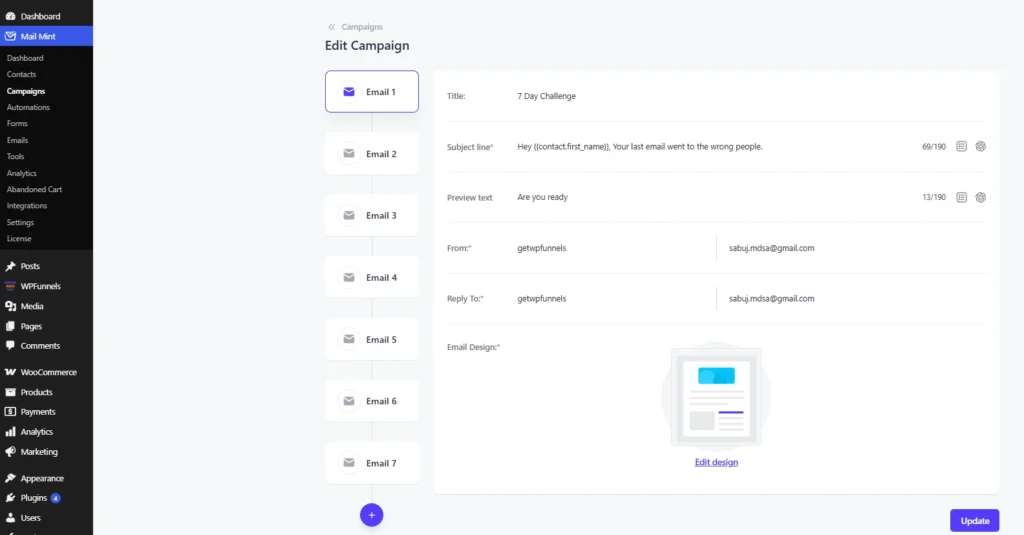
Once you’ve finished the first email, click the + button at the bottom of the email list to add the next one.
Repeat the same process until you’ve created all the emails for your challenge.
When all your emails are ready, click Update to save the entire sequence.
Your email sequence is now complete.
In the next step, I’ll return to the WPFunnels Visual Canvas and connect this sequence to the funnel.
This way, everyone who signs up for the challenge will automatically start receiving the right emails at the right time.
Step 5: Connect the Email Sequence to Your Funnel
Now that the email sequence is ready, it’s time to connect it to your funnel. This ensures that everyone who signs up through your landing page is automatically enrolled in your challenge email sequence.
Go back to the WPFunnels Visual Canvas.
Under the Landing Page, click Add Automation.
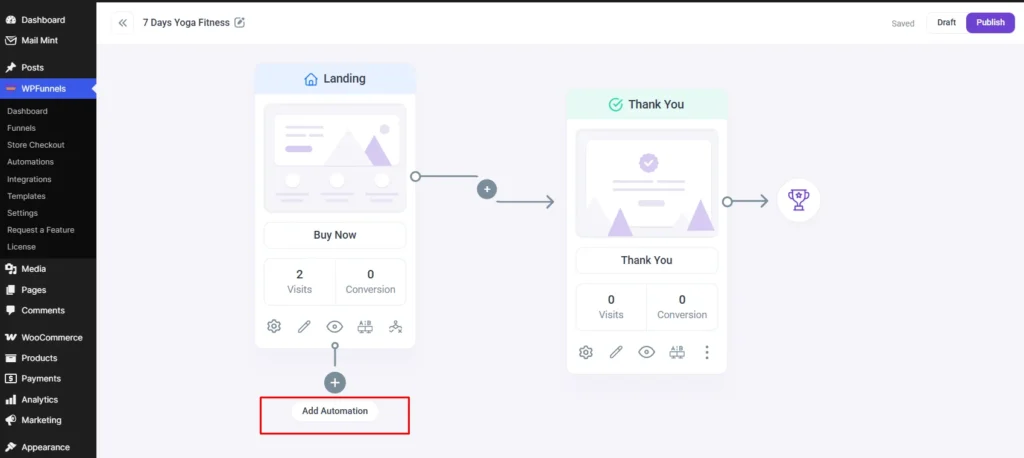
This will take you to the automation canvas where you can define what happens after someone submits the signup form.
Set the Automation Trigger
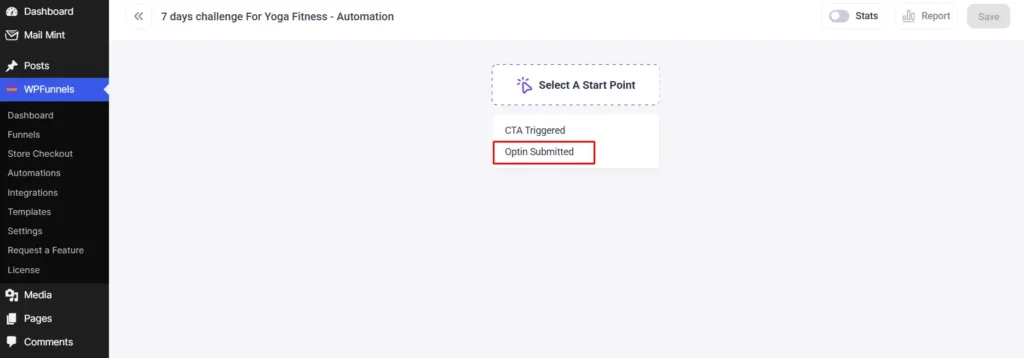
The first thing you need to do is choose a starting point for the automation.
- Click Select a Start Point.
- Choose Opt-in Submitted.
This means the automation will start whenever someone submits your signup form.
Connect Your Email Sequence
Now it’s time to decide what should happen after the opt-in is submitted.
- Click the + icon below Opt-in Submitted.
- Select Email Sequence.
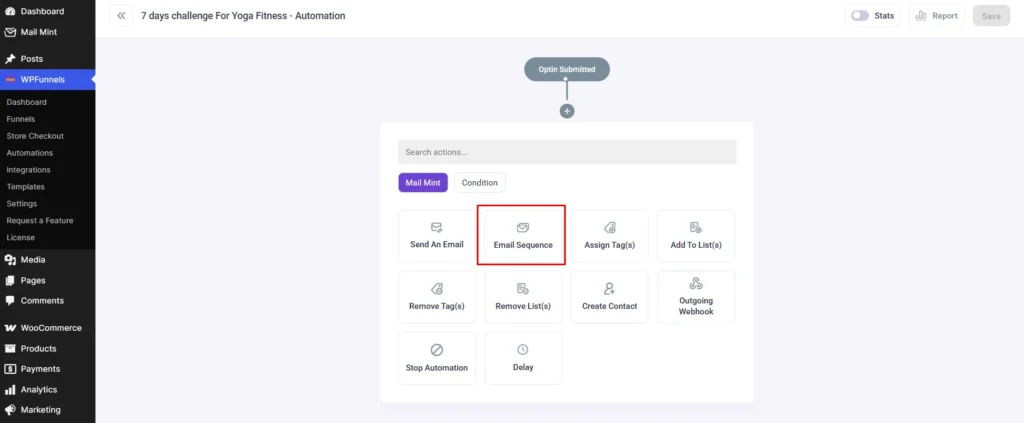
A popup will appear showing all the email sequences you’ve created in Mail Mint.
Select the 7-Day Challenge sequence that you created in the previous step and click Save.
That’s it. Your automation is now connected.
Whenever someone submits the signup form on your landing page, they’ll automatically be enrolled in your challenge email sequence and start receiving your emails based on the schedule you configured.
You Can Build More Advanced Automations
Email sequences are just one of the available automation actions. Depending on your workflow, you can also:
- Send a one-time email
- Assign tags
- Add contacts to a list
- Remove tags
- Remove contacts from a list
- Create a contact
- Add delays between actions
- Use conditions to create different automation paths
- Stop an automation when needed
You can combine these actions to build more advanced challenge funnels based on how participants interact with your emails and funnel.
Step 6: Send the Final Offer
Congratulations! Your challenge funnel is now fully set up.
As participants go through your challenge, they’ll automatically receive the emails you’ve created in your sequence. Each email should help them achieve a small win and build confidence in your expertise.
Once participants complete the challenge, it’s time to introduce your premium offer.
This could be:
- An online course
- A coaching program
- A membership
- A consulting service
- Any other paid product related to your challenge
For example, if you’re running a 7-Day Yoga Challenge, your final email could invite participants to join your premium 30-Day Yoga Program with additional training, personalized guidance, or exclusive content.
Since participants have already spent several days learning from you and seeing results, they’re much more likely to trust your recommendation and become paying customers.
The key is to make your offer feel like the natural next step. Instead of making a hard sales pitch, explain how your premium product helps participants continue the progress they’ve already made during the challenge.
Step 7: Measure Conversions
After launching your challenge, it’s important to monitor how your funnel is performing. Tracking your results helps you understand what’s working and where you can make improvements before running your next challenge.
To view your funnel analytics:
- Go back to the WPFunnels Visual Canvas.
- Click the Analytics icon in the top-right corner.
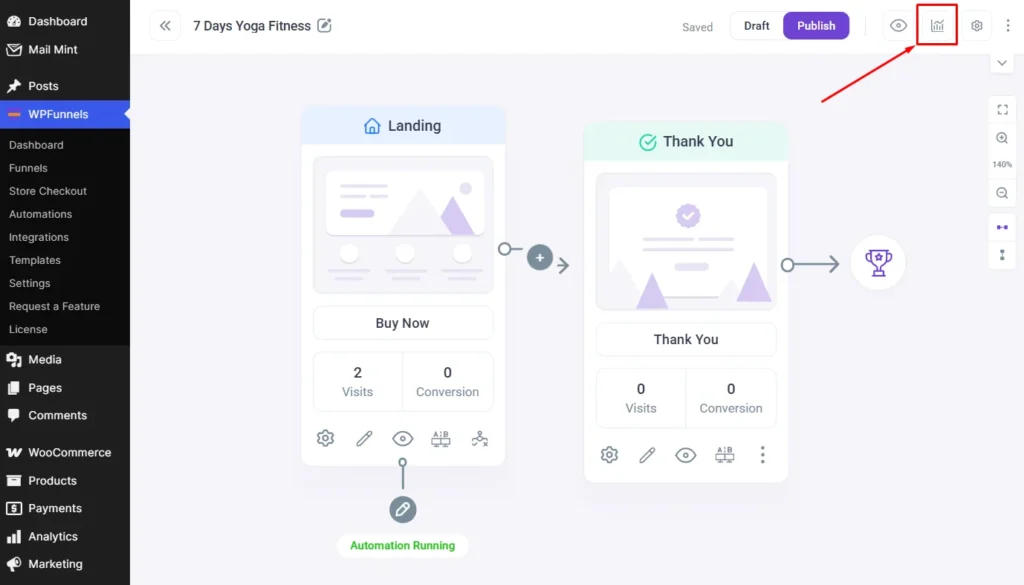
This will take you to the Analytics Dashboard, where you can monitor your funnel’s performance in one place.
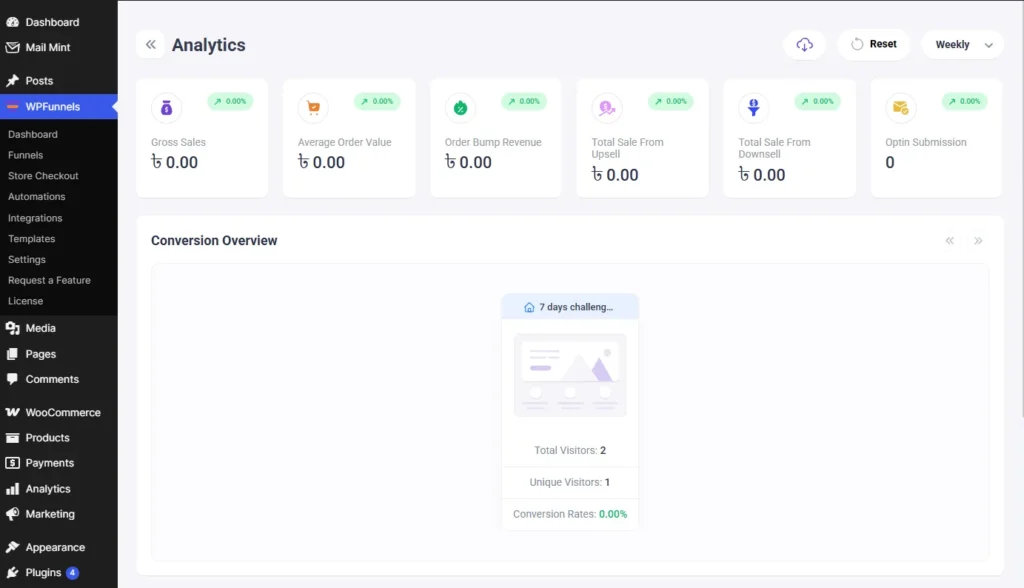
From here, you can track important metrics such as:
- Gross sales
- Average order value
- Order bump revenue
- Upsell revenue
- Downsell revenue
- Opt-in submissions
- Total visitors
- Unique visitors
- Landing page conversion rate
These insights help you identify how people are interacting with your challenge funnel.
For example, if you’re getting plenty of visitors but very few opt-in submissions, you may need to improve your landing page.
If lots of people complete the challenge but very few purchase your premium offer, you might need to refine your final sales email or offer.
Make it a habit to review your analytics after every challenge.
Small improvements to your landing page, emails, or final offer can significantly increase your conversion rate over time.
5 Successful Challenge Funnel Examples That were Super Successful
Following are five challenge funnel examples that have delivered way more leads & clients than expected.
- Russell Brunson’s One Funnel Away Challenge
- Tony Robbins’ 7-Day Challenge
- Jenna Kutcher’s List to Launch Challenge
- Amy Porterfield’s List Building Challenge
- James Clear’s Habit Builder Challenge
They all have their own unique approaches and have well-planned funnel journeys that are designed to get more results.
So let’s look at them more closely.
1. Russell Brunson’s One Funnel Away Challenge:
If you’re looking to master sales funnel building and marketing, this challenge is a great example to follow.
It guides you step by step in creating your first successful funnel, even if you’re starting from scratch.
Strategies behind sales funnel building and marketing
Russell Brunson’s One Funnel Away Challenge is a 30-day challenge designed to teach participants how to build a sales funnel from scratch.
Each day, you’ll tackle a new step, guiding you to create and optimize your funnel.
The goal is simple: help you generate more leads and sales for your business while giving you the confidence to master funnels.
It’s a hands-on approach that makes the process clear and actionable, so you can see real results by the end of the challenge.

Key tactics used in the funnel:
The challenge is structured as a series of daily video lessons, with each lesson building on the previous one.
Participants also get access to a private Facebook group where they can ask questions, get feedback, and connect with other challenge participants.
One Funnel Away Challenge Funnel Template
- Pre-Challenge: Before your first funnel challenge officially begins, you’ll get pre-training materials to prepare you for success. This includes mindset training and foundational knowledge to ensure you’re ready to tackle each step.
- Week 1 – Hook, Story, and Offer: During the first week, you’ll create a strong hook, craft a story that connects with your audience, and develop an irresistible offer. This hook story offer is the key elements that drive conversions in challenge funnels.
- Week 2 – Refining Hooks and Stories: In the second week, you’ll refine your hooks and stories to better communicate your message. This helps you build a deeper connection with your audience, making your offer even more compelling.
- Week 3 – Building the Funnel: This is where you build your first funnel challenge. You’ll create effective landing pages, sales pages, order forms, and thank-you pages. Plus, you’ll learn about different sales funnel examples and strategies to maximize conversions.
- Week 4 – Driving Traffic: In the final week, you’ll explore traffic strategies to bring the right audience to your funnel. This includes free and paid methods like social media marketing, email marketing, and advertising.
This step-by-step approach makes it easier for you to create and launch a successful funnel while building confidence in your skills.
Results achieved :
The Funnel Challenge has generated impressive results, with over 100,000 participants since its launch.
According to Russell Brunson, participants have generated over 3.8 million leads and $1.3 billion in sales through their funnels.
2. Tony Robbins’ 7-Day Challenge
This challenge funnel’s Niche or topic of the online course is Personal development and self-improvement
Strategies behind personal development challenges
Tony Robbins’ 7-Day Challenge is designed to help participants create a breakthrough in their personal or professional life.
Each day, participants are given a new challenge that helps them identify and overcome their limiting beliefs, develop new habits, and take action toward their campaign goals.

Key tactics used in the funnel:
The challenge is delivered via daily email lessons, with participants encouraged to share their progress in a private Facebook group.
Tony Robbins also offers additional resources, including live coaching sessions and access to his online courses.
Tony Robbins’ 7-Day Challenge Funnel Template:
- Awareness: Tony Robbins creates awareness about the challenge through multiple channels like his website, social media, and email lists. This is how he attracts potential participants, sparking interest in his challenge.
- Landing Page: Once you’re interested, you’re directed to a dedicated landing page. It includes compelling copy, testimonials, and videos that encourage you to sign up and join the 7-Day Challenge.
- Opt-in: On the landing page, you’ll be prompted to enter your email. This step allows Tony Robbins to capture contact info and build a list of interested participants for future engagement.
- Email Sequences: After signing up, you’ll receive daily emails for seven days. Each email includes a new challenge, along with insights and instructions from Tony Robbins to guide you through your journey.
- Private Facebook Group: You’ll be invited to a private Facebook group where you can share your progress, connect with others, and receive support from both Tony Robbins and fellow participants.
- Additional Resources: Throughout the challenge, you’ll gain access to extra resources, like live coaching sessions and exclusive content. These help you stay motivated and engaged as you go through the challenge.
- Transformation and Results: By the end of the 7-Day Challenge, you’ll experience personal transformations. Success stories and testimonials are shared, showcasing the results achieved, which helps build social proof and promotes the challenge.
Results achieved:
The 7-Day Challenge has been a massive success, with thousands of participants reporting breakthroughs and transformations in their personal and professional lives.
According to Tony Robbins, the challenge has helped participants increase their productivity, improve their relationships, and achieve greater success in their careers.
3. Jenna Kutcher’s List to Launch Challenge
This challenge funnel’s Niche or topic of the online course is Email marketing and list building.
Strategies behind Email marketing and list-building challenges
Jenna Kutcher’s List to Launch Challenge is a 5-day lead challenge designed to help participants grow their email list and launch their first digital product.
Each day, participants are given a new challenge that helps them build their email list, create a lead magnet, and develop their product ideas.

Jenna Kutcher’s List to Launch Challenge Funnel Template
- Day 1 Challenge: On day one, you’ll receive a challenge focused on the basics of email marketing and list building. This includes setting up your email marketing platform or creating an opt-in form to start growing your list.
- Day 2 Challenge: The second challenge helps you create a lead magnet, a valuable resource offered in exchange for email addresses. This is a key step in building your email list and attracting potential customers.
- Day 3 Challenge: Day three is all about developing your product idea. You’ll identify a digital product you can create and launch, setting the foundation for your future sales funnel.
- Day 4 Challenge: On day four, you’ll refine your product or create sales materials. This makes sure your product is irresistible to potential customers and ready for launch.
- Day 5 Challenge: The final challenge focuses on launching your digital product to your newly built email list. You’ll learn how to promote your product, craft persuasive emails, and set up a sales page that converts.
Throughout the challenge, you’re encouraged to share your progress and engage with others in a private Facebook group.
This fosters a sense of community and support, which makes the challenge experience more impactful.
Additionally, Jenna Kutcher offers extra resources like a free webinar on email marketing and list-building strategies. You can also gain access to her online courses for more in-depth guidance.
This sales funnel challenge is perfect for anyone looking to build and launch a digital product quickly, while also growing their email list
Key tactics used in the funnel:
The challenge is delivered via daily email lessons, with participants encouraged to share their progress in a private Facebook group.
Jenna Kutcher also offers additional resources, including a free webinar and access to her online courses.
Results achieved:
The List to Launch Challenge has helped hundreds of participants grow their email list and launch their first digital product.
According to Jenna Kutcher, participants have generated thousands of leads and sales as a result of the challenge.
4. Amy Porterfield’s List Building Challenge
This challenge funnel’s Niche or topic of the online course is List Building and Email Marketing.
Challenge funnel strategy for email marketing:
Amy Porterfield’s List Building Challenge is a perfect example of a strategy you can use to grow your email list.
Over five days, you’ll receive daily video lessons, helpful worksheets, and live Q&A sessions with Amy herself. This hands-on approach helps you build your list while gaining valuable insights along the way.
You’ll also be part of a private Facebook group, where you can connect with others, share your progress, and get support.
By the end of the challenge, you’ll feel confident in your ability to grow your list and be invited to join Amy’s email marketing course to take your skills even further.
If you’re looking to build your email list and improve your marketing, this challenge is a great way to get started.

Key tactics used in the funnel:
Some key tactics used in this funnel include a free offer, daily video lessons, live Q&A sessions, and a private Facebook group to encourage community building.
Amy Porterfield’s List Building Challenge Funnel Template
- Free Offer: The funnel starts with a free five-day challenge designed to help you grow your email list. This acts as a powerful lead magnet, attracting potential participants like you who are eager to improve their email marketing.
- Daily Video Lessons: Throughout the challenge, you’ll receive daily video lessons packed with actionable strategies. These lessons are focused on list-building and email marketing, giving you the tools to succeed.
- Worksheets: Along with the video lessons, you’ll get worksheets to help you implement the strategies and track your progress. These worksheets make the content more practical and easy to follow.
- Live Q&A Sessions: Amy Porterfield hosts live Q&A sessions where you can ask questions and get personalized guidance. This interaction ensures you stay on track and overcome any roadblocks you might face.
- Private Facebook Group: You’ll be encouraged to join a private Facebook group where you can connect with other participants. It’s a great way to share your progress, ask questions, and feel supported by a community of like-minded people.
- Invitation to Email Marketing Course: At the end of the challenge, you’ll be invited to join Amy’s email marketing course. This is the next step for you if you want to continue learning and dive deeper into mastering email marketing.
This marketing challenge is a great way to kickstart your email list-building journey, and it can easily fit into your coaching funnel template for future funnel strategies.
Results achieved:
According to Amy Porterfield, the List Building Challenge has helped her grow her email list to over 250,000 subscribers.
The challenge has also generated over $1 million in revenue for Amy Porterfield’s email marketing course.
5. James Clear’s Habit Builder Challenge
This challenge funnel focuses on personal development and habit formation, an area that’s incredibly valuable for anyone looking to improve their daily routines and build lasting habits.
Habit formation challenge funnel Strategy:
The Habit Builder Challenge is a free 30-day challenge designed to help participants build new habits and improve their daily routines.
The challenge includes daily emails from James Clear with guidance and support, along with access to a private Facebook group where participants can connect and share their progress.
Participants are also given the option to purchase James Clear’s book, “Atomic Habits,” at the end of the challenge.
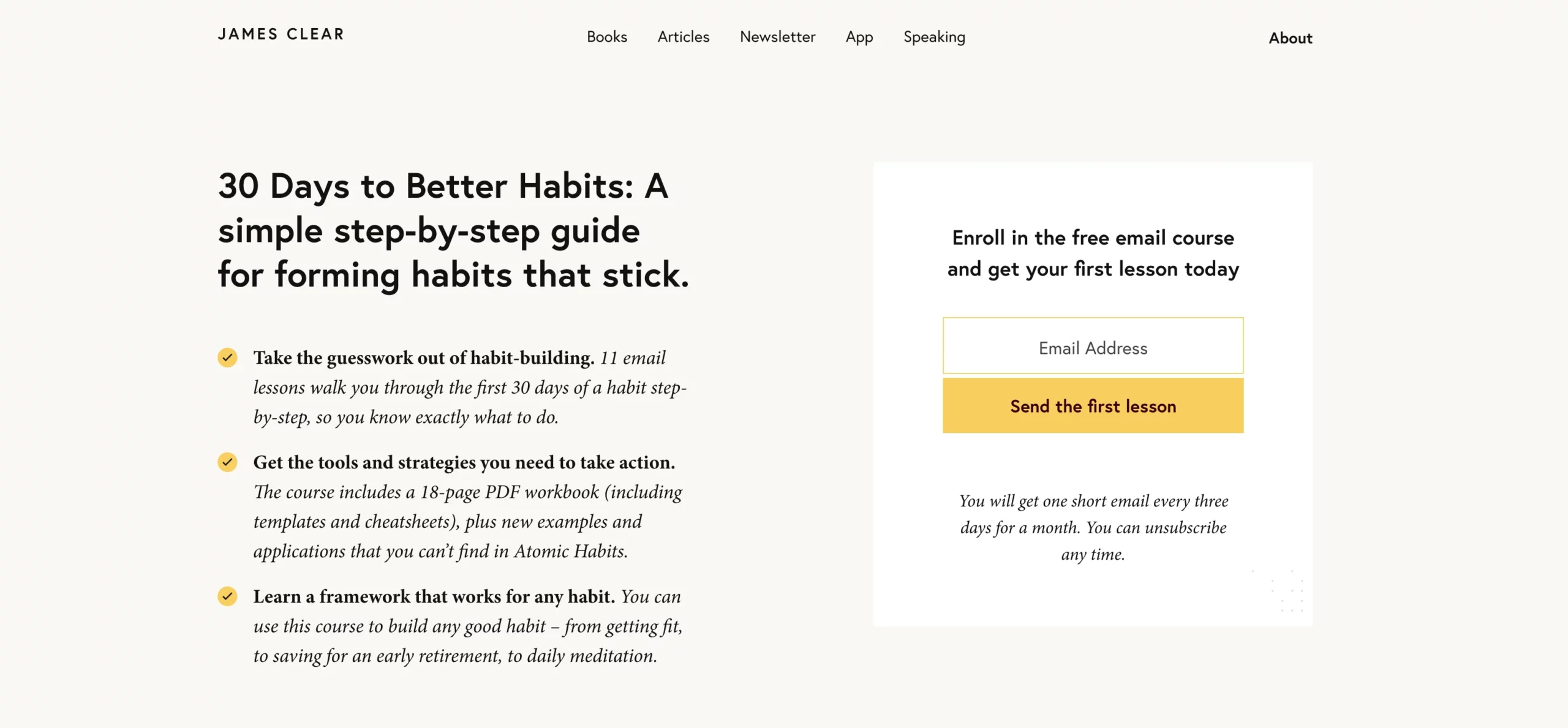
Key tactics used in the funnel:
Some key tactics used in this funnel include a free offer, daily emails, access to a private Facebook group, and an upsell to purchase James Clear’s book.
James Clear’s Habit Builder Challenge Funnel Template
- Free Offer: The challenge begins with a free 30-day Habit Builder Challenge, designed to attract individuals like you who are interested in personal development and habit formation. This free offer serves as the initial entry point to engage participants and provide them with value.
- Landing Page: When you sign up, you’ll be directed to a landing page where you can enter your email. The page highlights the benefits of joining the challenge and encourages you to take action and kickstart your habit-building journey.
- Daily Emails: After signing up, you’ll receive daily emails from James Clear. These emails provide guidance, actionable tips, and motivation to help you stay on track and build lasting habits over the 30 days.
- Private Facebook Group: You’ll also get access to a private Facebook group. This is a space where you can connect with others, share your progress, and get support from both James Clear and fellow participants, creating a sense of community.
- Upsell: At the end of the challenge, you’ll be invited to purchase James Clear’s book, Atomic Habits. This upsell encourages you to continue your personal development journey and deepen your habit-building skills.
This sales funnel challenge is a great example of how a simple challenge can lead to long-term transformation.
It also works well if you’re looking to apply the same approach in your own coaching funnel template for future challenges.
Results achieved:
According to James Clear, the Habit Builder Challenge has helped over 200,000 people improve their habits and routines.
The challenge has also helped increase the sales of “Atomic Habits,” which has sold over 3 million copies worldwide.
Research on this challenge funnels then start planning your first funnel challenge.
Now, I’ll mention some more industries that can host challenge funnels to get results.
Who Should Host Challenge Funnels?
Challenge funnels have proven to be particularly effective in industries where education and transformation are key objectives.
If you are operating in any of the following industries, incorporating challenge funnels into your marketing approach can lead to significantly more results.
Marketing or Business Coaching
Business coaching is a wonderful way to showcase your business expertise and help others while growing your revenue.
Whether you offer courses on project management or digital marketing you can have your potential prospects excited about your service.
For example, If you are a business coach, you can create a 5-day challenge on effective social media marketing.
Instruct and support them with different strategies and help them to improve their ROI.
When they show improvement in a few days many of them will come back for your service later.
Online Course Creators
Selling courses is a brilliant way to showcase your expertise and help others while growing your revenue.
Whether you offer courses on programming, personal growth, business growth, or even photography, you, too, can get more relevant potential clients excited about your services using challenge funnels.
For example, you run an online coding academy. You can create a 7-day coding challenge to teach them a core programming aspect, let’s say, OOP.
If your guidelines are properly created, then, the people who will attend the challenge will become efficient at using OOP.
After that, they will be more confident when purchasing your courses on other topics.
Personal Development Coach
Entrepreneurs and high-level officials often struggle to develop their personal lives in an organized manner.
If you are a coach who specializes in personal development, then issuing a challenge could be a great way to prove how good you are.
Then, you can readily offer your high-ticket services to the participants. Many of them can also consider hiring you because they have just seen great results.
For example, If you are a personal development coach, you can create a 7-day lifestyle improvement challenge to teach and get them used to it day by day.
provide additional resources and support during challenging times to encourage their continuous improvement.
Thus establish yourself as a guide. Build trust and confidence, so that, they can come back to you for better improvement.
Fitness & Wellness
Another industry that is fitness industry thrives on challenges, and incorporating a challenge funnel can help fitness coaches and wellness experts engage their audience and drive membership or product sales.
For example, If you are a fitness trainer you can create a 7-day challenge for health lover people. Let’s say you offer a challenge to improve their body strength for cardio.
Encourage and support them during the challenge of going the extra mile. During this period they will feel improvement in their strength and come back to you for more consultancy.
Common Mistakes to Avoid When Creating a Challenge Funnel
Even a well-planned challenge can fall flat if you make a few common mistakes. Here are some things to watch out for:
- Trying to teach too much. Focus on one clear outcome instead of covering everything.
- Making the challenge too long. A 5 to 7-day challenge is usually easier for participants to complete.
- Skipping follow-up emails. Keep participants engaged with reminders and daily guidance.
- Selling too early. Let participants experience a quick win before introducing your paid offer.
- Ending without a clear next step. Whether it’s a course, coaching program, or membership, make sure participants know what to do next.
Keep these tips in mind as you build your challenge funnel, and you’ll be off to a much stronger start.
Conclusion
Now you’ve seen how successful challenge funnels work and how you can build one yourself.
Don’t feel like you have to create the perfect challenge on your first try. Start simple, help your audience achieve one small result, and improve your funnel as you learn what works.
If you’re using WordPress, WPFunnels and Mail Mint can handle the setup and automation, so you can focus on delivering a great experience.
I hope this guide helped. Now it’s time to build your first challenge funnel.
And if you do, I’d love to hear how it goes. Feel free to share your progress or results. I’d be excited to see what you build!
Frequently Asked Questions
What is the ideal duration for a challenge funnel?
The ideal duration for your challenge funnel is 5–7 days. This keeps your participants engaged without overwhelming them. Shorter challenges are easier for your audience to complete, making it more likely they’ll see results and trust your expertise.
How do I promote my challenge funnel?
Start by sharing it on your social media platforms, email list, or even through collaborations with others in your niche. A compelling signup page with clear benefits will also help you attract more participants.
What kind of results should I promise in my challenge?
Focus on promising small but achievable wins that align with your expertise. For example, “Learn 3 new productivity hacks” or “Build your first funnel.” This builds trust and sets realistic expectations.
How do I keep participants engaged during the challenge?
You can send daily reminders through emails or messages and include easy-to-follow steps. Adding a supportive community, like a private group, can also keep everyone motivated and connected.
Can I reuse a challenge funnel for different audiences?
Yes, you can tweak the content to match the needs of each audience. With small adjustments, your challenge can serve different groups while saving you time and effort.
** FAQs **
What is the ideal duration for a challenge funnel?
- The ideal duration for your challenge funnel is 5–7 days. This keeps your participants engaged without overwhelming them. Shorter challenges are easier for your audience to complete, making it more likely they’ll see results and trust your expertise.
How do I promote my challenge funnel?
- Start by sharing it on your social media platforms, email list, or even through collaborations with others in your niche. A compelling signup page with clear benefits will also help you attract more participants.
What kind of results should I promise in my challenge?
- Focus on promising small but achievable wins that align with your expertise. For example, “Learn 3 new productivity hacks” or “Build your first funnel.” This builds trust and sets realistic expectations.
How do I keep participants engaged during the challenge?
- You can send daily reminders through emails or messages and include easy-to-follow steps. Adding a supportive community, like a private group, can also keep everyone motivated and connected.
Can I reuse a challenge funnel for different audiences?
- Yes, you can tweak the content to match the needs of each audience. With small adjustments, your challenge can serve different groups while saving you time and effort.

Comments are closed.



Comments (4)
I quite like reading through an article that can make people think.
Thank you for your feedback! I’m glad the article resonated with you.
I enjoy articles like this. Thank you.
Really nice and interesting post.