

I’ve worked closely with online businesses for years, and I’ve seen how easily businesses lose sales when customers aren’t guided through the buying journey.
When people know what to do next, they’re more likely to buy. They also tend to spend more because every step feels simple and intentional.
48% of marketers are focused on improving their sales funnels to get better results.
From experience, many businesses think they need more traffic. Quite often, they already have visitors. The real challenge is turning those visitors into customers.
That’s why many businesses start looking into sales funnels. Then they discover there are many different types, and that’s where things start to get confusing.
So naturally, the next question becomes…
Which sales funnel should you build?
It really comes down to what you’re trying to achieve. Every sales funnel is built for a different goal, so once you’re clear on what you want to accomplish, choosing the right one becomes much easier.
That’s exactly what we’ll cover in this guide. We’ll walk you through 13 different sales funnel types, grouped into six categories, so you can quickly figure out which one makes the most sense for your business.
So, let’s get started.
Quick Answer: There are around a dozen different types of sales funnels, each designed to achieve a specific goal, such as generating leads, converting first-time buyers, increasing average order value, or retaining customers. The right funnel depends on your business model, your price point, and what you’re trying to achieve, not on which one gets the most attention.
TL;DR – Quick Takeaway
- Six objective-based categories: audience building, trust building, first-purchase conversion, spend expansion, retention, and high-ticket qualification.
- Most businesses only need 2 to 3 funnel types running at once. Growth comes from mastering one before adding the next.
- A sales funnel guides someone from first hearing about you to buying, qualifying them at each stage along the way.
- Webinar, VSL, challenge, and application funnels are built for coaches, consultants, and course sellers. Forcing them onto a $20 to $150 WooCommerce catalog rarely pays off.
- Cart abandonment sits around 70% industry-wide, according to Baymard Institute, a number that’s barely moved in over a decade. Much of “funnel strategy” is really about recovering intent that already exists.
- Post-purchase upsells and order bumps typically lift average order value by 10% to 30%, which is why the checkout upsell funnel is the highest-leverage type for a store already making sales.
- Final verdict: Use WPFunnels’ prebuilt funnel templates to spin up the right funnel type quickly and compare performance
Now let’s get into the details.
What are Sales Funnels in General?
A sales funnel is a step-by-step process that guides potential customers from first learning about your business to purchasing while qualifying them at each stage to ensure they’re the right fit.
For example, as a business coach, you could use a lead magnet funnel to attract business owners by offering a free resource in exchange for their email addresses.
Each step builds trust and confidence, showing prospects why they need your service while filtering out those who aren’t the right fit.
13 Types of Sales Funnels to Boost Your Conversion
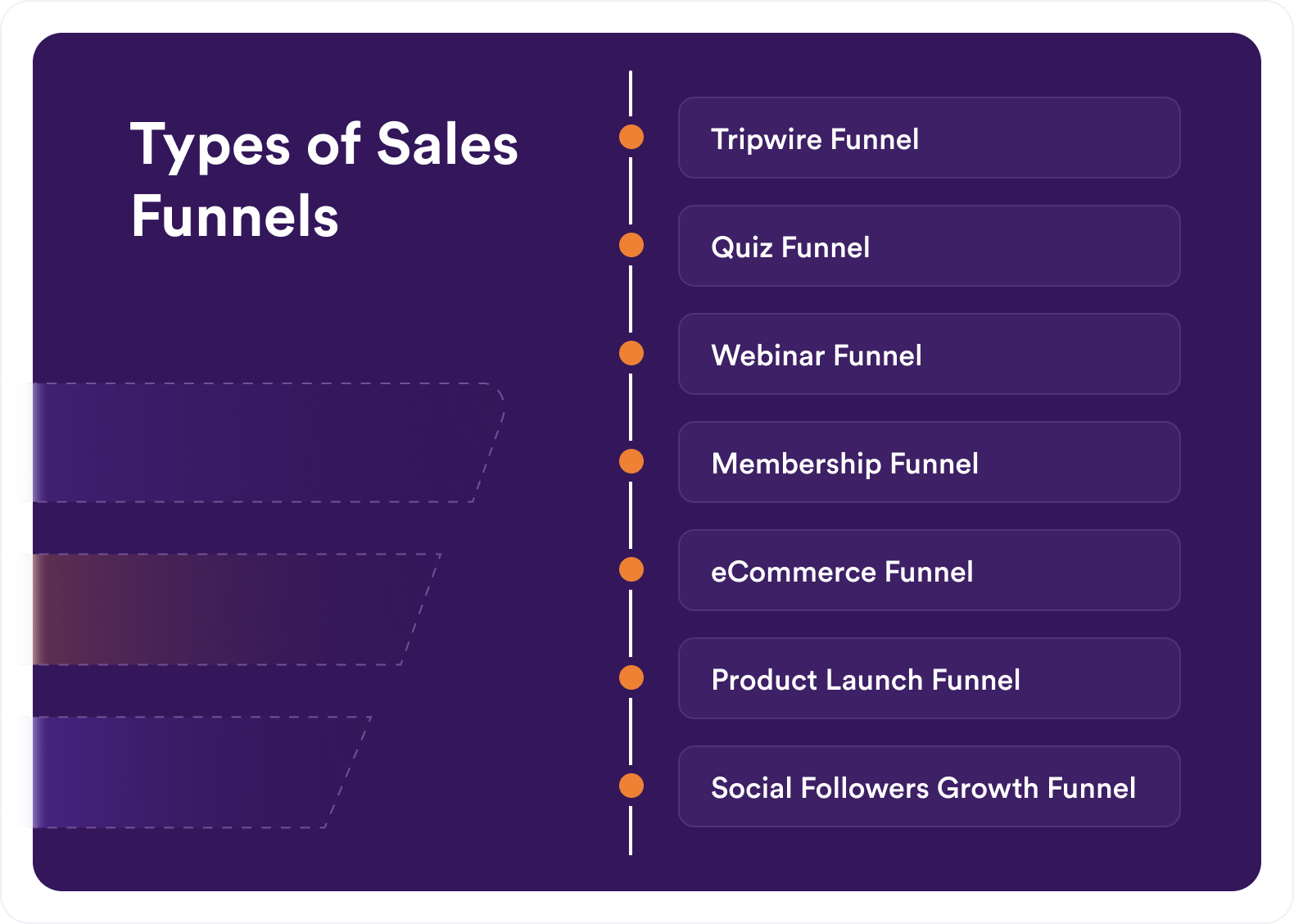
Now, as mentioned earlier, you have to plan a few sales funnels that will work to make your overall sales process successful.
Your sales process may vary depending on your business model and what you’re trying to achieve. That’s why there are 13 different types of sales funnels, each designed for a specific goal.
To make things easier, I’ve grouped these 13 sales funnel types into six categories based on the business goal you’re trying to achieve.
Let us explore these types of sales funnels you should consider using in the long run if you want to increase your revenue significantly.
| Proven Six Categories Sales Funnel Strategies for Any Business |
|---|
| 1. Audience Building Funnels 2. Trust-Building Funnels 3. First-Purchase Conversion Funnels 4. Average Order Value (AOV) Funnels 5. Customer Retention Funnels 6. High-Ticket Lead Qualification Funnels |
Each of them involves very specific funnel steps and tactics. In the next few sections, you will learn how each of them works and how you can implement them the right way.
1. Funnels That Build Your Audience
These solve one problem: you don’t have enough people to sell to yet. The goal isn’t revenue, it’s a list you can sell to later. Getting an email address is a much smaller ask than getting a credit card number, which is exactly why this category comes first.
1. Lead Magnet / Squeeze Page Funnel
A Lead Magnet Funnel helps you collect email subscribers by offering something valuable for free.
Visitors rarely purchase the first time they discover a business. Giving them a useful resource creates an opportunity to stay connected and continue the conversation through email.
The lead magnet should solve one specific problem your audience is already trying to solve.
A checklist, buying guide, calculator, template, free tool, or discount usually attracts more subscribers than a general newsletter because people immediately understand the benefit.
For example, suppose you sell WooCommerce plugins.
You could offer a Free WooCommerce Store Launch Checklist to help store owners avoid common mistakes before launching their stores.
Once someone downloads the checklist:
- Deliver it immediately.
- Send two or three helpful emails over the following week.
- Share practical tips that expand on the checklist.
- Introduce your plugin when it naturally fits the problem you’ve been helping them solve.
The lead magnet doesn’t have to solve everything. One quick win is enough to show that your advice is worth following and encourage people to open your future emails.
Many email marketers have shared similar experiences as well.
One marketer wrote:
“It’s possible but the opt in rate is much lower because no one really wants to sign up for another email.”
Another replied:
“Lead magnets really get you the best results. There’s a reason why every successful email marketer recommends lead magnets, so why not go with a proven strategy?”
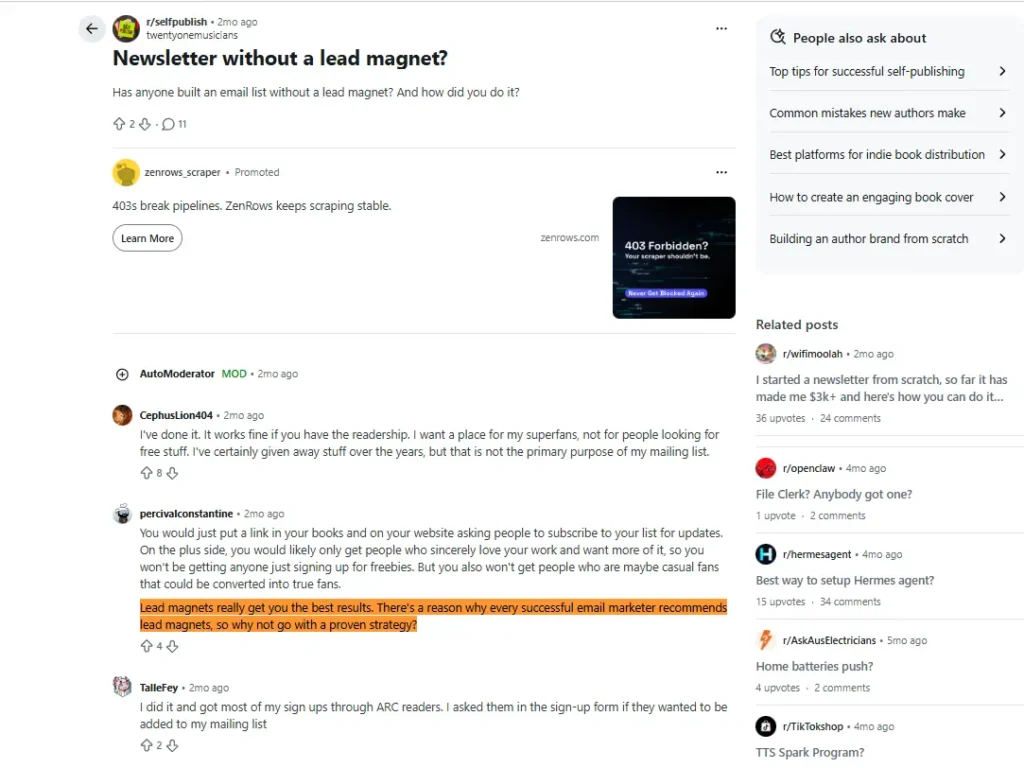
The takeaway is clear: people are much more willing to share their email when they receive something genuinely useful in return.
The Lead Magnet Funnel is ideal for ecommerce brands, SaaS companies, agencies, coaches, consultants, and service businesses that want to build relationships before making a sales pitch.
A Typical Lead Magnet Funnel Journey
To build a Lead Magnet Funnel, you need one lead generation funnel and an email automation sequence that continues delivering value after someone signs up.
Steps in the funnel for Lead Magnet:
- A landing page that explains the value of the lead magnet and includes an opt-in form.
- A thank you page where visitors can download or access the resource.
- An email automation sequence that delivers additional value before introducing your product or service.
Email automation campaigns required:
Send another email introducing your product or service once enough value has been delivered.encourage people to open your future emails.
Send the lead magnet immediately after someone subscribes.
Schedule two or three educational emails over the next several days.
Summary of the funnel journey:
After someone downloads your lead magnet, continue helping them through email before recommending your product or service. Building trust first usually leads to better engagement and stronger purchase intent.
- Drive traffic to your lead magnet landing page and collect email subscribers.
- Deliver the promised resource and continue providing helpful content through email.
- Introduce your product or service after you’ve established credibility and demonstrated value.
2. Quiz Funnel
A quiz funnel helps you learn more about your prospects and guides them to the right offer. You create a quiz with a few simple questions, and based on the answers, you recommend the product or service that fits them best.
For example, if you’re a fitness trainer offering courses on weight loss, muscle building, and stamina training, you could ask about a person’s age, fitness goal, and current activity level.
Based on their answers, you recommend the course that best matches their needs.
The value of a quiz comes from the recommendation. Every question should help you narrow down the right solution for that person.
Try to keep the quiz short. In most cases, three to five well-planned questions are enough to understand what someone needs. Adding unnecessary questions usually increases drop-offs before people reach the recommendation.
That same point came up in a Shopify Community discussion about product finder quizzes. Taras_Claspo wrote:
“The biggest mistake is that most of them only help the business. If a question doesn’t get the shopper closer to the right product, it probably shouldn’t be there.”
Another member added:
“For a large catalog, a quiz is worth testing when it removes real choice overload: fewer than about five questions, each one changes the recommendation, and the results page gives 2–3 products with a reason for each.”
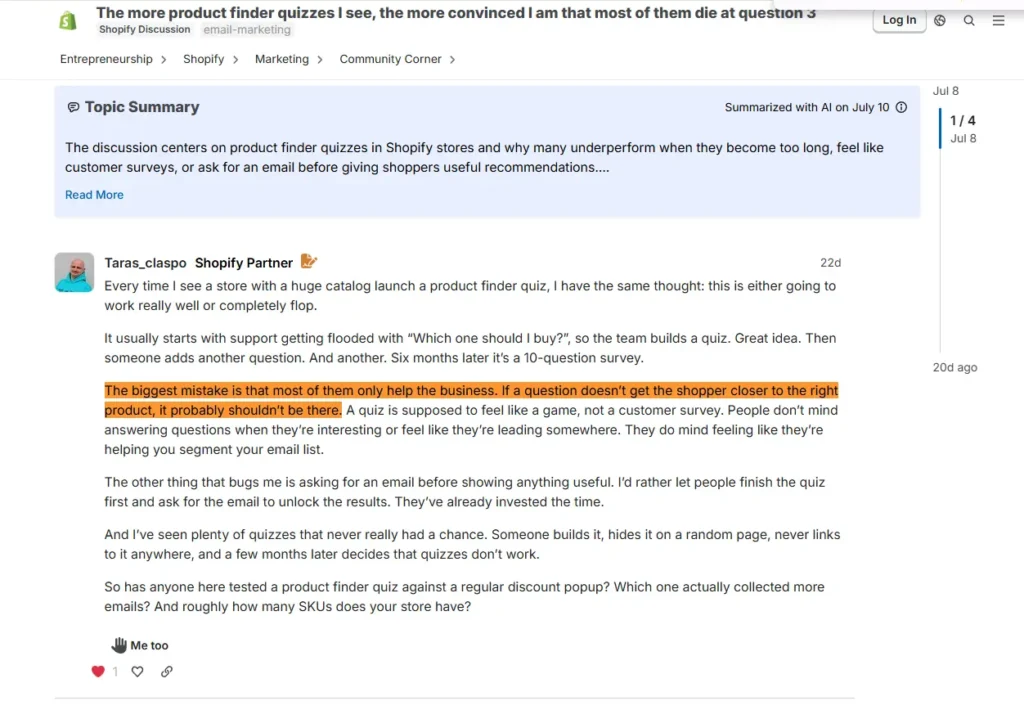
The lesson here is simple: every question should help visitors reach a better recommendation. If it doesn’t, it probably doesn’t belong in the quiz.
Planning a Quiz Funnel
When creating a quiz funnel, you will need a landing page with the quiz, and then you can create a sales funnel with dedicated offer pages for each of your services.
An email automation campaign is also required.
Let’s assume your quiz qualifies prospects for 3 of your services.
So, the steps you will need are as follows:
- A landing page with a quiz.
- Three sales funnels for each service with dedicated steps
– Landing page focusing on a service
– Checkout page to accept payment
– Upsell to offer added services
– Thank You page with confirmation and further instructions.
Email automation campaigns required:
- You will need 3 different email series of two emails for each of your services. Whoever completed the quiz but did not take your service, you can send two emails in the upcoming week and persuade them to take your service.
Summary of the funnel journey:
Run email automation campaigns to bring back the ones who do not take your service with persuasive emails. Run targeted Ads to bring traffic to your landing page with the quiz.
With the WordPress Quiz Plugin, you can easily create quizzes for your target audience, making your landing pages more interactive and increasing user participation.
After completing the quiz, take the prospect to the landing page of the funnel, which meets the requirements.
Upon taking the service, you can offer any added service as an upsell after checkout.
2. Funnels That Build Trust Before You Pitch
Once someone’s on your list, or has landed on your site cold, some offers need more convincing than a landing page can provide in fifteen seconds of reading. These funnels exist to build enough credibility, over a longer format, that a higher price starts to feel reasonable.
3. Webinar Funnel
A Webinar Funnel helps you showcase your expertise, answer questions, and build enough trust before presenting your offer.
It works especially well for high-ticket products and services such as online courses, coaching programs, consulting, and SaaS products.
For example, if you offer an online course on productivity, your webinar could be titled “5 Proven Strategies to Double Your Daily Output.”
During the session, you’d share actionable tips and show your audience how your course dives deeper to help them achieve their goals.
By combining valuable content with a clear pitch, webinars not only engage your audience but also convert them into loyal customers.
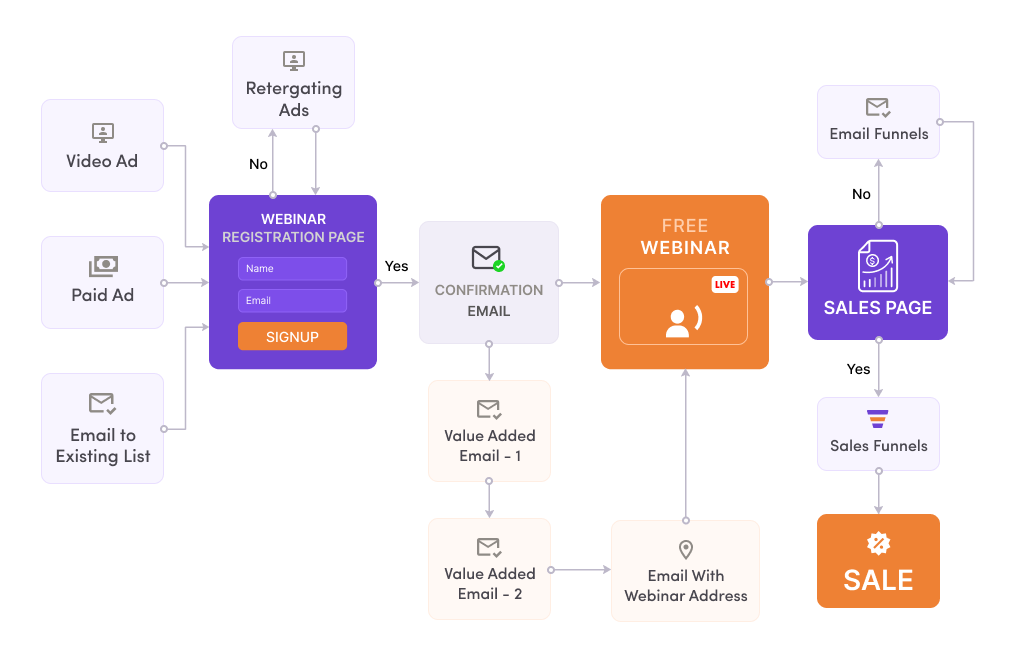
Now, there could be different ways to use webinars.
- You can conduct a free webinar and offer your core service near the end.
- You can run a paid webinar series, which has to be of low cost to register, and then offer your core service at the end of the series.
- Or, you can consider hosting a free webinar, followed by a paid webinar series where you have to pitch your paid webinar during the free event.
Whichever approach you take, the main goal here is to impress your prospects with your expertise on the first webinar so that you can convince them to take your core offer.
The Webinar Funnel is the best for online coaches, digital course sellers, marketing coaches, or any long-term professional service providers.
Funnel Steps of a Webinar Funnel
As mentioned above, you can decide how you want to use webinars.
Let’s assume you want to run a free webinar and then offer your core service.
For this, you will need three funnels: one to promote your free webinar, a second funnel to host the webinar and make a core offer, and a third funnel dedicated to the core offer. You will also need email automation.
Steps in the funnel to register attendees in the webinar:
- A landing page with the registration form for the webinar; the copy should be focused on the benefits of joining the webinar.
- Thank you page with a confirmation message.
Steps in the funnel to host the webinar:
- A landing page where you will host the webinar
- A sales page focused on your service, along with an embedded checkout form to take your service right away
- The thank you page is to confirm the purchase ofthe service.
Steps in the funnel for the core offer:
- A landing page focused on your core offer **Try giving a good discount here to trigger more sales.
- Checkout page to accept payment
- Thank you page to confirm the purchase
Email automation campaigns required:
- Whoever registers, send them an email with a link to your webinar hosting page.
- For all attendees who do not take your service, you can send two emails in the upcoming week and persuade them to take your service.
Include a link to your core offer funnel to take the service. The landing page copy can work as a final push towards a sale.
Summary of the funnel journey:
For the ones who do not take your service, run email automation campaigns to bring them back with persuasive emails.
Promote the free webinar on social media or via Ads and get prospects registered.
In the webinar, deliver the best content and deliver a pitch for your service in a smart way.
Take them to your offer sales page immediately after the webinar.
4. Video Sales Letter (VSL) Funnel
A Video Sales Letter (VSL) Funnel uses a pre-recorded video to explain your offer before asking prospects to buy.
It works well when your product or service needs more explanation than a standard sales page can provide.
SaaS products, online courses, coaching programs, consulting services, and technical products are all good examples because people usually want to understand how they work before making a purchase.
For example, let’s say you’re selling a project management tool. Your VSL could begin by showing why teams miss deadlines, lose track of tasks, and struggle to collaborate.
Then you demonstrate how your software solves those problems, walk through the key features, and show the results customers have achieved before inviting viewers to start a free trial or purchase a plan.
A good Video Sales Letter feels like a conversation. As the video progresses, it answers the questions people naturally have before buying.
When viewers understand the problem, see the solution in action, and know what to expect, deciding becomes much easier.
That same approach came up in a Warrior Forum discussion about Video Sales Letters.
“I’m a big fan of the VSL. Testing them on my own website, they convert better than text alone.”
He also explained that he first gives prospects a free educational video before sending them to a Video Sales Letter for his paid course.
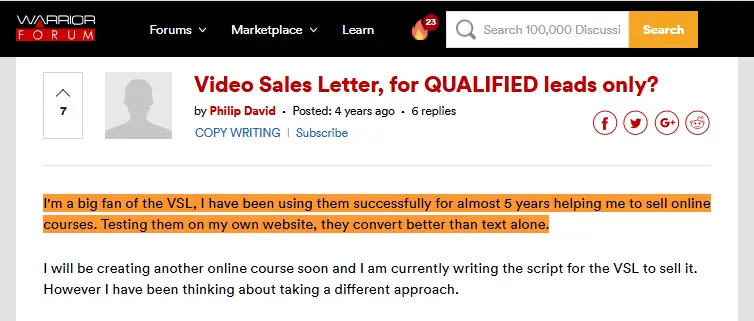
The educational content answers early questions, while the VSL explains the offer in enough detail for prospects to make a buying decision.
The Video Sales Letter Funnel is ideal for SaaS products, online courses, coaching programs, consulting services, premium services, and other offers that benefit from a detailed product demonstration before purchase
Planning a Video Sales Letter Funnel
A VSL Funnel is fairly simple to build. You’ll need a landing page with your Video Sales Letter, a checkout process, and an email automation sequence for follow-ups.
Steps in the funnel:
- A landing page with your Video Sales Letter.
- A checkout page where visitors can purchase your product or service.
- A thank you page confirming the purchase and explaining the next steps.
Email automation campaigns required:
- Send new leads to your Video Sales Letter after they subscribe to your email list or download one of your resources.
For anyone who watches the video but doesn’t purchase, send two follow-up emails over the next week.
Answer common questions, share customer success stories, and include a link back to the Video Sales Letter so they can continue where they left off.
Summary of the funnel journey:
Drive qualified traffic to your Video Sales Letter landing page and let the video explain your offer in a way that answers the questions prospects have before buying.
If someone doesn’t purchase after watching the video, continue the conversation through email and guide them back to the same offer.
- Bring prospects to your Video Sales Letter landing page.
- Explain the problem, demonstrate your solution, and present your offer through the video.
- Direct interested prospects to the checkout page.
- Use email automation to follow up with anyone who doesn’t complete the purchase.
5. Challenge Funnel
A Challenge Funnel helps people experience your teaching before introducing your paid offer.
Instead of asking someone to buy on their first visit, you guide them through a series of lessons or tasks over several days.
As they complete each step, they make progress and become more familiar with your method.
For example, a fitness coach could run a 7-Day Meal Prep Challenge, while a business coach might host a 5-Day Lead Generation Challenge. Each day introduces one simple task that participants can complete before moving on to the next lesson.
The purpose of the challenge is to help people achieve an early win. When participants see results for themselves, they’re more likely to trust your process and continue learning.
By the end of the challenge, introducing your course, coaching program, or premium service feels like a natural recommendation because they’ve already experienced how you teach.
Planning a Challenge Funnel
There are different ways to run a challenge. You can host a free challenge and introduce your paid offer on the final day.
You can charge a small registration fee and offer a premium program after the challenge ends.
Or, you can use the challenge to qualify participants before inviting them to a coaching program or consultation.
Let’s assume you’re running a free 7-day challenge followed by your core offer.
For this, you’ll need one funnel for the challenge, another for your paid offer, and an email automation campaign.
Steps in the challenge funnel:
- A landing page with the challenge registration form.
- A thank you page confirming the registration.
- Daily challenge lessons delivered through your website or email.
Steps in the funnel for the core offer:
- A landing page focused on your paid program.
- A checkout page to accept payment.
- A thank you page confirming the purchase.
Email automation campaigns required:
- Send participants a welcome email after registration, followed by one email each day with the next lesson.
When the challenge ends, send two follow-up emails introducing your paid program, sharing success stories, and inviting participants to continue their progress.
Summary of the funnel journey:
Promote your challenge through social media, ads, or your email list and encourage people to register.
Help participants complete each day’s lesson and achieve an early win.
Introduce your paid program after the challenge while their momentum is still high.
Use email automation to follow up with participants who don’t join your program right away.
Related read: For a full breakdown of how the challenge format works and a fitness-specific example, 7 Day Challenge Funnel – Business Hack for Fitness Trainers.
3. Funnels That Convert a Lead Into a First Buyer
This is where the relationship shifts from “interested” to “customer.” The goal isn’t maximum profit on this transaction, it’s the first yes, because someone who’s paid you once is measurably more likely to pay you again.
6. Tripwire Sales Funnel
A tripwire sales funnel is a strategy where you offer something valuable at a super-low cost to encourage prospects to take the first step with you.
This initial offer, called the tripwire offer, is designed to deliver more value than people expect for the price.
The idea is simple. That first purchase changes the relationship. Your prospect is no longer just a visitor… they’ve become a customer. Even if you don’t make much profit from the tripwire, you’ve earned something more valuable: their trust.
Once people experience the quality of your product, introducing your main offer becomes much easier because they already know what to expect.
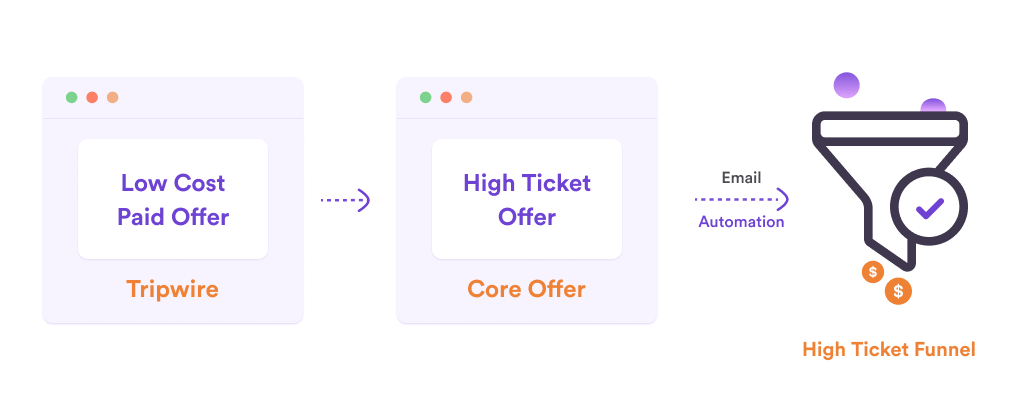
For example, suppose you are a Digital Marketing Consultant.
- Initially, you can offer a Basic Video Course on SEO at a low cost, maybe $50.
- Once people sign up, you send them a couple of more valuable pieces of content via email to nurture them and gain authority.
- After one week, once you believe the prospects have gone through the course, you can reach them with your service as the main offer, maybe at $500-$1000 for live, personalized coaching sessions.
Now, even though it’s called a Basic Course, it still has to deliver real value.
Think of a course, people would normally pay $100–$200 for on a course marketplace.
When customers receive that much value for a small investment, they quickly realize you know what you’re talking about.
That experience builds credibility in a way that a sales page alone can’t.
Later, when you introduce your high-ticket coaching service, many businesses struggling with SEO will already feel more comfortable investing because they’ve experienced your teaching firsthand.
Your tripwire offer doesn’t need to generate huge profits.
You need to earn enough trust that customers feel confident taking the next step with you.
A Reddit discussion about growing a B2B SaaS business reflects the same idea. One founder, 10Kronos10, shared:
“The easiest sales and the majority of my MRR are from these agencies purchasing more campaigns for their clients.”
He summed it up with:
“Find ways to upsell to your current customers — they’re the easiest to sell to once they love your product.”
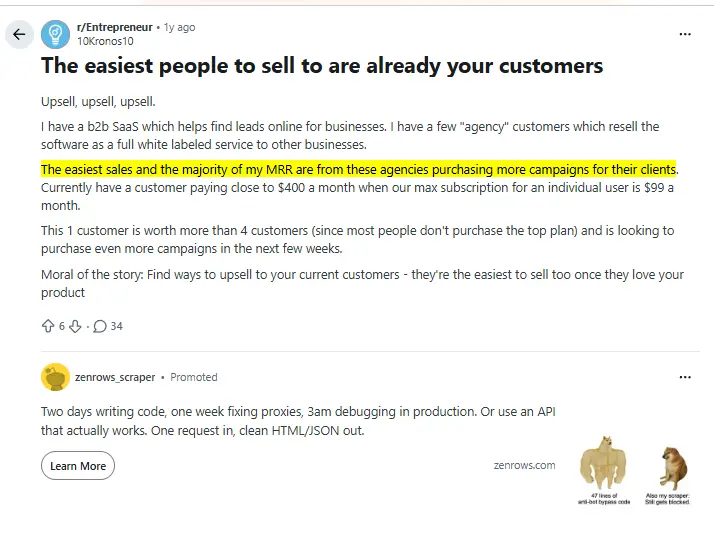
That’s exactly what a tripwire funnel is designed to do. The first purchase creates trust, and every positive experience makes the next recommendation feel much more natural.
The Tripwire Funnel is ideal for selling expensive products, monthly subscriptions, or long-term services.
A Typical Tripwire Funnel Journey
To devise a tripwire funnel, you need to prepare two funnels, one for the tripwire offer and another for the core offer. And you will need to set up a couple of email automation campaigns.
Steps in the funnel for the tripwire offer:
- A landing page with a sales copy for the Tripwire offer that focuses on highlighting the value for money the prospect will get.
- The checkout page is to accept the payment.
- A post-purchase upsell to offer the core service.
- A thank you page with a summary of the purchase and instructions.
Steps in the funnel for the core offer:
- A landing page with a sales copy focused on your core offer. An extra discount on the core service can be a good trigger in this funnel.
- The checkout page is to accept the payment.
- A thank you page with a summary of the purchase and instructions.
Email automation campaigns required:
- Set up two value-added emails to be sent out in the following week for people who purchase the tripwire offer but not the core offer in the first funnel.
- And then set the third email to be sent a few days after the first two emails, with a link to your second funnel to offer your core service.
- Set up a couple of more emails to be sent to people who have visited our second funnel but did not purchase. In these emails, focus on convincing the buyer to take the service and highlight the long-term benefits the business will get.
Summary of the funnel journey:
If the buyer does not take the upsell offer, run email automation campaigns to bring the buyer to your second funnel and convert them.
- Initially, you will bring in traffic to the landing page of the first funnel.
- Upon taking the tripwire product, offer your core service as an upsell.
- If the buyer does not take the upsell offer, run email automation campaigns to bring the buyer to your second funnel and convert them.
7. Product Launch Funnel
A product launch funnel is a powerful journey to create excitement and anticipation around your new product or major feature before it’s released.
For example, if you’re launching a new A/B Testing software, you’d start by creating a series of sneak peek videos to show your audience why your software is the next big thing.
You can promote an opt-in page where people can sign up to get early access and a special discount.
Once someone registers, you’ll send them a series of emails to build anticipation, showcasing the benefits and features of your software.
In the final email, you’ll provide a special early bird offer with a discount code, creating urgency and encouraging them to act fast.
This product launch email strategy is one of the unique funnel types that help boost excitement and conversions, turning potential leads into paying customers.
The key is to give people something to look forward to before launch day instead of waiting until the product is available. This is a strategy many experienced marketers follow as well.
In a Reddit discussion about pre-launch marketing, one marketer, Secretmecret_1, explained it this way:
“The timing matters less than the moment you give people something to care about. If you start too early with nothing tangible, people forget. If you start too late, you miss momentum. The sweet spot is usually 2–4 weeks, but only if you’re showing progress behind-the-scenes, local restaurant partnerships, early signups, real previews. Pre-launch shouldn’t feel like ‘waiting,’ it should feel like something is building and the real goal isn’t awareness, it’s anticipation.”
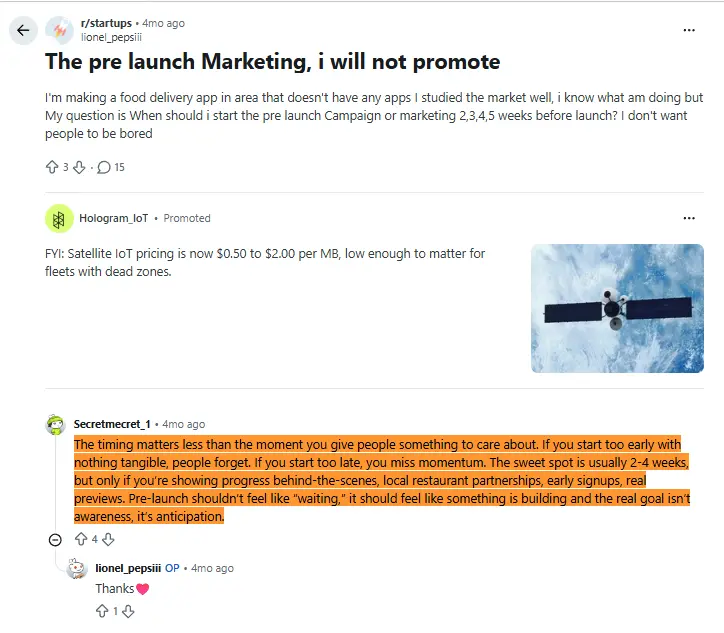
That’s exactly what your Product Launch Funnel is trying to achieve.
By sharing sneak peeks, highlighting important features, and keeping prospects engaged with emails before the launch, you’re building familiarity with the product long before asking people to buy.
As a result, your audience is much more likely to be excited and ready to purchase when your Early Bird offer goes live.
Planning a Product Launch Funnel:
To plan your Product Launch Funnel, start with an opt-in funnel to collect leads, then create a funnel for your special offer. To design high-converting pages, team up with a digital product design studio that can help you create visuals and experiences your audience will love.
Use landing pages to highlight product features and leverage email automation to send these pages throughout the campaign, keeping prospects engaged until the launch.
Steps in the funnel for collecting leads:
- Landing page to announce the upcoming release of a great product while highlighting what can be done with it. Include an optin form to collect leads of people who want the early bird offer when the product is launched.
- A Thank You page
Pages Involved In The Product Sneak Peek Series
- Create 3-5 landing pages, where, on each, highlight an important feature of the software. The copy should focus on why this is important, along with use case examples. And include a video to show how it can turn out. You can also add a CTA to mark the calendar with the launch date.
Steps in the funnel for the Early Bird Offer:
- A landing page with exciting copy regarding the launch. Highlight the special offer that the early bird users can get. It’s best to keep it limited, maybe to 50 or 100 potential buyers who are interested in getting a huge discount to purchase early.
- The checkout page to accept payment.
- Thank you page to inform what’s next.
Email automation campaigns required:
- For people who register, set up an email automation campaign to send emails with links to your sneak peek landing pages. (If you have 3 sneak peeks, then you will send 3 emails.)
- On the launch day, email these prospects the launch news. Include a link to your Early Bird Offer funnel landing page.
- For people who do not purchase the product, send them a series of three emails in the next couple of weeks to collect the discount before it expires.
Summary of the funnel journey:
- Promote your Early bird registration and upcoming launch via Ads, social media, and your existing email list to collect potential leads.
- Send these leads sneak peeks of your product to create excitement about what’s in store.
- Finally, make a good offer on the product as an Early Bird campaign to these prospects to get instant sales right on the launch.
This product launch funnel is one of the best types of sales funnels for driving huge sales right after the launch.
Even when your product is ready, it’s best to plan a Product Launch Funnel to create hype over your potential buyers before the release.
Once your product is ready, make a 2-week to 1-month plan to run a successful product launch funnel campaign.
This will help to get instant traction on the launch date and result in landing a few early sales really quickly.
Related read: if you sell through both physical and digital catalogs, How To Build WooCommerce Digital Products Sales Funnel walks through the setup specifics.
4. Funnels That Increase What Each Customer Spends
Once someone’s already decided to buy, this category solves a completely different problem: getting more value out of a transaction that’s already happening, without spending another dollar on acquisition.
8. Cart & Checkout Upsell Funnel
A Cart & Checkout Upsell Funnel is designed to increase the value of an order by presenting additional offers while the customer is already making a purchase.
These offers usually appear as an order bump during checkout or as a one-click upsell immediately after payment.
The goal is to present complementary products while customers are already committed to making a purchase.
For example, suppose you run an online electronics store.
A customer adds a wireless keyboard to their cart. During checkout, you offer a matching wireless mouse at 20% off as an order bump. After the purchase is complete, you present a one-click upsell for an extended warranty or a premium keyboard case.
These additional offers don’t interrupt the buying experience because they’re directly related to the customer’s original purchase.
To make this funnel successful, your upsell offer has to feel like a natural extension of what the customer is already buying.
Accessories, refill packs, premium versions, extended warranties, and complementary products usually perform much better than unrelated recommendations.
Focus on products that genuinely improve the original purchase rather than showing additional products for the sake of it.
This is exactly what many ecommerce store owners have experienced. In a Reddit discussion about increasing average order value, Terry_Ecom shared:
“AOV = bulk purchases – buy 2 for 10% discount, buy 3 for 15% discount etc etc … for repeat purchases, a decent email flow with discounts. Or consider After cart for immediate and additional purchases at checkout.”
Another seller, ExtensionsMarket, explained why relevant offers perform better than generic recommendations:
“By the time someone reaches the cart they’ve already mentally committed to one item. Showing a bundle offer on the product page… ‘Complete the set’ or ‘Most customers also grab X’ outperforms generic ‘You might like’ every time.”
MitoLinen also shared results from a client after adding an upsell bar that encouraged customers to spend more for free shipping:
“We launched an upsell bar… +38.7% AOV.”
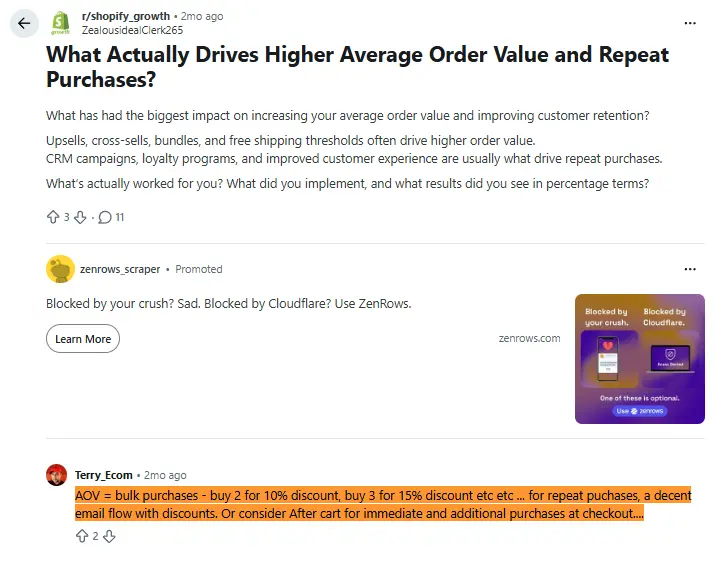
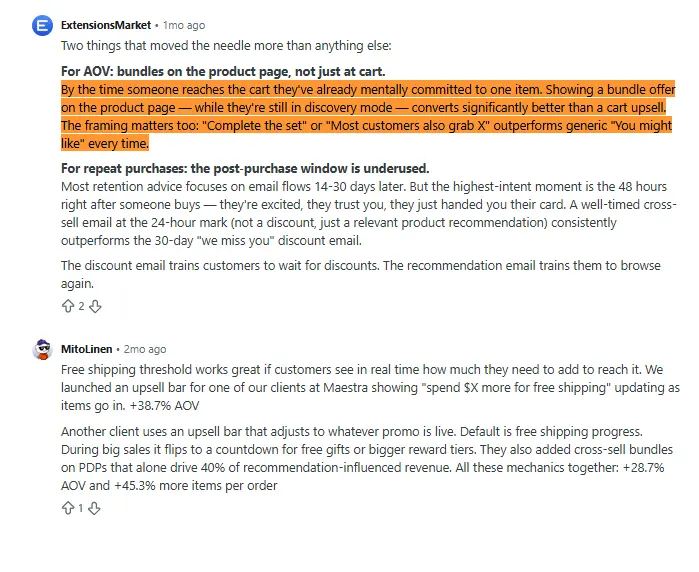
All three examples point to the same conclusion: relevant upsells consistently outperform generic recommendations.
A relevant recommendation feels helpful, while a random one often gets ignored.
The Cart & Checkout Upsell Funnel is ideal for WooCommerce stores, ecommerce brands, subscription businesses, and any business that wants to increase average order value without increasing traffic.
Planning a Cart & Checkout Upsell Funnel
To build a Cart & Checkout Upsell Funnel, start by identifying products that naturally go together.
Then create order bumps for the checkout page and one-click upsell offers that appear immediately after the initial purchase.
Focus on products that enhance the customer’s original purchase instead of unrelated recommendations.
The more relevant the offer, the higher the chance of increasing your average order value.
Steps in the funnel:
- A product page where customers choose the main product.
- A checkout page with an order bump offering a complementary product at a special price.
- A payment page to complete the purchase.
- A one-click upsell page immediately after checkout with a premium version, extended warranty, refill pack, bundle, or another related product.
- A Thank You page with the order summary and purchase confirmation.
Email automation campaigns required:
If a customer declines the post-purchase upsell, follow up with a limited-time offer or educational email showing the benefits of that product.
Send an order confirmation email immediately after purchase.
A few days later, send helpful emails explaining how to get the most value from the purchased product while recommending complementary products the customer hasn’t purchased yet.
Segment customers based on what they bought and send personalized cross-sell or replenishment emails when appropriate.
Summary of the funnel journey:
Bring customers to your product page through your existing marketing channels.
Once they add a product to their cart, present a relevant order bump during checkout.
After the purchase, show a one-click upsell with another complementary offer before displaying the Thank You page.
Continue the relationship through email automation by recommending relevant products based on the customer’s purchase history.
This funnel helps increase the value of every order without requiring additional traffic, making it one of the most effective sales funnels for WooCommerce and other ecommerce stores.
9. eCommerce Funnels for Global Conditions
Typically, you are accustomed to setting up sales funnels for individual products in your WooCommerce store, assigning specific order bumps, and offering upsells to selected products.
However, now you can utilize one of the newest funnel types, which allows you to set up offers for a group of products based on specific conditions.
For example,
- You can offer a 10% discount for any purchases above $500,
- You can assign an upsell offer for all products that are in a certain category, or
- Maybe you can make upsell offers with a higher quantity of any products in the store, etc.

The concept here is to set up a funnel based on conditions to define a group of products. If these conditions are met, a buyer will enter the funnel when trying to complete the purchase.
In the funnel, you can offer discounts on the cart total or make relevant dynamic upsell offers after checkout.
The scope of planning such funnels is huge. The most logical conditions would be,
- Dynamic Upsell For A Single Category: Set a funnel for a single category so that anyone who wants to purchase a product from that category, he/she will enter the funnel. Offer the highest-selling product in that category as the upsell offer at a discount. Since the upsell product is from the same category as what the buyer was purchasing, it has a higher chance of conversion due to relevancy.
- Quantity-Based Offer: Create a funnel so that whichever product the buyer wants to purchase, they will enter the funnel. And after going through checkout, offer him to buy more of the same product at a discount. Let’s say five instead of one.
- Offer on a Target Amount Spent: Craft a funnel where the buyer will enter the funnel if they have more than a target cart total. You can then offer a dedicated discount on the cart total and later make upsell offers with the highest-selling product in-store.
These types of sales funnels are very effective because the offers are relevant to what the buyer is purchasing. Plus, an attractive discount is always loved by buyers.
Any eCommerce website can benefit from using similar conditional funnels.
Steps to creating a conditional eCommerce funnel:
- Set up conditions based on which you want to make specific offers and design a checkout page to accept the initial payment. Offer a discount on the cart total if you want to.
- Choose dynamic upsell offers to make the offers relevant.
- View a thank you page to give the order summary.
Now, creating such funnel types can be quite challenging on most eCommerce sites. But if you use WooCommerce, then you can use WPFunnels and its Global Funnels addon to set it up easily.
10. Membership Funnel
This is a simple yet effective funnel type designed to sell memberships and take buyers from a lower membership plan to a higher one.
For example, let’s say you run a website with video editing resources, and you offer two membership plans: the Basic membership, which includes vector images, stock videos,
and After Effects 2D animations, and the Elite membership, which includes everything from royalty-free audio to 3D motion animations and presentation slides.
To maximize your profits, you’ll want most of your customers to choose the Elite plan. After a customer buys the Basic plan, you can offer the Elite membership at a discounted rate as a post-purchase upsell.
This is a great example of using high-converting funnels to increase revenue and guide customers toward higher-value offers.
Funnel Journey to Selling Memberships
All you need is two funnels, one where you offer the Elite plan as an upsell offer to the Basic plan, and another where you create a dedicated sales page for the Elite plan.
And then, you can link them to your plan CTAs on your website landing page.
Steps in the funnel for the Basic plan:
- A Landing Page focusing on the features included in the Basic Plan
- Checkout page to accept payment
- The Elite Plan is an upsell offer after checkout at a discount
- A Thank You Page to summarize the purchase.
Steps in the funnel for the Elite plan:
- Sales page to highlight the advantages of going for the Elite Plan
- The checkout page to accept the payment
- A Thank You Page to summarize the purchase.
Once you have these ready, link them to the respective CTA’s on the website landing page or the pricing page.
Email automation campaigns required:
- For anyone who doesn’t go for the Elite Plan in the first funnel, run an email campaign to send them three emails in the following month, highlighting the discount and the benefits. Include a link to your Elite Plan funnel.
Summary of the funnel journey:
- Drive traffic to your website landing page.
- If someone chooses the Basic plan, they will enter the first funnel and get a chance to take the Elite plan instead at a discount.
- Whoever doesn’t take the Elite plan, bring them to the second funnel via persuasive email campaigns.
5. Funnels That Keep Customers Around
Acquisition gets most of the attention, but for any business with recurring revenue or a repeat-purchase catalog, retention is often the cheaper lever. These funnels exist to catch people before they leave, or to bring them back once they have.
11. Cancellation / Win-Back Funnel
A Cancellation / Win-Back Funnel is designed to retain existing customers or bring back customers who have stopped buying from you.
The funnel begins when someone cancels a subscription, requests to close their account, or hasn’t made a purchase for a long time.
For example, suppose you run a subscription-based project management software.
A customer decides to cancel their monthly subscription. Before completing the cancellation, you ask them why they’re leaving through a short exit survey.
If they select “Too expensive,” you can offer a lower-priced plan or let them pause their subscription for a few months.
If they choose “Didn’t have time to use the product,” you can send a few onboarding emails with tutorials and practical tips to help them get started.
For customers who haven’t purchased or logged in for a long time, you can send personalized emails announcing new features, product improvements, or a limited-time offer to encourage them to return.
Personalizing your response based on why a customer is leaving gives you a much better chance of retaining or reactivating them.
The Cancellation / Win-Back Funnel is ideal for subscription businesses, SaaS products, memberships, ecommerce brands with repeat customers, and businesses that rely on long-term customer relationships.
Planning a Cancellation / Win-Back Funnel
To plan your Cancellation / Win-Back Funnel, create an exit survey to understand why customers are leaving, then prepare different offers and email sequences based on their responses.
For inactive customers, create a separate re-engagement campaign to remind them about your product, announce new features, or offer an incentive to come back.
Steps in the funnel:
- A cancellation page with a short exit survey.
- A personalized retention page based on the customer’s response, such as a lower-priced plan, a paused subscription, or additional onboarding resources.
- A confirmation page if the customer decides to stay, pause, or complete the cancellation.
- A dedicated landing page for customers returning through a win-back campaign.
Email automation campaigns required:
Send product updates, new features, or limited-time offers to encourage inactive customers to return.
Send a follow-up email after a customer pauses or cancels their subscription.
Create separate email sequences based on the customer’s reason for leaving.
Send onboarding emails to customers who didn’t get started.
Summary of the funnel journey:
When a customer decides to cancel, collect feedback through an exit survey.
Present a relevant offer based on their reason for leaving before completing the cancellation.
If they still leave, continue the conversation through personalized email campaigns and encourage them to return with updates, helpful resources, or special offers.
12. Social Followers Growth Funnel
A Social Followers Growth Funnel is a great way to boost your social media presence and engage with your target audience.
It’s one of the unique types of marketing funnels that helps you grow your social followers while delivering value.
For example, if you’re a motivational speaker with a strong presence on Facebook and Instagram, you can offer a free giveaway of a small book you wrote.
When someone signs up to receive it, you ask them to follow you on social media for more valuable content and resources in the future.
This funnel helps you grow your audience and connect with more potential clients to whom you can later market your services. It’s a simple yet powerful strategy for increasing your reach
It works best for individuals who promote themselves for consultation or events. For example, motivational speakers, musicians, photographers, etc.
The Funnel Journey of a Social Follower’s Growth Funnel
This strategy involves two simple steps: first, people sign up for your free giveaway, then they go to a page to claim it and are asked to follow you on social media for more content.
You’ll also need email automation to send the giveaway and remind them to follow you. This helps grow your social following while providing value.
For this, you need to follow the steps below:
- Create a landing page to promote the free giveaway. Include an opt-in form to claim the reward.
- Prepare a page where the prospect can collect the giveaway, either by downloading or simply viewing it there. Also, promote the benefits of following you on social media on this page.
- Set up email automation to send the link to the reward page.
- Set up another email automation campaign of 3 email sequences to request the prospects to follow you on social media.
Summary of the funnel journey:
- Promote the free giveaway and collect leads.
- Follow up with a link to a page to collect the reward from and persuade them to follow you on social media.
- Send email sequences afterward to further request that they follow you on social media.
6. Funnels That Qualify Before You Talk
At the highest price points, a landing page or even a webinar can’t close the sale alone. These funnels exist to filter out people who can’t afford, or aren’t ready for, a serious conversation before anyone spends time on a call with them.
13. Application / High-Ticket Funnel
An Application / High-Ticket Funnel is designed to qualify prospects before they can book a sales call or purchase a high-ticket product or service.
Instead of allowing anyone to schedule a call, you ask them to complete a short application first. This helps you understand whether they’re a good fit before investing time in a conversation.
For example, suppose you run a marketing agency that offers SEO services starting at $3,000.
Rather than letting every visitor book a consultation, you ask them to complete an application with questions about their business, marketing goals, monthly budget, current challenges, and timeline.
Based on their responses, you can decide whether to invite them to a discovery call or recommend another solution that better fits their needs.
This helps you spend your time on prospects who are genuinely qualified and ready to have a sales conversation.
Businesses that qualify prospects before booking calls often report similar results.
In a Reddit discussion on r/SaaS, u/Ok-Amphibian5313 shared what happened after requiring prospects to complete a qualification form before booking a demo.
form before booking a demo.
“Added qualification: Required form before booking: company size, budget range, timeline, current solution.”
The results were:
“Calls per month: ~18 (down 55%) Close rate: 38% (up 111%) New customers per month: ~7 (same) Hours spent on sales calls: ~9 (down 55%) Same revenue, half the time.”
They summed it up simply:
“Bad-fit prospects waste your time and theirs.”
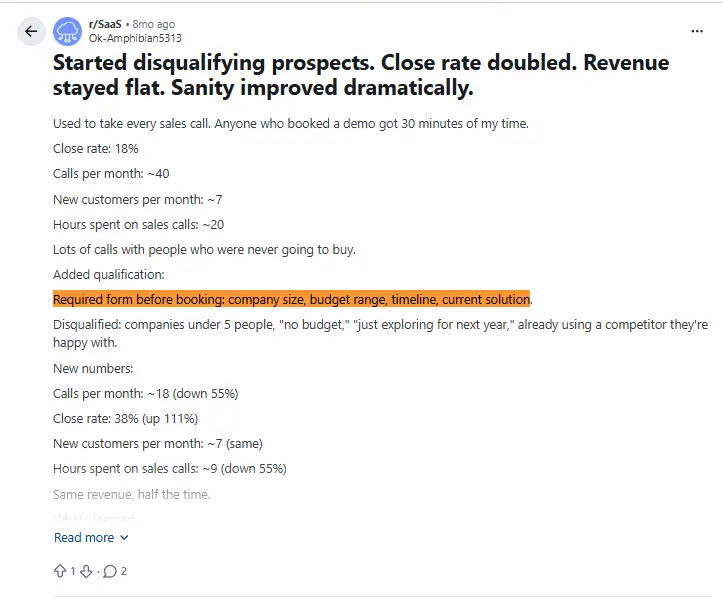
A short qualification form filters out poor-fit leads before they reach your calendar, so you spend more time speaking with prospects who are more likely to become customers.
The Application / High-Ticket Funnel is ideal for consultants, agencies, coaches, B2B service providers, and businesses selling high-ticket products or services.
Planning an Application / High-Ticket Funnel
To plan your Application / High-Ticket Funnel, start by creating a landing page that clearly explains your offer and who it’s designed for. Then build an application form that asks only the questions needed to qualify a prospect before booking a call.
Steps in the funnel:
- Create a landing page explaining your high-ticket offer, its benefits, and the type of clients you work with.
- Add an application form to collect information such as business size, goals, budget, timeline, and current challenges.
- Review each application and invite qualified prospects to schedule a discovery call.
- Redirect qualified applicants to a booking page where they can choose a convenient meeting time.
- After the call, send interested prospects to your proposal or checkout page to complete the purchase.
Email automation campaigns required:
After the consultation, send personalized follow-up emails, proposals, case studies, or testimonials to help prospects make a decision.
Send a confirmation email after someone submits the application.
Notify qualified applicants with a link to book their discovery call.
Follow up with applicants who don’t schedule a call after being approved.
Summary of the funnel journey:
Drive traffic to your landing page and encourage interested prospects to submit an application.
Review each application to identify qualified leads before scheduling a sales call.
Continue nurturing qualified prospects through follow-up emails and consultations until they’re ready to become customers.
Related read: for a longer breakdown of how application and consultation funnels work for service businesses, What Is A B2B Sales Funnel – Steps, Tips & Implementation Guide.
More Specialized Funnels Worth Knowing
Besides the main types of sales funnels we just covered, there are also Specialized & Niche Funnels you can use to level up your marketing.
These funnels are designed for specific goals, audiences, or product types, and can help you get better results in areas your standard funnels might miss. Some examples are listed below:
- Squeeze Page Funnel – Captures leads with a single focused page. You can convert cold traffic into subscribers efficiently.
- Summit Funnel – Built around an online event featuring multiple speakers or industry experts. It’s commonly used to grow an audience, generate leads, and establish authority in a niche.
- Self-Liquidating Offer (SLO) Funnel – Starts with a low-priced offer that covers ad costs. This lets you acquire buyers quickly while building trust for future upsells and promoting multiple products.
- Evergreen Funnel – Runs all year without live launches automatically. It keeps your sales consistent with minimal hands-on effort and works well as an automated funnel.
- Sales Call Booking Funnel – Designed to book consultation or discovery calls. Unlike an Application Funnel, the primary goal is filling your calendar rather than qualifying prospects through a detailed application.
- Affiliate Funnel – Optimized for visitors referred by affiliates or partners, with tracking in place to attribute sales and calculate commissions.
As your business grows, you may find that one of these specialized funnels better matches your products, audience, or marketing strategy.
Bonus Tips to Improve Your Sales Funnel Performance
Here are some handpicked tips that are proven for several types of sales funnels.
- Make exclusive discounts on Upsell products.
Discounts play a big part in converting buyers to post-purchase upsells. Make sure to offer a discount that the prospect who be able to get anywhere else on your website.
- Create personalized & persuasive copy for your Upsell.
On the upsell page, make sure to make the copy as personalized as possible. The prospect should feel this is a special offer just for him. For example, “Just for you, 50% off today!”
- Use the FOMO (Fear Of Missing Out) strategy.
Always make sure to run offers for a limited time or in limited numbers. And reflect the lack of time or the chance of missing this offer in your sales copy.
- Offer coupons now and then if you are running an eCommerce shop.
Coupon codes work like a charm for eCommerce products. Try to find creative ways to offer coupons to drive more sales. For example, a discount coupon for a target purchase amount can help to increase order values.
How to Pick the Right Funnel for Your Business
Rather than a topic-by-topic recap, here’s the actual decision logic, because “which funnel should I build” really only depends on two questions: how warm is this traffic, and how much does my price point need to justify itself.
| Funnel Type | Primary Objective | Works Best For | Traffic Temperature |
|---|---|---|---|
| Lead Magnet / Squeeze Page | Build a list | Any business, any stage | Cold |
| Quiz Funnel | Personalize the offer | Multi-product or multi-service businesses | Cold to warm |
| Webinar Funnel | Build trust for a high-value ask | Coaches, course creators, $200 to $2,000 offers | Warm |
| VSL Funnel | Explain and demonstrate value | High-ticket or complex offers | Warm |
| Challenge Funnel | Prove value through experience | Coaching, course, and membership businesses | Cold to warm |
| Tripwire Funnel | Earn a first purchase | Digital products, courses, subscriptions | Cold |
| Product Launch Funnel | Build urgency around new releases | Any business with periodic new releases | Warm (existing list) |
| Cart & Checkout Upsell | Increase AOV | Any ecommerce business | Already buying |
| Conditional Discount | Make relevant, condition-based offers | Ecommerce with a varied catalog | Already buying |
| Membership / Subscription | Move customers to higher-value tiers | Recurring revenue, consumables, subscription boxes | Existing customers |
| Cancellation / Win-Back | Reduce churn or reactivate dormant buyers | Subscriptions and repeat-purchase catalogs | Existing customers |
| Social Followers Growth | Build an owned audience | Personal brands, DTC brands | Cold |
| Application / High-Ticket | Qualify before a sales call | $3,000-plus services | Warm to hot |
Read that table by cross-referencing your traffic and your price, not by picking whichever row sounds most sophisticated.
Cold traffic being asked to spend $2,000 needs a webinar or challenge in between; cold traffic being asked to spend $10 doesn’t need anything more than a clean tripwire offer.
Practical AI Action If you’re not sure where your own business falls on this table, this is a fast way to find out. Open Claude or ChatGPT and paste in: “Here’s my product catalog: [list your products, price points, and whether customers typically buy once or repeatedly]. Based on the 13 sales funnel types (lead magnet, quiz, webinar, VSL, challenge, tripwire, product launch, cart upsell, conditional discount, membership, cancellation, social growth, application), which 2 to 3 should I build first, and in what order?” You’ll get a business-specific starting point in under a minute instead of guessing from a generic list.
If You Run a WooCommerce Store, Which Funnel Types Should You Build First?
Everything above applies across business models. But if you’re running a live WooCommerce store today, making sales already, with margins that feel tighter than they should, the honest answer is that not all 13 types deserve equal attention. Some solve problems you don’t have yet. A few solve exactly the problem you’re dealing with right now.
The table below narrows the full list down to what actually matters for a WooCommerce catalog, and how complex each one is to set up.
| Funnel Type | Best For in WooCommerce | Setup Complexity | WPFunnels Template Available |
|---|---|---|---|
| Cart & Checkout Upsell | Any store, immediately | Low | Yes |
| Conditional Discount | Stores with more than one product category | Low to Medium | Yes, via Global Funnels |
| Tripwire Funnel | Stores with a digital add-on or low-cost entry item | Medium | Yes |
| Quiz Funnel | Catalogs with 3 or more distinct product lines | Medium | Partial (pairs with a quiz tool) |
| Lead Magnet Funnel | Any store still building its list | Low | Yes |
| Product Launch Funnel | Stores with seasonal or limited releases | Medium | Yes |
| Membership / Subscription | Consumables and repeat-purchase products | Medium | Yes |
| Cancellation / Win-Back | Subscription stores, or dormant-customer win-back | Medium | Partial (email automation, not a page funnel) |
| Social Followers Growth | DTC brands with an active audience to build | Low | No, this is largely a social/email play |
| Webinar / VSL / Challenge / Application | Only if you sell a course or premium service alongside your catalog | High | No, not the plugin’s focus |
If you’re deciding where to start, the order that makes sense for most live stores is: checkout upsell first (it applies to every order you already have), conditional discount second (it makes your existing catalog work harder without new traffic), then a tripwire or lead magnet once the first two are running, to start acquiring new customers more cheaply than paid ads alone.
Remember: None of this requires touching PHP or hiring a developer. Every funnel type marked “Yes” in the table above is buildable visually, on the store you already have, without rebuilding your product pages or checkout from scratch.
We’ve covered the full step-by-step setup process elsewhere: How to Create a Sales Funnel to Automate Your E-Commerce Sales Process.
How to Create a Sales Funnel without Any Complications or High Expenses?
Different types of funnels explained in this guide are truly worth investing in. However, it is important to have the right tools at hand to execute them.
You will find tons of tools out there that promise you the best funnel-building experience. However, here’s what we believe you should go for:
- Use software that requires minimal studying of documentation.
- Try to get a funnel builder that gives you a visual journey representation.
- Consider using a tool that makes it easy to design the funnel pages.
- Look for a solution that has all the elements required, such as forms, checkout, A/B testing, funnel offers, email automation, etc.
- Choose a tool that will allow you to get a higher ROI.
Considering all these requirements, your best investment would be to go for the following combination:
- Use a WordPress site to have more control and less expense.
- Get WPFunnels for a visual funnel-building experience with forms, native page builder integration, custom checkouts, post-purchase offers, and pre-built templates.
- Consider using Mail Mint to collect leads, segment them, and set up the email automation workflows for your funnels
- Use WooCommerce to host your products to be sold in your funnels.
This combination will ensure you have all the features required to craft high-converting sales funnels without spending a fortune.
Trust me, you will be spending less than $70 a month while earning hundreds or even thousands.
Final Thoughts
One thing should be clear by now: there isn’t a single sales funnel that’s right for every business.
Some businesses need to recover abandoned carts. Others need to increase average order value with upsells and order bumps. Some need better lead qualification before booking sales calls.
The right funnel depends on the problem you’re trying to solve.
So don’t feel like you need to build all 13 funnels at once. Start with the one that will have the biggest impact on your business today. Once it’s working, measure the results, improve it, and then move on to the next opportunity.
If you’re running a WooCommerce store, WPFunnels gives you everything you need to build high-converting sales funnels, including landing pages, checkout funnels, one-click upsells, order bumps, conditional offers, and more, all inside WordPress.
Instead of piecing together multiple plugins, you can create, test, and optimize your entire funnel from one place.
Hopefully, this guide helped you figure out which funnel your business actually needs. When you’re ready to build it, WPFunnels is ready to help.
our sales and grow your business. And try WPFunnels to make it easier and more affordable.
** FAQs **
How can I understand what my visitors want before selling?
A survey funnel with interactive quizzes helps you see what your visitors really want. Asking the right questions at key points in the sales funnel stages lets you qualify leads early. This way, you can guide people naturally toward taking action.
How do I justify higher prices for my service?
A case study shows real results and product use cases, which builds trust for your service online. It works well for high-ticket sales with custom prices and shares nicely on social networks. Your prospects feel confident and informed, not pressured.
How do I turn traffic into qualified leads?
Specialized funnels using an online form builder or quiz maker help separate serious prospects from casual visitors. Leads can be organized into clear sales pipelines, so you can focus on people most likely to act. This keeps your funnel efficient and targeted.
How can I increase engagement on my funnel?
A personalized surveys calculator builder makes your funnel interactive, while quizzes keep visitors engaged. Every step feels relevant. It helps them move smoothly through the sales funnel stages. Engagement goes up, and visitors stay longer.
How do I manage long B2B buying journeys?
Funnels built around specific pipeline stages match how B2B prospects make decisions. Using different types of sales funnels aligns your messaging with their buyer journeys. This keeps your approach product-led without relying on constant promotions.
Which sales funnel converts the best?
There’s no universally “best converting” funnel, because conversion rate depends entirely on whether the funnel type matches the traffic temperature and price point it’s being used for. A tripwire funnel converting cold traffic at 5% and a webinar funnel converting a warm email list at 2% can both be performing well for their respective goals.
Can a business use multiple sales funnel types at once?
Yes, and most growing businesses do. A typical sequence is a lead magnet funnel feeding a tripwire funnel, which feeds a checkout upsell, with a membership or subscription funnel running separately for retention. Running funnels in sequence like this, rather than all in parallel from day one, tends to convert better because each stage builds on trust the previous one created.